Art of Science: The Shigir Idol is Older than Stonehenge, Just as Mysterious

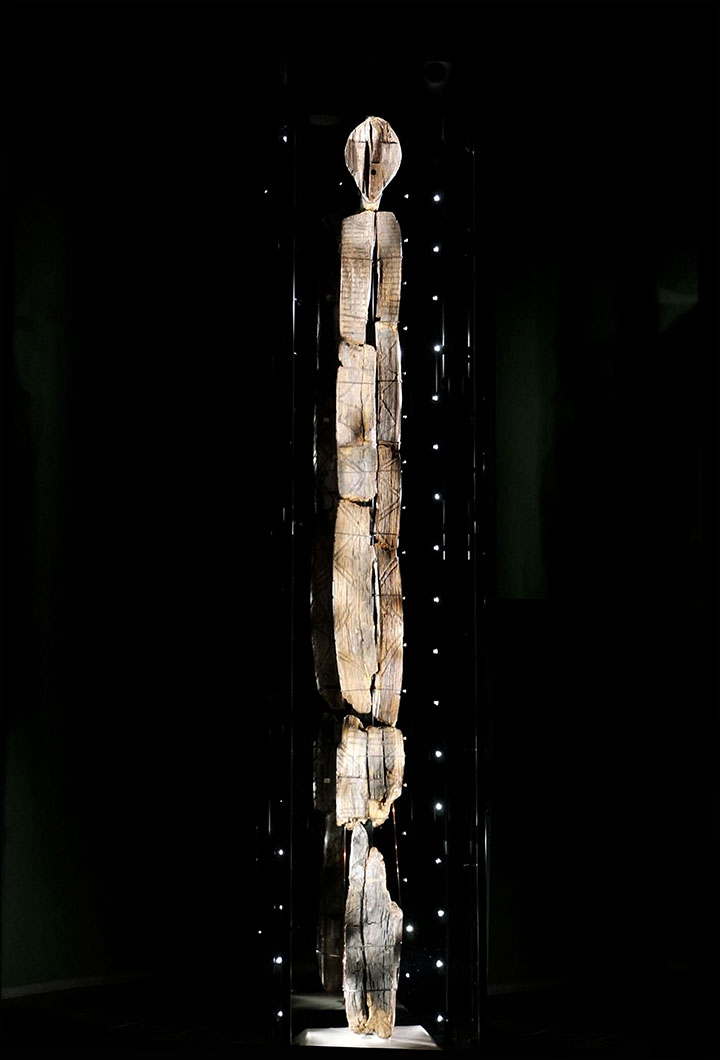
The Shigir Idol Photo: The Siberian Times
The Shigir Idol
Photo: The Siberian Times

Most of the oldest surviving art in the world is made of stone. But scientists now believe that the Shigir Idol, a huge, enigmatic wooden sculpture found in a peat bog in Russia in 1890, is twice as old as the pyramids at Giza.

The Idol, which once stood about 15 feet tall, depicts a man with many faces and an elaborate pattern of carved lines.

The sculpture was carbon-dated in 1997 and determined to be about 9,500 years old. However, many scientists disputed the findings, so curators at the Sverdlovsk Museum decided to submit samples for re-testing.

A lab in Germany conducted tests using Accelerated Mass Spectrometry on seven tiny wooden samples. The results indicated the idol was in fact about 11,000 years old, from the early Holocene epoch.  It was carved from a larch tree using stone tools.

Professor Mikhail Zhilin, of the Russian Academy of Sciences’ Institute of Archeology, told the Siberian Times: “We study the Idol with a feeling of awe.  The ornament is covered with nothing but encrypted information. People were passing on knowledge with the help of the Idol.” While the sculpture’s carvings remain “an utter mystery to modern man,” Zhilin said the Idol’s creators “lived in total harmony with the world, had advanced intellectual development, and a complicated spiritual world.”

Music of the Burgess Shale

This is the second of two posts about the Burgess Shale. The first went up last week.

Last week I took you on a virtual trip to the Burgess Shale. This area of Cambrian-era fossils didn’t just inspire paleontologists, geologists and climate scientists, but musicians as well.

In 1994, composer Rand Steiger wrote an orchestral piece for the Los Angeles Philharmonic called “Burgess Shale”, inspired by Stephen Jay Gould’s book about the fossils. Each movement is named after a different organism.

Of the movement “Anomalocaris”, Steiger writes:

“This was by far the largest and fiercest creature found in the shale, and it was also the most disfigured by the calamity (probably a mud slide) that instantly snatched the life of these creatures and preserved them. The most interesting thing is that parts of anomalocaris were thought to be four individual creatures; it wasn’t until recently that it was discovered that they were component parts of the same animal. SO the music for this section became a monstrous concoction featuring tuba, along with contrabass clarinet, horn, and lower strings.”

I can’t manage to find any working clips of the Burgess Shale piece online [UPDATE: See comments section – the audio links on Steiger’s site have been fixed], but in this video Steiger talks about his inspiration for the work.

It is not polite to talk about one’s “Chaos Regions” in public

You can argue that Pluto is not really a planet (really, at this point, why would you?), but the New Horizons probe has categorically dismissed any notion that Pluto and its associated moons are boring. Pluto has a “Chaos Region”. Boring things do not have “Chaos Regions”.

Chaos-Region-9-10-15

HT: Xeni Jardin at BoingBoing.

Science Caturday: New Old Hoomins

anthrocat1

The biggest news in science this week was the announcement of the discovery of a new human ancestor, Homo naledi. After anthropologists excavating in South Africa found an almost inaccessible cave which appeared to contain hominid remains, they recruited a team of the smallest, skinniest cavers they could find and sent them to explore it. What they found was astonishing – the skeletons of some 15 individuals of a human-like species with features unlike any seen before. This article in National Geographic gives many more details, with more sure to come as teams of researchers study the finds.

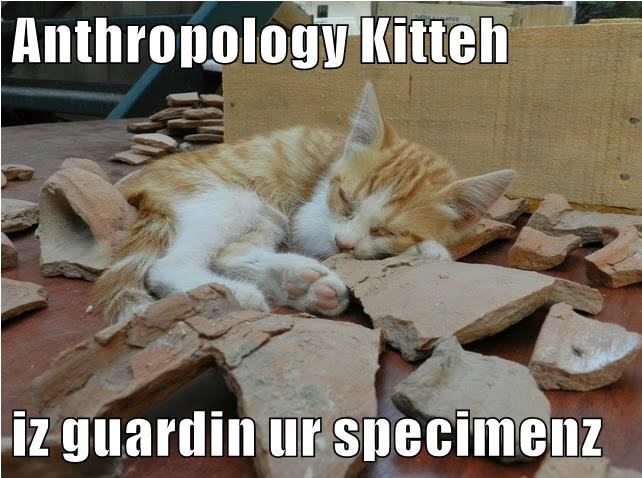
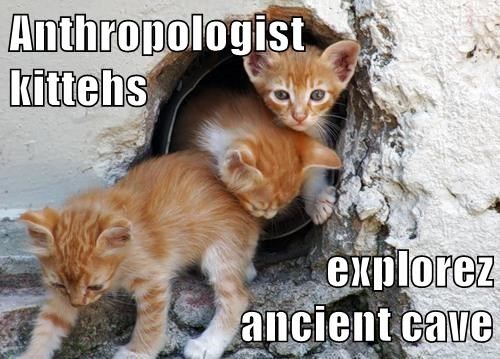
While our science kittehs applaud the discovery of new hoomins, they are slightly vexed that they were not allowed to join the team, given that they are experts in crawling through small tunnels and also highly skilled at guarding valuable stuff.

guardin

Science for the People: Eye of the Beholder

sftpThis week, we’re learning about the history of optics, and how our perception of the world and how we see it underwent a radical transformation in 17th-century Holland. We’ll spend the hour with historian, philosopher, and science writer Laura J. Snyder, talking about her book Eye of the Beholder: Johannes Vermeer, Antoni Van Leeuwenhoek and the Reinvention of Seeing.

Science for the People is now on Patreon, and is accepting your support and donations! Visit the Patreon page to get more information about how it works, and learn about the extra content you can access as a monthly supporter! You can also find out what other ways you can support the show, or visit our bookshelf.

*Josh provides research help to Science for the People and is, therefore, completely biased.