
“We won’t leave it all in our heads” Rich Aucoin’s anthem for science

Science is a process, sometime a very long one: Gels won’t run, programs need to be debugged, engines overheat and fry the instruments, and populations of chimps suddenly make themselves elusive.  Even after the experiments, observations and analyses are done you’re left waiting on your supervisor, the reviewers, or the journal editors to finally make up their minds. Whether as a student, a technician or a full-time researcher, making it through these times of frustration and waiting takes perseverance. This weeks’ song is for those times.

Rich Aucoin’s It is the centerpiece of a three-piece suite of songs: The Little Creatures Know / It / The Greatest Secret in the World from his 2011 independent release We’re all dying to live. Aucoin’s music is spirited, joyous even. Like the titles together suggest, these songs are anthems to the knowledge held by even the smallest of us. Slowly building from a soft and restrained vocal, when the chorus finally bursts through it’s hard to not get swept up in it, chanting to yourself: “We won’t leave it all in our heads!” Sitting in the lab, pouring over a manuscript, or struggling with a database those frustrations can seem overwhelming. A rousing song like this can be just the antidote. Don’t leave it in your head – get it out there. Science needs to be shared!

Is science powerless to confront the supernatural?

Larry Moran praises a recent philosophical paper knocking the idea that science, by definition, cannot consider the supernatural:

Maarten Boudry, Stefaan Blancke, and Johan Braeckman have an article coming out in Science & Education on “Grist to the Mill of Anti-evolutionism: The Failed Strategy of Ruling the Supernatural out of Science by Philosophical Fiat.”

It relates to the idea that science is limited by its insistence on adhering to methodological naturalism. According to this view, science cannot investigate the supernatural. The view is popular among some who oppose creationism since it means that creationism can’t be scientific, by fiat. It’s also important for accommodationists because it allows science and religion to co-exist in separate magisteria.

Continue reading “Is science powerless to confront the supernatural?”

A win for academic freedom

In case you missed it, Virginia Attorney General’s fishing expedition against climate scientist and former UVA faculty member Michael Mann has been shut down by the Virginia Supreme Court.

The principle of academic freedom does not mean blanket immunity from legal scrutiny, but if it means anything, it certainly means that academic researchers should be protected from legal harassment by government authorities whose aim is to suppress research conclusions that they don’t like. Attorney General Cuccinelli claims that: Continue reading “A win for academic freedom”

What’s the score?

For Scorecasting (by L Jon Wertheim & Tobias Moskowitz), the question is not whether it is a swing or a miss, rather the question is whether it is a called strike on a 0-2 count. If you read the book, you will find out that the odds of a called third strike on an 0-2 count are different than on a 3-0 count. I’m not sure where this metaphor is going, but my short review is that Scorecasting was a very enjoyable read, even for a data nerd like myself.

It should come as a surprise to no one that I would be very interested in a book about the math, statistics, and incentives of sports. At the same time, I feared picking up yet another Freakonomics retread. Continue reading “What’s the score?”

‘May I be excused? My brain is full.’

Samuel Arbesman reports for Wired with excitement about a year-old article in PLoS ONE (“Variable Cultural Acquisition Costs Constrain Cumulative Cultural Evolution” by Alex Mesoudi) that presents a dire scenario for the continued progress of human civilization. Apparently, we are getting full. According to the study, human knowledge is becoming so complex that it will eventually take so much time and energy to learn what we already know that there will be no time to discover anything else. Graduate students know this feeling.

I will tell you not to worry. The study proceeds from a specific set of assumptions that we have no reason to accept. One of these assumptions is the knowledge equivalent of the falsified evolutionary development aphorism, “ontogeny recapitulates phylogeny”.

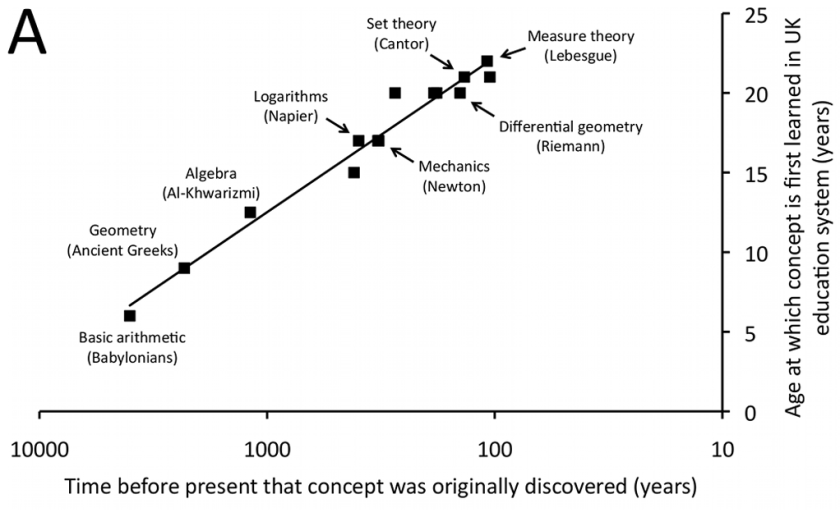
This assumption is presented in such a way that it could look like a finding to some readers using this figure:

This figure shows that UK students learn math concepts in the same order that they were discovered throughout history. It appears that individuals learn concepts in the same order that culture discovered those concepts. It is as if each individual’s learning experience is a microcosm of the entire experience of humanity. Continue reading “‘May I be excused? My brain is full.’”