
“Nature deficit disorder ‘damaging Britain’s children'” warns a dire sounding headline from BBC.com. The article describes a report from the National Trust that argues that “UK children are losing contact with nature at a ‘dramatic’ rate, and their health and education are suffering.” That sounds serious indeed. I may have to run over and rescue the neighbour’s kids. I can see they are dangerously inside. Continue reading “Some do’s and don’ts for using a medical metaphor, hints from Frightened Rabbit”
I don’t understand my CD player or my genome
There is something dissatisfying about our current explanations of how the genome exerts its effects on the cell. This is particularly true of the non-protein-coding regulatory regions of the genome, which, as we all know, make up a substantially larger fraction of the genome than those DNA sequences that encode proteins.
So what is that we don’t understand? Rather than give a wordy and abstract explanation, let’s go with an analogy: our poor understanding of how the genome operates is like my poor understanding of how a CD player works.
Let’s start with what I do know about CD players (with a little help from Wikipedia, which I hate but still refer to dozens of times per day.) The data in a CD is encoded as little pits in a polycarbonate surface. Behind the polycarbonate surface is the shiny layer of the CD, and so the pattern of pits can be scanned by using a photodiode to detect laser light that is reflected off the CD. The pits change how the light is reflected, which changes the electrical signal that is emitted by the photodiode. Those output electrical signals are amplified, passed to a loudspeaker and finally to my ears and slightly buzzed brain. (Obviously I’m talking about listening to music after work.) Continue reading “I don’t understand my CD player or my genome”
Freeman Dyson on the rampage
Freeman Dyson muses on outsider science in the NYRB, “Science on the Rampage”:
In my career as a scientist, I twice had the good fortune to be a personal friend of a famous dissident. One dissident, Sir Arthur Eddington, was an insider like Thomson and Tait. The other, Immanuel Velikovsky, was an outsider like Carter. Both of them were tragic figures, intellectually brilliant and morally courageous, with the same fatal flaw as Carter. Both of them were possessed by fantasies that people with ordinary common sense could recognize as nonsense. I made it clear to both that I did not believe their fantasies, but I admired them as human beings and as imaginative artists. I admired them most of all for their stubborn refusal to remain silent. With the whole world against them, they remained true to their beliefs. I could not pretend to agree with them, but I could give them my moral support.
My main problem with Dyson’s view is that it doesn’t take into account those cranks and pseudoscientists who are actually acting in bad faith – peddlers of snake oil, front-men for deep-pocketed business interests threatened by research on tobacco, climate change, etc., and religious fundamentalists who can’t make peace between their faith and thoroughly established science. In fact, it’s likely that there are many, many more dishonest pseudoscientists than the deluded but honest amateurs that Dyson describes, and his knee-jerk sympathy for the scientific outsider makes him a potential sucker. Continue reading “Freeman Dyson on the rampage”
The Mathematics of Life
 The Mathematics of Life was mathematician Ian Stewart’s most recent book, at the time I received it; but Stewart is prolific, writing a new book every 57 minutes or so. The Mathematics of Life is now his second most recent popular science book. In my opinion, your enjoyment of this book will depend upon your expectations. Continue reading “The Mathematics of Life”
Being a Scientist: Genomicist
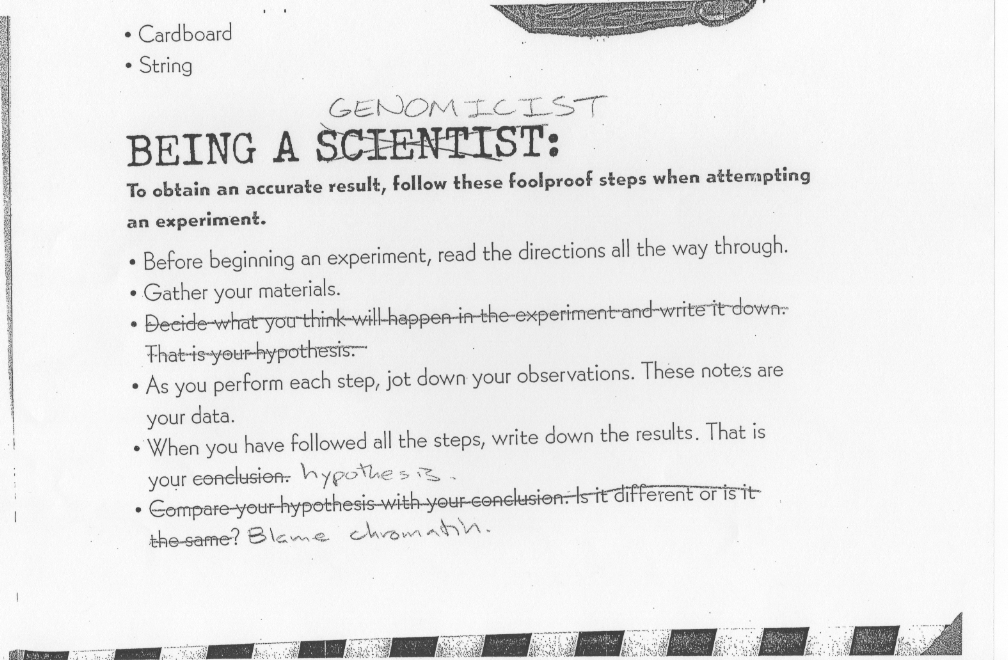
This probably qualifies as Mike and I making fun of ourselves as we have both done/do genome-wide experiments. Some of us work in places with the word “Genome” in their name. Dear colleagues, please remember this is satire. Sort of.
You can get your own “Being a Scientist” template here and create your own, you crafty bastards you.
 The Finch and Pea