
Math Madness 4: Aftermath

Last night, the University of Kentucky men’s basketball team defeated Kansas University 67-59 to claim the school’s 8th NCAA Championship, just as I predicted about two seconds before tip-off. The point difference with 1:32 left was just 5 points. So, we can debate whether it was a close contest overall, even though the point differential was much larger for most of the game. As far as predictions go, it appears that I am either marginally clever or lucky1.

How did the Kentucky Wildcats pull off the win?

Neither team played with particular efficiency on offense. Their shot selection distributions tended to look like those of average teams, especially in their choice to shoot two point jump shots. As we talked about last night, shooting two point jump shots is correlated with losing.
Continue reading “Math Madness 4: Aftermath”
Math Madness #3: Jump Shots and Expectation

For those of you who do not embrace, much less embody, stereotypical geek indifference to athletics, you may have noticed that it is NCAA basketball tournament time. In fact, the final game between the Kansas and Kentucky is just about to tip-off. Living in the UK, I haven’t watched much college basketball this season, but I’m picking Kentucky in a close one.

Let me tell you why. Continue reading “Math Madness #3: Jump Shots and Expectation”

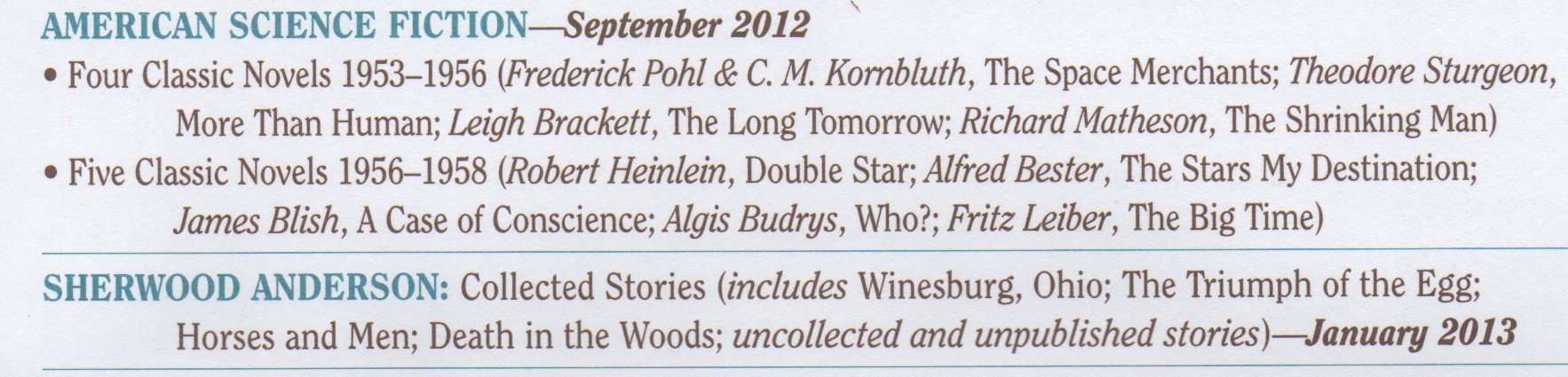
Library of America does vintage science fiction

Hot damn! I can’t wait until September, even though I’ve got some of these:

Plus the collected Sherwood Anderson!

Jerry Coyne reads Stanley Fish so we don’t have to

Why Evolution Is True: “Stanley Fish misunderstands science; makes it a faith equivalent to religion

Fish’s big mistake: the reasons undergirding that belief are not that we can engage in a lot of philosophical pilpul to justify using reason and evidence to find out stuff about the universe. Rather, the reasons are that it works: we actually can understand the universe using reason and evidence, and we know that because that method has helped us build computers and airplanes, go to the moon, cure diseases, improve crops, and so on. All of us agree on these results. We simply don’t need a philosophical justification, and I scorn philosophers who equate religion and science because we don’t produce one.

Continue reading “Jerry Coyne reads Stanley Fish so we don’t have to”

Questions you should ask your thesis mentor…