
Inside the 50’s science fiction bubble

“American SF by the mid-1950’s was a kind of jazz, stories built by riffing on stories. The conversation they formed might be forbiddingly hermetic, if it hadn’t been quickly incorporated by Rod Sterling and Marvel Comics and Steven Spielberg (among many others) to become one of the prime vocabularies of our age.”

So writes Jonathen Lethem in his introduction to The Selected Stories of Philip K Dick. If you’re looking for that sci-fi conversation at its most hermetic, go read the 1956 celebratory anthology, The Best From Fantasy and Science Fiction, Fifth Series. The collection reads like a series of bad inside jokes, although three stories make it worth the $2.50 I paid for it at my favorite source of vintage sci-fi. (Check out the full listing of this anthology at isfdb.org.)

So where did this collection go wrong? Continue reading “Inside the 50’s science fiction bubble”
Sunday Poem

From the greatest science poem ever written, Lucretius’ The Nature of Things. The first stanza sets up the second, Lucretius’ rationale for doing, if you’ll forgive me the anachronism, science.

Sooner of later, you will seek to break away from me,
Won over by doomsayer-prophets. They can, certainly
Conjure up for you enough of nightmares to capsize
Life’s order, and churn all your fortunes with anxieties.
No wonder. For if men saw that there was an end in sight
To trials and tribulations, they would find the power to fight
Against the superstitions and the threats of priests. But now
They have no power to resist, no way to reason how,
For after death there looms the dread of punishment for the whole
Of eternity, since we don’t know the nature of the soul:
Is the soul born? Or does it enter us at our first breath?
And does it die with us, and is it broken down at death? Continue reading “Sunday Poem”

Announcing the Finch and Pea book club

I know what you’re asking – is a book club appropriate at a pub? Certainly at this one, where we like books as much as we like beer. And hey, pubs have always been a place to have great conversations.

And so, on the second Tuesday of each month we’ll discuss a fantastic book that is at least tangentially related to science. Continue reading “Announcing the Finch and Pea book club”

Turing asked the most interesting questions in science

Turing biographer Andrew Hodges writes in today’s issue of Science:

But more deeply, anything that brings together the fundamentals of logical and physical description is part of Turing’s legacy. He was most unusual in disregarding lines between mathematics, physics, biology, technology, and philosophy. In 1945, it was of immediate practical concern to him that physical media could be found to embody the 0-or-1 logical states needed for the practical construction of a computer. But his work always pointed to the more abstract problem of how those discrete states are embodied in the continuous world. The problem remains: Does computation with discrete symbols give a complete account of the physical world? If it does, how can we make this connection manifest? If it does not, where does computation fail, and what would this tell us about fundamental science?

Personally I find this the most interesting question in science. It’s what drew me to biology, and it is what drives my current research in gene regulation. The problem of gene regulation is a problem of computation, and what is remarkable is the fact that genetic information is stored digitally as a string of discrete, two-bit chemical units. It didn’t have to be that way, and people* didn’t think that way until Schrödinger’s speculations on aperiodic crystals and the discoveries of molecular biologists in the 50’s and 60’s.

*To be fair, geneticists were thinking digitally, beginning with Mendel, and continuing, after a hiatus, with the early 20th century pioneers. But these geneticists didn’t really didn’t care about the physical implementation of genetic information. Those who did think about it weren’t thinking in terms of digits.

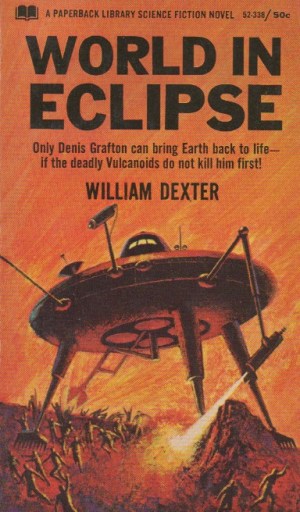
Apocalypse 1954: Flying Saucers, Vulcanids, and Thorium Bombs

World in Eclipse, William Dexter (1954)

World in Eclipse is a mildly entertaining but second-rate cosy catastrophe story that leaves you with an itch to go read some Day of the Triffids or No Blade of Grass. It’s one of those ‘aliens save a small human remnant from armageddon and return them later to the devastated earth’ stories. (The worst book in this field has got to be A.J. Merak’s abysmal, 1959 The Dark Millennium.) Dexter’s plot could be mistaken for a parody of 50s sci-fi clichés, as you can see from the following brief plot summary (mild spoilers ahead):

The perennially dismissed reports of flying saucers turn out to be accurate accounts of visitors from planet Vulcan, which is undiscovered by humans because it is hidden in the asteroid belt. Continue reading “Apocalypse 1954: Flying Saucers, Vulcanids, and Thorium Bombs”