
Like lots of people my age, I spent the weekend listening to the Beastie Boys: considering the huge impact they’ve had on music, remembering them as the soundtrack for much of my youth, and thinking with sadness and regret that it won’t be the same after Adam Yauch’s death on Friday. Continue reading “Remembering with the Beastie Boys’ “Pow””
Energy and information (or lack thereof) in biological thinking
Eric Smith, “Thermodynamics of Natural Selection” (PDF):
The two paradigms dominating biological theory are the machine-like functioning of componentry (increasingly elaborated in molecular biology) (Alberts, 2002), and the Darwinian framework for understanding the stochastic dynamics of death and reproduction (Gould, 2002; Lewontin, 1974). The representation of biological processes as machines is often by way of models, which represent control flow and causation, and for which the goal is to conceptually or quantitatively reproduce typical observed behaviors (mechanisms of binding, Stormo and Fields, 1998, transcription or translation, Berman et al., 2006, cell cycling, Novak et al., 2001, regulation of cell division, Tyson et al., 2002 or metabolic pathways, Holter et al., 2001, etc.). Energy naturally appears in these contexts as an input, as a quantitative constraint, or as a medium of control. However, models constructed for the purpose of illustrating causality often diminish the importance of the incursion of error at all levels of organization and the consequent energetic costs of systemic error correction, and so are not suited to composition into a system-level description of either emergence or stability. At the other extreme, Darwinian selection is a purely informational theory, concerned with emergence and stabilization through statistical processes. Yet, for lack of a comprehensive theory of individual function, models of the dynamics resulting from selection inevitably take for granted (Hartl and Clark, 1997) the platform of physiology, growth, development, and reproduction, decoupling the problem of information input from energetic constraints on the mechanisms by which it occurs.
Sunday Poem
This week it’s more of a prose poem, from the great Argentine author Julio Cortázar’s book From the Observatory. This book is a stream of reflections on two scientific images, one of an 18th century Indian prince who built a marvelous, Escher-like obsveratory; and the other of the epic migration of the European eel from continental freshwater streams to the Sargasso sea.
In this passage, the Indian prince Jai Singh “confronts the cosmic bull”, and is portrayed, not completely without irony, as someone who uses the scientific tools of his eccentric observatory to break free of human slavery to nature, or human slavery to superstition in the face of nature’s overwhelming force. In the book, Jai Singh stands in contrast to the pedantry of those myopic scientists who study the minutiae of the eels without any appreciation for the majestic scope of the eels’ life cycle.
Jai Singh must have dreamed something else raised like a guerrilla of the absolute against the astrological fatality that guided his lineage, that decided births and deflowerings and wars; his instruments stood up to a destiny imposed from outside, the pentagon of galaxies and constellations colonizing the free man, his stone and bronze devices were the machine guns of real science, the great reply to the total image facing the tyranny of planets and conjunctions and ascendants;
the man Jai Singh, little prince of a declining kingdom, stood up to the many-eyed dragon, answered the inhuman fatality as a mortal provoking the cosmic bull, decided to channel the astral light, trap it in retorts and spirals and ramps, clipped the nails that bled his species;
and all that he measured and classified and named, all his astronomy on illustrated parchments was an astronomy of the image, a science of the total image, a leap from the brink to the present, of the astrological slave to the man who stands in dialogue with the stars.
Adaptive humor
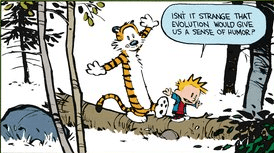 Dear Calvin,
The correct answer may be genetic drift, unless you can reject the null hypothesis.
Yours truly,
Josh
Pinky, are you pondering what I’m pondering?
 My favorite Animaniac was always Wacko Warner, but my brother and I spent countless hours riffing off Pinky and the Brain, voiced by the immortal Rob Paulsen and Maurice LaMarche. Now you have LEGO Pinky and the Brain signed by the immortal Rob Paulsen and Maurice LaMarche.
 The Finch and Pea