In fact, a few years ago, I tried to rewatch my favorite cartoon as a child, Voltron, with the idea that I might show it to my own children. Let’s just say, my children still have not seen that iteration of Voltron. My imagination is still pretty childlike*, but this was too much to ask**.
*I can provide references.
**As much as it saddens me to say it, this is also true for Airwolf.
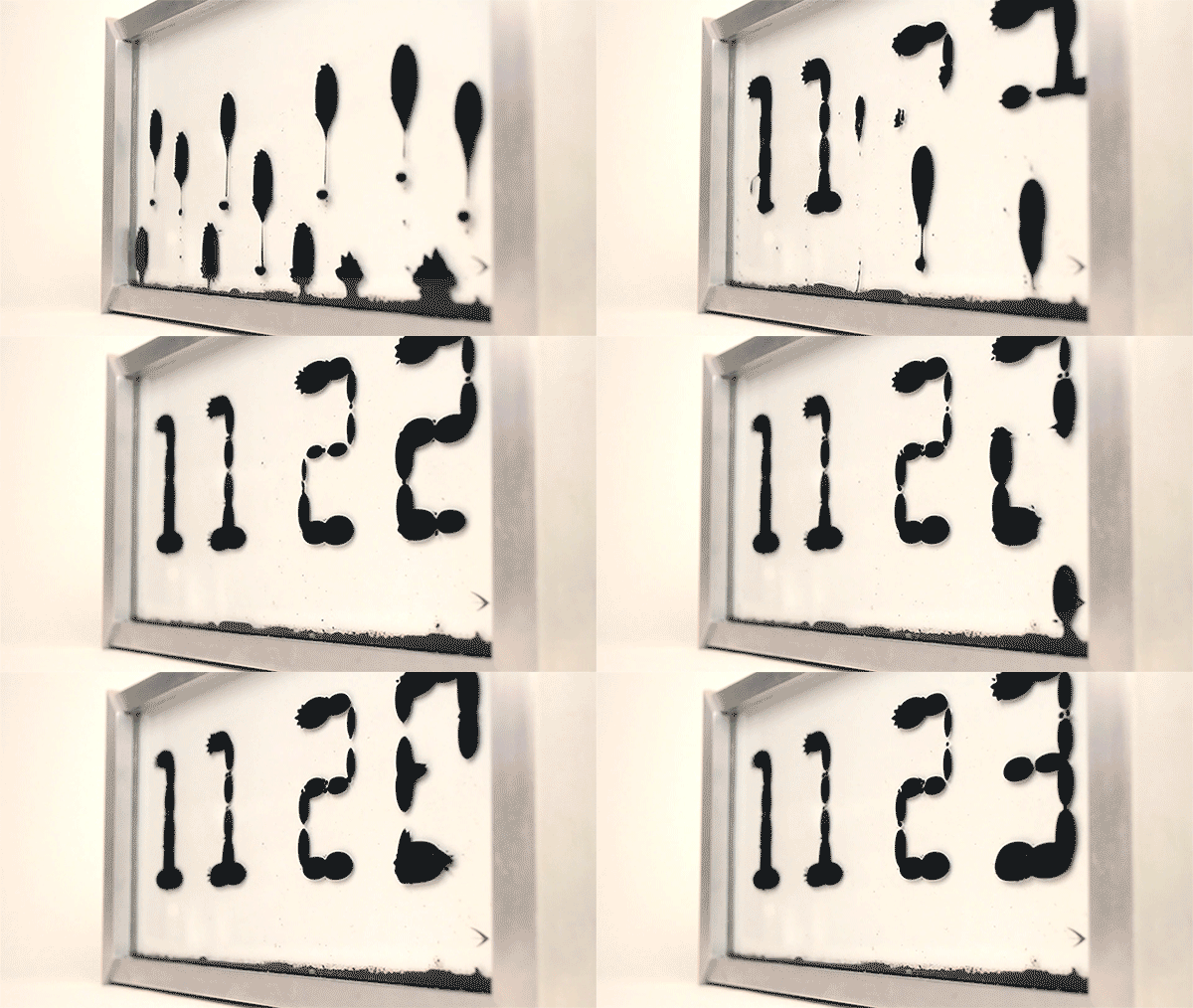
Ferrolic can be filed under “so nice we blogged it twice”, because it is not only cool, but Michele did a much better job of explaining how this works than her erstwhile stand-in did.
From the department of supercool things that may or may not have a point: Ferrolic, a screen display that uses electromagnets and ferrofluid. Created by Dutch designer Zelf Koelman, Ferrolic consists of a sort of tank with a screen, behind which drops of ferrofluid (a compound containing iron and a surfactant) are moved by an array of electromagnets controlled by programmable software.
The software can be edited via the web, allowing users to direct the blobs of ferrofluid (which Koelman calles “creatures”) to display numbers, letters and other shapes. Ferrolic does not produce light and is completely silent, since it does not contain any mechanically moving elements.
So is Ferrolic a work of art, a technology of the future or just an expensive toy? Who knows? But it sure is mesmerizing to watch.
Imagine a cross between 826 stores, the Wellcome Collection, makerspaces and the best birthday parties you remember from your childhood. That’s Action Potential Lab. Located in a century-old pharmacy building in Toronto, Action Potential Lab welcomes kids and adults to explore the intersection of art and science.
Lisa Carrie Goldberg started Action Potential Lab when she returned to Toronto after eight years studying in Boston and Perth. When I visited Toronto recently, I dropped by the lab to meet her. Even though I was there after hours, Lisa’s day was far from over, and she had to briefly interrupt our conversation to receive some samples for an upcoming thermochromatic dye screenprinting workshop. She had a few minutes for an interview, though:
The Nobel Prize in Physics was awarded this week to Arthur McDonald and Takaaki Kajita for their work with neutrinos.
The two were honored for their contributions to experiments demonstrating that subatomic particles called neutrinos change identities. The neutrinos transform themselves among three types: electron-type, muon-type and tau-type.
The transformation requires that neutrinos have mass, dispelling the long-held notion that they were massless. The Royal Swedish Academy of Sciences, which awards the Nobels, said the discovery “has changed our understanding of the innermost workings of matter.”
This is super impressive and, more importantly, gives us an excuse to re-run this awesome lolcat.



 The Finch and Pea