Sunday Poem

This week’s poem is Mary Oliver’s “Imagine”, which places imagination and wonder at the heart of our efforts to understand the world. At its best, science capitalizes on imagination and wonder, and becomes a fulfilling pursuit whether you are a professional or not. In the absence of those essential, fundamental traits, science as a job becomes a stifling activity that does not repay the opportunity costs of its pursuit.

I don't care for adjectives, yet the world 
   fills me with them.
And even beyond what I see, I imagine more. Continue reading "Sunday Poem"

Pictionary

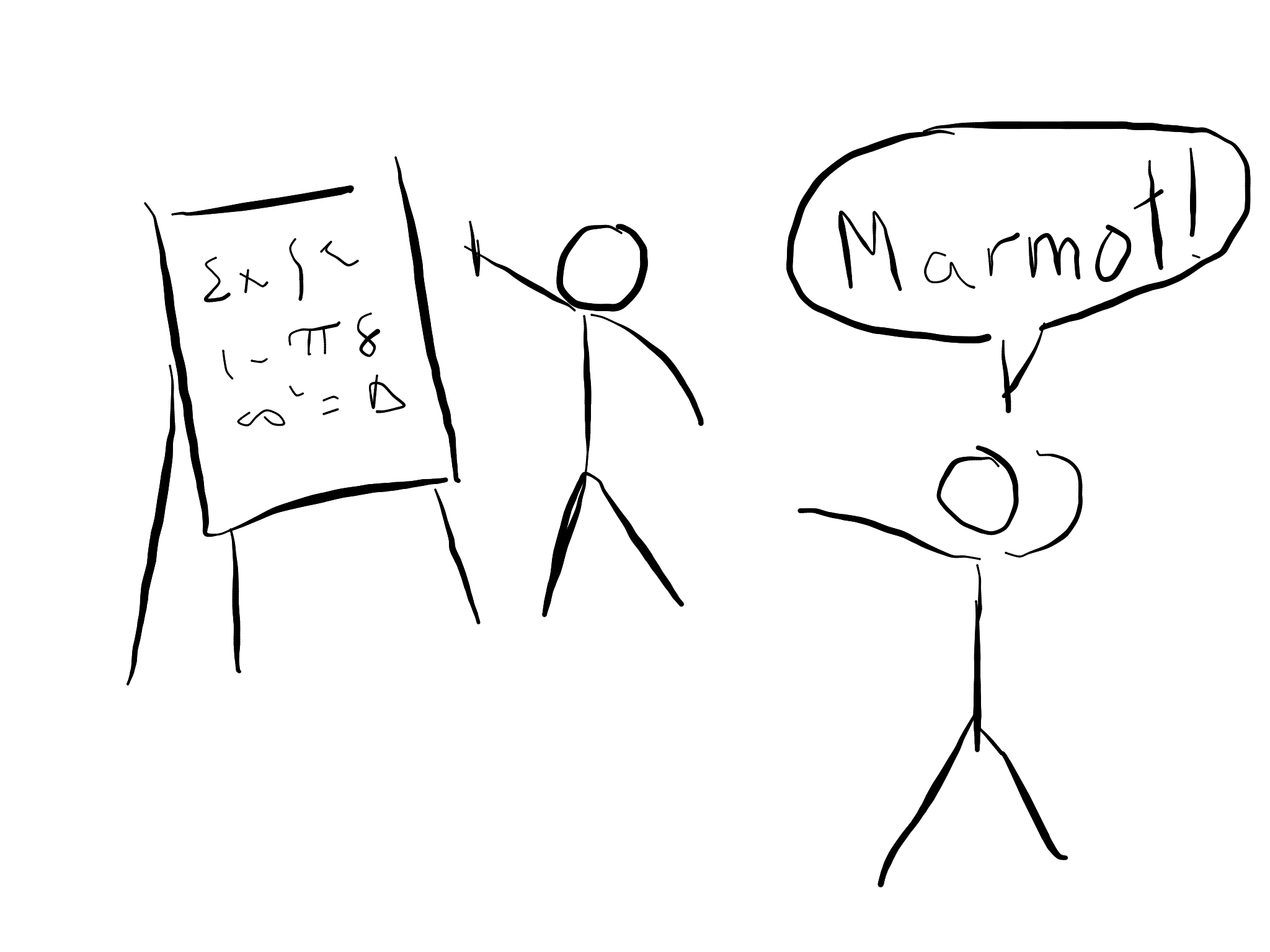
I think my major concern about physicists successfully developing a Theory of Everything (TOE), from which everything in the Universe can be described in a series of equations, is that it would absolutely ruin Pictionary:

Study shows multi-taskers are fooling themselves

This study may be old news to many of you, but I don’t remember encountering it. From my university’s teaching newsletter:

The findings of the third, laboratory-based, study further illuminate the relationship between the use of devices and the potential for distraction. The researchers in this study set out to test whether undergraduates who are “heavy media multi-taskers” might have an improved ability, relative to peers who are “light media multi-taskers,” to filter out distracting information. The researchers defined “media multi-tasking” or simultaneously engaging with different media—including print, television, computer-based video, music, text messaging, instant messaging, web-surfing, email. Their findings were precisely the opposite of what they had expected to find: heavy media multi-tasking was related to a reduced ability to ignore distractions and focus on pertinent information—even after accounting for potential differences in academic aptitude, personality and performance on standard creativity and memory tasks. Continue reading “Study shows multi-taskers are fooling themselves”

Please don’t put industrial strength bleach in the butts of autistic kids

Sadly, we live in a society where we need to tell people not to do this. The industrial strength bleach (sodium dichlorite solution) called Miracle Mineral Solution or MMS previously came to our attention as a “treatment” for Crohn’s disease, as well as everything else from HIV to colds. Now it is being marketed as a “treatment” for autism via oral administration, baths, and enemas.

MMS treatments cause side effects like discomfort, fever, diarrhea, and vomiting (these are the one’s its proponents advertise) with no evidence that it is an effective treatment for anything other than being comfortable and not having diarrhea. Fortunately, there is something you can do to help. Emily Willingham has started a petition to ban the sale and use of MMS as a treatment for autism (read the whole petition below).

The claims made by MMS are duping concerned parents into torturing their children, who are not in a position to understand why mommy and daddy are hurting them. Continue reading “Please don’t put industrial strength bleach in the butts of autistic kids”

On models and misunderstandings

Folks commonly misunderstand what the term ‘model’ means in science, particularly those operating from a particular theological or ideological model of the world that leads them to attack mainstream conclusions in climate science or evolutionary biology. This confused comment attacking climate models is fairly typical:

Extrapolation is not fact. It is estimate. And the accuracy is in the eye of the beholder. So if they [the North Carolina legislature] want to legislate HOW to estimate, it is far less controversial than you make it sound. You base estimates on past experience, not models, which is what climate change is really based on, not fact.

This person is lacking a coherent notion of what extrapolation, estimate, model, and fact mean in science. Reading the comment in context, this person seems to be defending the idea that a linear fit to your data which you use to make predictions is “extrapolation” from past experience, not a model, and is a more reliable way to do science than using a model. To be fair, this confusion is common, and in my experience the role of models in science is not generally taught well in schools. So let’s talk about the role of models in science. Continue reading “On models and misunderstandings”