
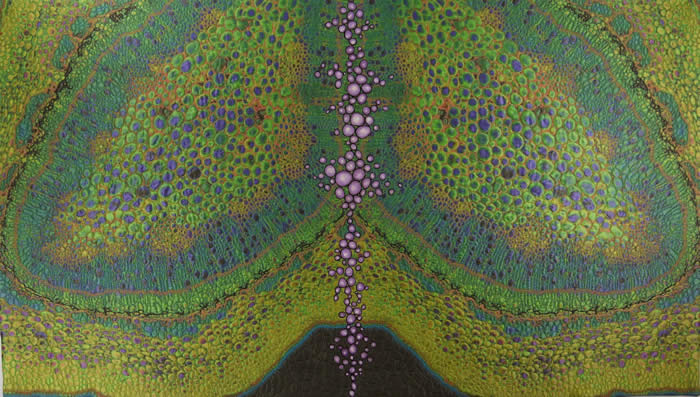
The Art of Science: Growth Factor

Betty Busby, a textile artist based in New Mexico, uses quilting to explore scientific themes.  Her large and often spectacularly detailed pieces represent biological processes, including cell division and the growth of plants and other organisms.

Busby uses photomicrographs of scientific images as inspiration for her work.  She says that because the colors in microscope photos are mostly artificially produced, either through chemical or lighting methods, it gives her the freedom to experiment with “the wildest color combinations I can think of, unhindered by expectations of realism.”

This piece, Growth Factor, looks at cell growth and development.  Busby printed the cell images on silk in a palette of green and gold, evoking a forest, then appliqued the purple organelles welling up in the middle. This piece will be shown at “Quilt Visions: Brainstorms”  at the Visions Art Museum in San Diego, CA, in October 2012.

You can see more of Busby’s work on her website  and at her etsy shop.

This post contains material that originally appeared in Guru magazine

Sam Isaac’s Carbon Dating, Another science metaphor used for musical communication

One of the reasons I enjoy writing the Song of the Week so much is that I’ve always felt a lot of resonance between the underlying motivations of science and music. They are both about finding a way to make sense of the world around us. Science probes the physical world, music more often the social and emotional one. But I often come away from listening to a great song with the same feeling I get from reading a fascinating article or watching a terrific science video: the satisfaction and pleasure that the world is just a bit more understandable, graspable.  I’ve written before about how Duffy and the Doubters exhibit that with a life lesson that can also be valuable in science. Frightened Rabbit use the inverse connection to excellent effect, employing science to deepen their lyric communication, with their metaphor of a modern emotional leper.

Today’s song, from UK singer-songwriter Sam Isaac, plumbs a similar vein, choosing scientific and science fiction comparisons as a vehicle for musical communication to quite charming results.

_______
*Thanks to F&P colleague Michele Banks for pointing this track out to me.

Eulogy for Jonah Lehrer’s career

There isn’t much left to be said about the unraveling of Jonah Lehrer‘s career (though I suspect he’ll be back).

For a long time, I’d advised family members to take the information from Lehrer’s writing and TV appearances with some serious salt, which would give you the impression that all new discoveries in neuroscience fit neatly into the way Lehrer had been telling you it all worked. Media personalities have the luxury of making the research fit the world view that has made them popular. Quality researchers with true expertise and experience do not.

Lehrer broke the rules of both journalism and science, but was only punished when he was caught breaking the rules of journalism.

I was never a Lehrer fan, but we can’t pretend this is an isolated action by a “bad apple”. Like many science fraudsters, fraudulent journalists are responding to the perverse incentives provided by their field. Good science reporting often takes time and a moderate tone. We reward speed and attention grabbing prose. It makes you wonder if the decision makers either don’t know or don’t care when the journalists break the rules of science.

Skycranes >> Ospreys

I had a nightmare last night. A very nerdy nightmare*.

During the space shuttle’s ascent in to low earth orbit, I was dropped out of the space shuttle’s cargo bay strapped to an osprey. Somehow, both the osprey and I survived our descent. I know what you are thinking. The poor osprey’s wings should have snapped into pieces the moment it tried to provide lift for the two of us. This, my friends, was a key point in my complaint to the NASA authorities. I also suspected that my publicly stated preference for unmanned space exploration was a factor in the decision to drop me into the upper atmosphere. I have no idea what the osprey did to piss NASA off. Continue reading “Skycranes >> Ospreys”

Pursue ignorance, learn science

Ignorance is not just a blank space on a person’s mental map. It has contours and coherence, and for all I know rules of operation as well. – Thomas Pynchon, Slow Learner

Dr. Stewart Firestein, a Columbia University neurobiologist is a scientist after my own heart. A former actor and theater manager, he went to graduate school in his mid-thirties, and despite the late start, has pursued a successful career understanding olfaction. He teaches a class on ignorance in science, and he’s written a book based on the ideas in the class, Ignorance: How It drives Science.

The basic message of the book is that facts are boring, while ignorance is (or can be) interesting, and we need to teach and practice science with this in mind. In this brief, genial book, Firestein gives advice on how to have an interesting conversation with a scientist – ask any of the following questions:

Continue reading “Pursue ignorance, learn science”