The Art of Science: Spencer Finch and the Color of Water

finch-iwanbaan-700There’s an old saying that we never step in the same river twice, but the relentless pace of change in something we see every day still has the power to startle. In 2009, artist Spencer Finch captured a 700-minute period in the life of the Hudson River in New York City. The resulting artwork was called The River that Flows Both Ways.

“From a tugboat drifting on Manhattan’s west side and past the High Line, Finch photographed the river’s surface once every minute. The color of each pane of glass was based on a single pixel point in each photograph and arranged chronologically in the tunnel’s existing steel mullions. Time is translated into a grid, reading from left to right and top to bottom, capturing the varied reflective and translucent conditions of the water’s surface. The work, like the river, is experienced differently depending on the light levels and atmospheric conditions of the site. In this narrative orientation, the glass reveals Finch’s impossible quest for the color of water.” (source)

In 2011, Finch did a similar project in Folkestone, on the southern coast of England, taking photos of the sea over a period of weeks and using them to create a color wheel and 100 flags dyed in the various shades of the water under different conditions of light and weather.

Finch’s work, poised between scientific and artistic documentation, invites us to reflect on change as a constant. It also reminds us that virtually all of the seemingly fanciful shades that artists use to portray the earth, sea and sky are, in fact, found in nature.

More at Spencer Finch’s website.

The Red Nose Gene

Rudolph's FamilyTis the season…for my 4 year old to ask me to sing Rudolph the Red-Nosed Reindeer repeatedly during any car trip longer than 30 seconds. My apologies to anyone who gets caught in the crossfire. My singing does not get better with repetition.

My kids also love the Rankin/Bass stop animation classic film Rudolph the Red-Nosed Reindeer. As you probably have come to expect, I have had a lot of time to wonder about how two seemingly normal reindeer could have a child with a glowing nose. Classic genetics is well-equipped to deal with this problem.

Both Santa and we should be very concerned about the genetics of red reindeer noses. According to Wikipedia, the Rudolph story dates back to 1939. There have probably been quite a few foggy Christmas Eves in the intervening years. According to the Pittsburgh Zoo, reindeer typically live for 10 years in the wild. While we can expect that Santa’s reindeer do a bit their those in the wild, it is clear that Rudolph alone would not be able to “guide Santa’s sleigh” today. Given their success breeding flying reindeer, it is not hard to imagine that Santa’s elves could generate a stable of red-nosed reindeer. How they would go about doing so would depend on how, genetically, Rudolph wound up with that first Red Nose. Continue reading “The Red Nose Gene”

Science Caturday: Deck the Cat

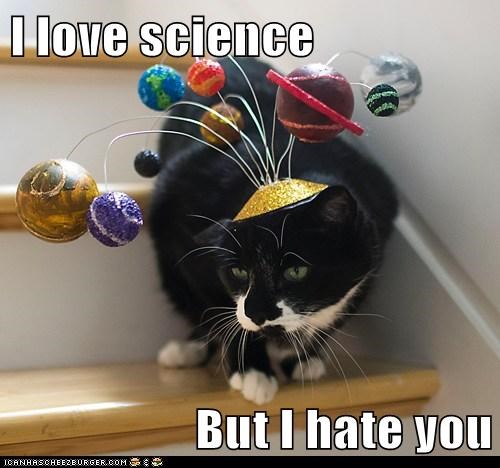
lovesci

Most cats don’t especially love to get decked out for the holidays, and this kitty in his spectacular “Solar System Cat Fascinator” by NotSoKittyShop on etsy, appears to be no exception.

But a friend of the Finch & Pea, physicist Sarah Kavassalis, has managed to dress up her cat, the remarkably patient Felis Klein, in a holiday outfit every day this month. (Here she is looking adorable in her Santa suit) You can see all the outfits so far in @FelisKlein’s twitter stream.

felis


photos via Cheezburger.com and Sarah Kavassalis

Let’s talk about books…

I will be providing a quick book review of a book that is very special to my older daughter and me, Rare Treasure: Mary Anning* and Her Remarkable Discoveries by Don Brown, for the Skeptically Speaking “Science Books for Your Gift List” episode. The episode will be available to download at 8PM (ET) tonight (Friday, 21 December 2012)

*The band Artichoke has a fantastic song about Mary Anning that is available to download for free (MP3 – 2.2MB).

UPDATE: According to the producer of Skeptically Speaking, KO Myers, my review comes up at 47:33 in the podcast. While I would be flattered by anyone downloading the podcast only to listen to my two minutes, I would strongly recommend listening to the other reviews, which I hear will include Bug Girl reviewing Spider Silk by Leslie Brunetta & Catherine L. Craig even though spiders aren’t bugs.