
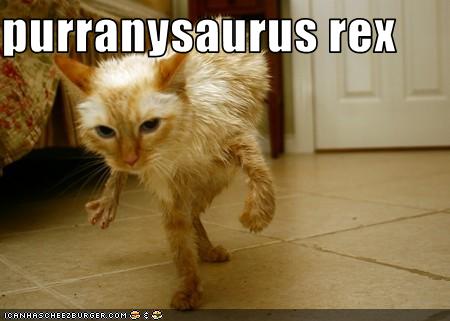
Science Caturday: Dinosaur Edition

funny-pictures-cat-is-dinosaur

Today we have a special Science Caturday to celebrate the publication of My Beloved Brontosaurus, a book by dinosaur expert, cat servant and friend of the Finch & Pea Brian Switek, aka @laelaps.

The Wall Street Journal says that you should “read Mr. Switek’s book to rekindle your love of all things dinosaur: the cheesy movies, the action figures, the many happy hours spent wandering through imaginary Jurassic jungles. But more than that, read it to remind yourself that the dinosaurs’ story is our story and that, as Mr. Switek writes, ‘extinction is the ultimate fate of all species. Nothing so majestically encapsulates these simple, powerful truths of nature quite like a dinosaur.’” We concur!

Brian will be appearing in several cities in the next few weeks to talk about the book – you can catch him this coming Monday, April 29, at Politics & Prose in Washington, DC. Some other upcoming “Brontotour” stops are listed here. If he’s not coming to your town, Brian is always happy to chat about his work on twitter.

In the meantime, enjoy these dinokittehs.
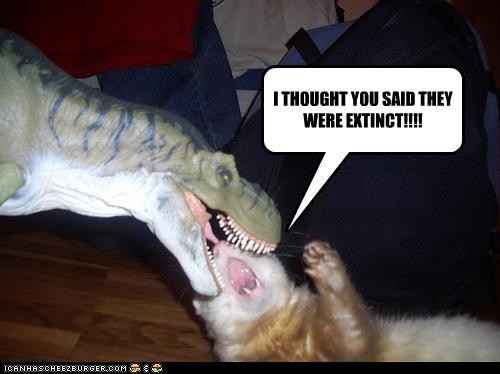
extinct

praying

all photos via Cheezburger.com

An argument between Dawkins & Wilson

Saturday Morning Breakfast Cereal features an argument between Richard Dawkins and EO Wilson, with a cameo by Michael Lynch.


*I fear this may be a very inside evolutionary biology joke which greatly oversimplifies the positions held by all three individuals.

When Dr. Seuss sold things other than books

Contractor postal cards, between 1930 and 1940, Dr. Seuss Collection, MSS 230. Mandeville Special Collections Library, UC San Diego (Fair Use)

The Mandeville Special Collections Library at UC San Diego has a special exhibit of the artwork of Dr. Seuss from before he made a living selling books when he helped other people sell things.

You may notice much of the work is signed “Dr. Seuss”, which drove me to spend a significant chunk of time reading up on Theodore Geisel and when he started using the pseudonym. If that was my rabbit hole, then that signature was my white rabbit.

It is really interesting to see versions of recognizable characters, like Horton the elephant, appear in the ads. It’s like finding old commercials done by celebrity actors when they were young (except that these ads are more good-looking and stylish than embarrassing).

*Hat tip to Neatorama.


Giving credit where credit is due

Earlier this week, the very popular Facebook science outreach site, I Fucking Love Science, came under fire for its seemingly systematic use of copyrighted material from a variety of artists without attribution or their permission. This sparked a “conversation” – most of which is depressing and not worth reading – about how content should be shared. Over at the Symbiartic blog at Scientific American, artist (and the guy you want to design your tattoo for you) Glendon Mellow has, in the words of Peter Edmonds, composed an “important, smart post” summarizing his thoughts on the issue.

As members of the online culture, we don’t have to accept that image theft will always be the dominant way of sharing visual information online: culture matures. Expectations change. But right now, large portions of science communication online are part of the problem. – Glendon Mellow, “Mash-Up This! Science Communication’s Image Problem”

*Hat tip to Peter Edmonds.

The Art of Science: Camille Lorin’s PIP Show

pip_2541960b

Overnight sensations are rare in the art world, but a one-night display in Marseilles, France of an artwork called “PIP Show” by an unknown French artist named Camille Lorin made a major media splash this week. The title of the work, a simple mixed media installation of silicone breast implants hanging inside black fishnet stockings, refers to the French firm Poly Implant Prothèse (PIP), whose top executives are currently on trial, facing charges of aggravated fraud, namely that the firm knowingly provided substandard breast implants and hid evidence from safety inspectors. More than 300,000 women in over 60 countries are believed to have received the implants, which experts say are twice as likely to rupture as other brands.

Lorin has said she wanted to shift the focus from the PIP trial to the prevalence of breast implants, and the pressure on women to conform to standards of beauty. Certainly, whether, or why, women feel the need for breast implants is a worthy subject for treatment in art. However, the timing of the exhibit in Marseilles to coincide with the trial has put the focus squarely on PIP, whose 73-year old founder, Jean-Claude Mas, has not only denied that the substandard implants posed any health risks but has dismissed the women seeking compensation as “fragile people, or people who are doing this for money”.

Doing it for money should, of course, seem reasonable to Mas, who has admitted filling the implants with a homemade mixture made of industrial-grade silicone gel and other unapproved ingredients, which investigators say allowed the company to save $1.6 million in one year alone. He and three other executives of PIP face up to 5 years in prison if found guilty.

So bravo to Camille Lorin, whose work reminds us that art can still strike a powerful chord and shine a spotlight on an ugly story of science, medicine, business, politics and society.

Photo by Christine Poujoulat/AFP/Getty Images