
Thinking about Angelina

Writing in Forbes, David Kroll has a very thoughtful take on Angelina Jolie’s announcement that she had a preventative double mastectomy after learning that she was at exceptionally high risk for developing breast cancer. While taking nothing away from Jolie’s bravery in writing about her choice, Kroll raises concerns about health care access, gene patents, “certainty” in medicine, and the influence of celebrity (which could be both positive and negative in this case):

On the one hand, I am stunned by the bravery of this high-profile woman to not only undergo such a transformative surgery and then write about it in the nation’s newspaper of record less than three weeks later…On the other hand, I do worry that the ensuing publicity surrounding her announcement might evoke some magnitude of panic in women with breast cancer, particularly those who don’t have BRCA1/2 gene mutations or cannot afford to have the testing done…My primary concern is that some women with breast cancer may think that they are not being aggressive enough with their current treatment plan. – David Kroll
Classing it up

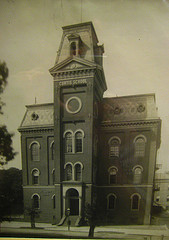
William Curtis School (Adolf Cluss, 1875), O Street, NW between 32 and 33rd Streets. Razed 1951. DCPS Archives

Those of you out there who went to graduate school, try to think back to the early days….I know the PTSD makes it difficult, but try to remember the beginning of graduate school. Do you remember the required classes that you had to take?  These classes were a mostly a hodge podge of random professors talking about either their own work, or a concept they may not even be familiar with. I read a Commentary in the journal Cell the other day that gives me hope that schools will consider modifying their graduate curriculum and spend more time on teaching. Continue reading “Classing it up”

You are probably going to be ok

Vaughan Bell penned an insightful piece for The Guardian about psychologically recovering from disasters. Evidence and expert opinion from world leading health agencies supports the statement that the vast majority of people who experience a “disaster-level” trauma recover, psychologically, on their own.

The evidence does not support the trendy notion of “psychological debriefing” – one-off counseling immediately after events to help people “process” – in fact it shows that it is worse than doing nothing. The actual experts in disaster relief seem to be wise to the research and using methods to help identify those people who do need help, rather than “helping” people who do not need it.

*Hat tip to Ed Yong.

Old Maps, Ingenuity, and the Internet

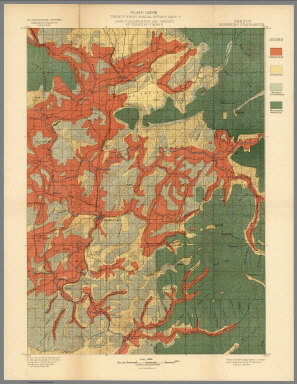
Plate CXXVIII. Roseburg Quadrangle, Oregon, Land Classification and Density of Standing Timber (Cartography Associates CC BY-NC-SA)

I love old maps. Many are wildly inaccurate. Many are fanciful. Many are surprisingly well done. In our era of Google Maps and GPS, it is easy to forget that early mapmakers could not easily see what they were drawing from above. The combination of skills, tricks, rules-of-thumb, and artistry that goes into cartography bends the mind.

David Rumsey has collected maps for decades and decided to donate his map collection to the Internet. Now, the internet has one more thing with which it can distract me.

*Hat tip to Rebecca Rosen.


The Art of Science: Who’ll Stop the Rain

rain

Every movie villain worth his salt schemes to control the weather; now that experience is available to New York City museum-goers. The Museum Of Modern Art’s Rain Room, open from May 12 to July 28, is a “large-scale environment” which will allow visitors to “experience how it might feel to control the rain.”  The work, by design group Random International, consists of a structure that pours down water like rain, except when its sensors detect the presence of a human body.

MoMA says that the piece “also invites visitors to explore what role science, technology, and human ingenuity can play in stabilizing our environment.” Well maybe – although I doubt that creating blatantly fake environments which allow humans to “control nature” does much to advance our thinking about our real relationship with, say, weather and climate. Let’s just call it an undoubtedly cool piece of techno-art that will be a magnet for New Yorkers and tourists alike this summer.