
The MIT Museum

I was in Boston a few months ago and managed a visit to the MIT Museum. I found the museum among the geeky travel destinations in the Geek Atlas – very much like my series here, but with more actual science. The Miracle of Science Bar + Grill, which lists its menu on a periodic table behind the bar, is only a few steps away from the MIT Museum, but it wasn’t open when I walked by.

Kismet!
Kismet!

The museum wasn’t open when I got there either. Apparently, getting places early is a thing I do. It was spring break. So, I waited with groups of school kids and their adults. When the doors opened, the groups had to wait to go in. I was able to walk past and immediately went upstairs, where it was still quiet. Upstairs is where you want to go to see the main exhibit. It’s very small, but there are lots of neat things to see. Like Kismet, the robot! (In fact, I just discovered that I saw Kismet on his tenth anniversary of being in the museum!). Continue reading “The MIT Museum”

Eva is a @RealScientists

Last week, Eva tweeted on behalf of @RealScientists. They have helpfully created a Storify for her discussions of science and cake:Storify of Eva's Tweets for @RealScientists

MOOCs verus a science education

Are massively open online courses (MOOCs) going to revolutionize high education? Over at Pacific Standard, I argue that they won’t – at least not science education, and I suspect that’s true of most other areas as well.

The punch line:

Far from overturning the staid and overpriced traditional lecture model of education, MOOCs reinforce that model and conflict with recent research on how to teach technical subjects like science.

Continue reading “MOOCs verus a science education”

Daniel Dennett: I talk therefore I am

What makes us human? In the New Statesman, philosopher Daniel Dennett argues it’s language:

I think it is quite obvious that language is what sets us apart from all other animals. But what is less often recognised is how language enables all the other distinctly human phenomena, transforming inherited “animal” dispositions, instincts, desires and tastes into forms that bear scant resemblance to their ancestral forms…

So utterly does language transform our minds that it is almost impossible to launder its influence from our imagination when we think of the “minds” of other species.

Language utterly and irrevocably changes our relationship with the world.

Where the Sidewalk Ends

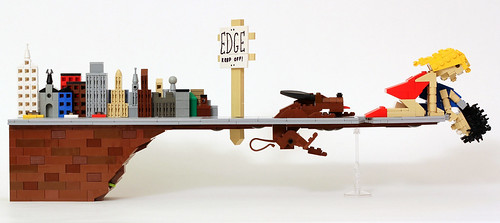
“Where the Sidewalk Ends” by Jason Allemann (All Rights Reserved; Used with Permission)

Sure, it’s pure nostalgia. I’m ok with that. Jason Allemann’s LEGO rendering of the iconic artwork from Shel Silverstein’s Where the Sidewalk Ends is spectacular in every detail. His other works (eg, a ball clock, a UFO visited farm, and a be-squided marble maze) are no less impressive. They, however, do not allow me to drop my favorite bit of Shel Silverstein trivia on y’all. Continue reading “Where the Sidewalk Ends”