The Art of Science: Space Bling

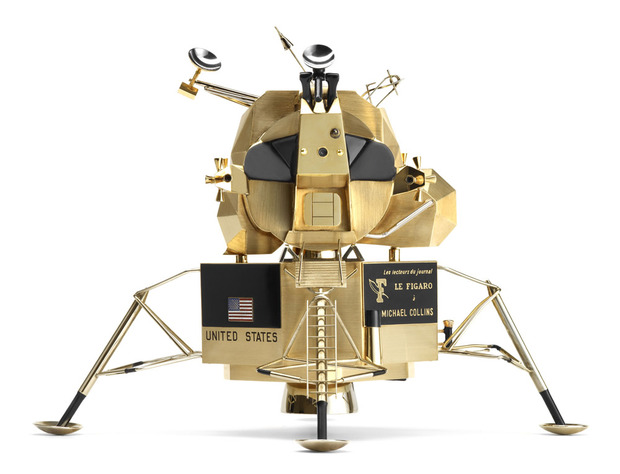
Lunar Landing Module by Cartier
Lunar Excursion Module by Cartier

Surely a strong contender for best trip souvenir ever, this solid gold Lunar Excursion Module is one of three made by Cartier and presented to Apollo 11 astronauts Michael Collins, Neil Armstrong and Buzz Aldrin. This stunning piece is now on display at the Forbes Galleries in New York through September 7 as part of an exhibit entitled “Out of This World: Jewelry in the Space Age”.

According to exhibit curator Elyse Zorn Carlin, “Space has always been in our consciousness and often expressed in jewelry. The ancients wore amulets depicting the moon; in Georgian and Victorian jewelry we see numerous depictions of the moon, stars, and Halley’s Comet. The mid-20th century saw an explosion of “space age jewelry” and corresponding couture, and today the “futuristic” look in fashion is “in” thanks to Lady Gaga and other entertainers.” (source)

The exhibit contains many stunning pieces inspired both by the mysteries of the cosmos and by the modern technology that allows us to see space and travel there.  A gallery of images is here.

Academics on the Internets

Via Scott Esposito, I read David Parry on why academics should write more for the general public:

Meanwhile, the general public perceives faculty members as isolated from reality, holding cushy jobs, and uninterested in open communication. The public has little access to the broad diversity of knowledge, experience, and background inside higher education, because those academics who do achieve broader platforms generally come from only the most elite universities. Although many of those public intellectuals are brilliant writers and speakers, they represent only a tiny percentage of the expertise available in the academic world.

This raises the question of what academics have to offer large online media outlets that is different from what excellent professional journalists offer. My first thought is sheer number: there aren’t enough excellent professional journalists who can write competently on certain specialized topics (e.g., we have a lot of great political and sports journalists writing even for smaller outlets, but fewer great science journalists); academics can help fight the good fight and take good opportunities that come their way. Continue reading “Academics on the Internets”

The Hunterian Museum

Hunterian_Museum1London is old and full of dead people. Most of them are out of sight, decomposing under ground. Some are not. Some are on display for all to see — or at least parts of them are. The most famous visible dead person is the philosopher Jeremy Bentham, whose bones, padded with clothes, and topped with a wax replica of his head, sit in a display case at University College London.

Even more dead body parts can be found at the Hunterian Museum of the Royal College of Surgeons, which is celebrating its 200th birthday this year. That’s two centuries of collecting, preserving, and displaying skulls, bones, limbs, hands, and various other organs.

The museum started out as the collection of surgeon John Hunter. He’s one of the founders of modern day surgery, but his Wikipedia page also highlights one of his mistakes: he inoculated himself with gonorrhea in an experiment – no wait, that’s not yet the mistake! –  but didn’t realize the sample was contaminated with syphilis as well. When he contracted both diseases, he assumed they were both the same, and set back our knowledge of venereal diseases a few years. Oops.

As a surgeon, he also made and collected thousands of preparations of plant and animal species, to learn more about the natural world. A lot of his samples were of diseased or malformed human body parts, which allowed him and others to study these conditions.

Hunterian_Collection

A controversial centrepiece of the collection is the skeleton of 18th century giant Charles Byrne. Afraid of being used for medical experiments, Byrne had requested to be buried at sea, but when he died, John Hunter bribed a member of the funeral party to steal Byrne’s body. Now his skeleton stands in the Hunterian.

If you’re in London, you should definitely check out this collection, but the museum also has a lot of information on their site, including this video made for their bicentennial celebrations:

Images: Woodcut by Sheperd and Radclyffe [Public domain], via Wikimedia Commons and Hunterian Collection by Paul Dean (CC-BY-SA)

Zombie Cabbage!

Image courtesy of Wikipedia

Fly rooms – the place where fruit fly researchers search for virgins and freaks – around the United States have two things in common: fruit flies and NPR. Thus, I heard the craziest science segment I’ve heard in a long time. You know those cabbages at the grocery store? Those heads of cabbage that always seem to always make way too much coleslaw? Even though they’ve been harvested, shipped and chucked onto the sprinkling grocery shelf, they’re aliiiiiive. Continue reading “Zombie Cabbage!”

Sunday Science Poem: Emily Dickinson and the Experiment of Consciousness

Emily Dickinson’s # 822

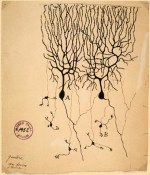
PurkinjeCellHow much consciousness is necessary for experience? Does a lobster or E. coli have experience, or does experience exist only with more awareness, awareness not just of the environment, the direction of a food source or a competitor for a mate, but awareness of self, of the passage of time, of the past, and of the alternative possibilities of the future?

In # 822, Emily Dickinson describes experience as an experiment in consciousness. Each of us, as a consciousness, is aware of environment (‘the Sun’), our fellow species members (‘Neighbors’). We share this basic level of awareness with much of the living world. A much rarer awareness, probably existing only in some vertebrates, is self-awareness (‘itself’ is used five times in this poem of 67 words), and awareness of death.

Beyond self-awareness, we have a capability for mental experimentation that is only possible with language, and is thus probably unique among organisms. Here is how Daniel Dennett illustrates this capacity: Continue reading “Sunday Science Poem: Emily Dickinson and the Experiment of Consciousness”