
Natural History Museum in London

ROARAfter some exotic trips, it’s time to visit a museum again. The Natural History Museum in London is right next door from the Science Museum. They’re very different, though. While the Science Museum is focussed on technology and engineering – lots of man-made scientific work – the Natural History Museum is all about, well, natural history.

If you’re going to the NHM during a school vacation, and want to see dinosaurs, you need to plan well ahead. Arrive at the museum when it opens, and as soon as you’re in, immediately line up for the dino exhibit. I can’t remember who gave me that tip when I went a few years ago, but thanks! Later in the day the dino-line was the length of several diplodocus’ necks. At the moment, the museum is offering free online advance tickets to see the dinosaurs gallery. So, again, plan ahead if you want to see dinos.

It’s well worth it: the dino gallery is very elaborate, and you get to walk around a lot of the skeletons. They’re displayed high and low in the room, and you can see them from all angles.
Continue reading “Natural History Museum in London”

Peer reviewers rejected Fisher’s paper that defined variance

The rejection of R.A. Fisher’s groundbreaking paper defining variance seems to be one of the bigger mistakes of peer review:

Fisher completed his paper on Mendelism and biometry by June 1916 and submitted the paper to the Royal Society of London for publication. The referees suggested it be withdrawn. He subsequently submitted the paper to the Royal Society of Edinburgh, which with his financial assistance published it on 1 October 1918 under the title “The Correlation between Relatives on the Supposition of Mendelian Inheritance.”

The Origins of Theoretical Population Genetics, William Provine (1971), p. 144

This paper has 2439 citations according to Google (which sounds extremely low), as well as its own Wikipedia page. I’d call that a success.

In addition to its importance in statistics, the paper was a key landmark in the synthesis of genetics, evolution, and biometry.

The 6 Million Dollar Man would have been made with optogenetics

I was reading this 2010 review of optogenetics (PDF) by Karl Deisseroth, a pioneer in the field, and was struck by this sentence:

Optogenetics is a technology that allows targeted, fast control of precisely defined events in biological systems as complex as freely moving mammals.

Then I read this in a recent paper in Science:

Successful integration of advanced semiconductor devices with biological systems will accelerate basic scientific discoveries and their translation into clinical technologies. In neuroscience generally, and in optogenetics in particular, the ability to insert light sources, detectors, sensors, and other components into precise locations of the deep brain yields versatile and important capabilities.

My immediate thought was: cyborgs.

Over at Pacific Standard, you can read the results: Our Cyborg Overlords May Arrive Sooner Than Expected.

It’s shocking how fast biotech is growing. For a long time we had restriction enzymes, ligases, PCR. Now we have GFP, RNAi, ZFNs and TALENs, optogenetics, CRISPRs…

Whitehorse’s Achilles’ Desire [Repost]

Editor’s Note: Marie-Claire has been too busy getting situated as the first Research Chair in Science Education and Public Engagement. How busy? Too busy to listen to music. Forget about writing about music. To give you a reprieve from my musical tastes, we are reposting this gem from 11 September 2012.

Husband and wife duo Whitehorse pack an emotional punch with the first single from their new album The Fate of the World Depends on this Kiss. (I promise I’m not wallowing in clichés here, the punch is literal. Watch the video.) Luke Doucet and Melissa McClelland, major talents in their own right, have continued their musical partnership that began last year with the release of their self-titled debut. Continue reading “Whitehorse’s Achilles’ Desire [Repost]”

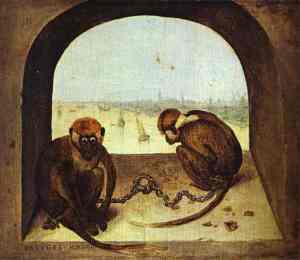
Sunday Science Poem: The Two Apes of Brueghel

pieter-bruegel-the-elder-two-chained-monkeys-1I’ve discussed this poem before, but you may have missed it, in which case it will be, as NBC says, new to you. The Sunday Poem will be back next week with completely new material.

This is one of my favorite poems by the Polish Nobel laureate Wisława Szymborska (1923-2011). All I have to say about this poem is that a monkey rattling a chain is never a good thing, especially at a thesis committee update.

The Two Apes of Brueghel (1957), 

So appears my big graduation exam dream:
In a window sit two monkeys fixed by chains,
Beyond the window the sky flies
And the sea splashes.

The subject is the history of mankind.
I stammer and flail.

One monkey, gazing at me, ironically listens,
The second seems to doze -
But when after a question comes silence,
It prompts me
By softly clinking the chain.

Translation from the Polish by yours truly.
Image: Pieter Bruegel’s “Two Chained Monkeys” (1525)