
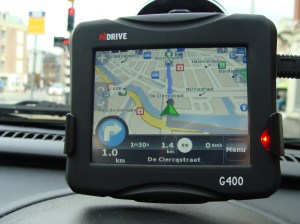
You carry your GPS with you

NDrive_GPS

Somehow, when you get out of bed in the middle of the night, you manage to remember where the end of the bed is, how far it is to the bathroom and where the light switch is. You have developed a complex spatial memory of your house, and our brains are filled with countless other spatial maps (maybe some of us have fewer….cough, cough). How exactly does your brain encode this specific spatial information?

It turns out that is it using cells called grid cells, which work much like their name suggests. These neurons are spread out in a grid pattern in your brain and will generate an electrical spike in a pattern related to the direction you are moving. While this has been known about rats, mice and bats it has only recently been confirmed in humans. While fMRI experiments have suggested the existence of such cells, the only way to confirm that individual cells are spiking in response to a directional task is to make electrical recordings from them.


Continue reading “You carry your GPS with you”

Aristotle wrestling with the concept of haploid gametes & diploid organisms

He takes on the problems of Pangenesis to boot, 2,100 years before Darwin adopted it as his theory of heredity.

On the Generation of Animals, 722b:

Again, if the semen come from all parts of both parents alike, the result is two animals, for the offspring will have all the parts of both. Wherefore Empedocles seems to say what agrees pretty well with this view (if we are to adopt it), to a certain extent at any rate, but to be wrong if we think otherwise. What he says agrees with it when he declares that there is a sort of tally in the male and female, and that the whole offspring does not come from either, ‘but sundered in the fashion of limbs, some in man’s…’ For why does not the female generate from herself if the semen comes from all parts alike and she has a receptacle ready in the uterus? But, it seems, either it does not come from all the parts, or if it does it is in the way Empedocles says, not the same parts coming from each parent, which is why they need intercourse with each other.

Yet this is impossible…

– Translation by Arthur Platt, from The Basic Works of Aristotle, Richard McKeon, ed., Modern Library (1941).

Ursus inanimus

This cutie creature has been aptly described as a cross between a house cat and a teddy bear in appearance.

Photo Credit: Mark Gurney

This quote is pulled from our own Heidi Smith’s coverage of the olinguito discovery and/or reclassification1. It is based, like most of the coverage on The Smithsonian’s own description of the animal. In context, this is clearly a description of what it looks like, not an effort to ascribe the olinguito’s origins to an animate and fertile teddy bear humping a kitty.

The problem is that people don’t always remember the context; and some of those people get to talk on national morning news shows2: Continue reading “Ursus inanimus”

Sunday Science Poem: Outward Exploration and Our Inner Passage to India

Walt Whitman’s “Passage to India” (1871)

ColombusMapWhat does our drive to explore and discover tell us about our inner landscape?

Walt Whitman’s poem “Passage to India” takes as its launching point three astoundingly ambitious projects to connect the world in the mid-19th Century: the transatlantic telegraph cable, the Suez Canal, and the U.S. transcontinental railroad. These are “the great achievements of the present,” but to understand their full meaning, Whitman tells us we need to turn to the past – to the dreams and aspirations of earlier explorers and visionaries, who launched us into the present, and whose restlessness tells us about our own psychic composition.

The past shows us that humans have always been dissatisfied with boundaries, “Wandering, yearning, curious, with restless explorations,/ With questionings, baffled, formless, feverish, with never-happy hearts”: prehistoric humans expanding out of Africa into Asia and Europe; following mammoths over the frozen Siberian tundra; trekking across to what is now Alaska and down the entire Western Hemisphere; sailing to remote Pacific Islands in what to us seem like insanely inadequate vessels that are are little more than rafts. Are these external explorations a manifestation of our struggles with some unexplored internal landscape?

Continue reading “Sunday Science Poem: Outward Exploration and Our Inner Passage to India”

Science Caturday: The Unknown Cause of Global Warming

gwkitteh

Many of our current technologies are useless against the growing threat of kitteh warming, but scientists are developing a planet-sized catnip toy that shows great promise.

Photo via Cheezburger.com