We still don’t know why children resemble their parents

AmericanGothicBack in May, the St. Louis Post-Dispatch held a mother-daughter look alike contest. In their write-up of the results, they turned to a geneticist, Barak Cohen, for some expert commentary on why daughters look like their mothers:

We asked Dr. Barak Cohen, professor of genetics at Washington University Medical School, to explain this phenomenon.

“They are just the ones, who in a sense of the word, won the genetic lottery,” he said. In these cases, most of the mother’s genes are dominant.

(Barak tells me this quote was the outcome of a 30 minute conversation.)

The real truth is, we still don’t understand why children look like their parents, or rather, we don’t understand how DNA builds complex traits. Over at Pacific Standard this week, I discuss the case of the missing heritability and recent evidence that genetic variants with small effects might be a big deal. Go check it out. (And please don’t come back and talk to me about epigenetics.)*

A few more (largely personal) thoughts on genetic variation below the fold: Continue reading “We still don’t know why children resemble their parents”

Meet the Portugese Man o’ War

Man-o-War“I want to be a Portuguese Man O’ War for Halloween” He asked if I meant a sexy Portuguese Man O’ War because that’s what happens to the majority of girl’s costumes. Uh no, of course I wanted it to be as close to anatomically correct as possible. He said he would be one too. Then he said “you know people will just think we’re jellyfish” which meant he knew that although they were cnidarians as well, they were definitely NOT jellyfish. *sigh* The Portuguese man o’ war (Physalia physalis) is a bad ass colonial organism. This doesn’t mean it has taken over an African country and exploited its people and resources (colonial style), but rather it is made up of many polyps coming together to form a super organism. On top there is a floating gas sac known as a pneumatophore and other polyps attach to this. Only one polyp is lucky enough to be the pneumatophore and the others fall into rank in one of the three remaining divisions: feeding, reproduction, or defense. The long tentacles of the defense troop can be up to 50 meters and have venom containing nematocysts. These stinging cells paralyze small prey and the feeding polyps begin the ocean buffet. Continue reading “Meet the Portugese Man o’ War”

The Finch and Pea is conceived

How did the sleek and polished Public House for Science known as the Finch and Pea come to be?

Well, I was digging around in my Gmail All Mail folder trawling the NSA mainframe (don’t ask) and ran across some early records. What follows is an abridged version of the genesis of the present establishment:

Chat with Josh Witten, 6/4/10

11:03 AM
me: In any case, if you’re up for it, I’m ready to start group blog – with a good name, and a decent spot (maybe wordpress?), and perhaps one other person we trust to write.

Josh: one or two more could be better, but not essential at the start
for both name and other writers i think we need to consider what we see as the blog concept

me: Just tossing out some ideas regarding the concept: explaining/applying good scientific thinking to current biology, to junk science, or to cool phenomena. Plus sophisticated references to culture… Continue reading “The Finch and Pea is conceived”

The Mixed Media Inspiration & Art of Julie Shackson

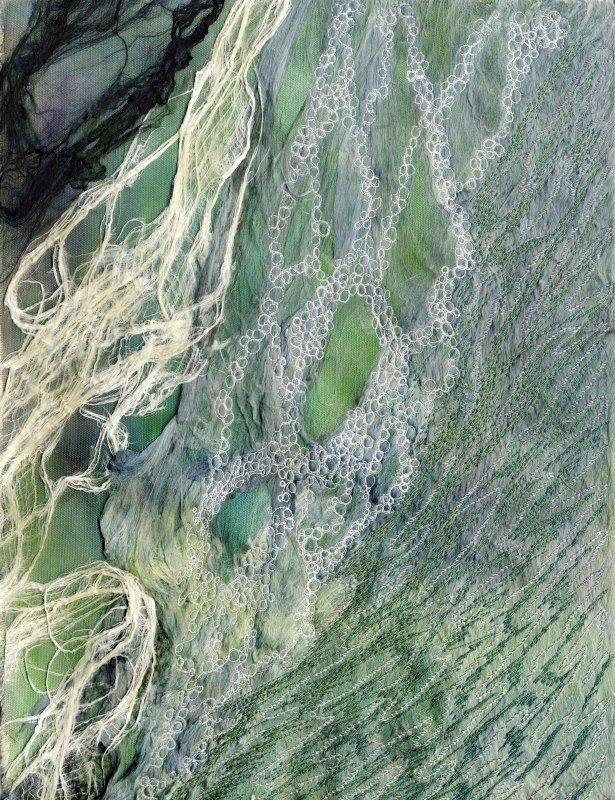
Shoreline 3, mixed media by Julie Shackson

Julie Shackson, an artist living in Wales, takes nature in forms large and small as her inspiration.  Working in a wide variety of media from photography to painting to textiles, often in combination, she produces artwork with depth and texture, whether her subject is a microscopic view of plant cells or a rugged shoreline.  The piece shown above, Shoreline 3, joins paint on canvas with “dry” elements such as mulberry bark and silk embroidery to produce an effect which is decidedly watery, even bubbly.  You can see more of her work at her website, or buy prints or originals from Saatchi Online.

The Ontario Science Centre

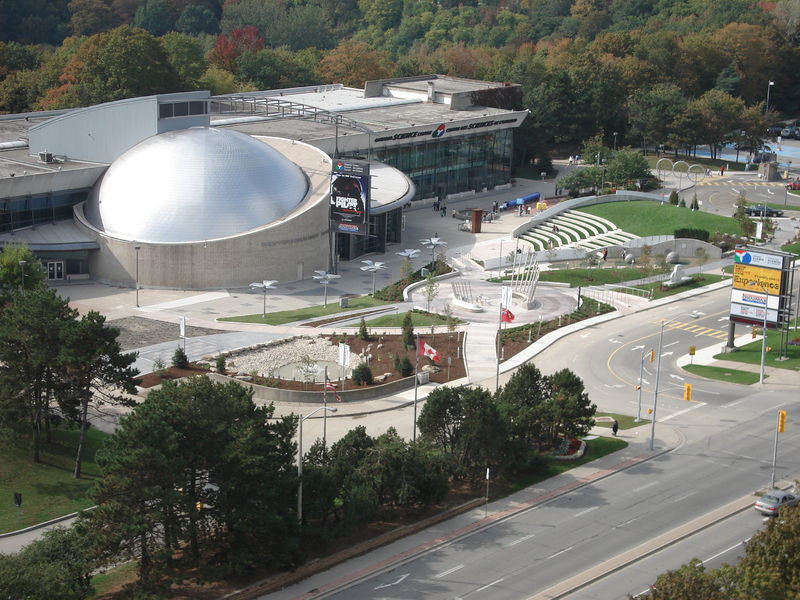
I lived in Toronto for years before I finally made it to the Ontario Science Centre. First I didn’t know it existed, then I didn’t know where it was, and then it just took me forever to find time to travel that far on the subway and bus. It’s not downtown, where everything else is, but in a residential neighbourhood – and I never needed to be there.
800px-0OSC_Sept23_06

But when I did finally make it, it was awesome, and I made a point of coming back a few times. The science centre was built in the 1960s, and uses its surroundings really well. It’s on a hill, with some sections at the top, and others further downhill. The parts are connected with hallways that vaguely remind me equally of a spaceship and my elementary school. It’s difficult to explain…

The hillside location gives the science centre a lot of space to do interesting things. There’s obviously an IMAX theatre, because that’s what all science centres have these days.

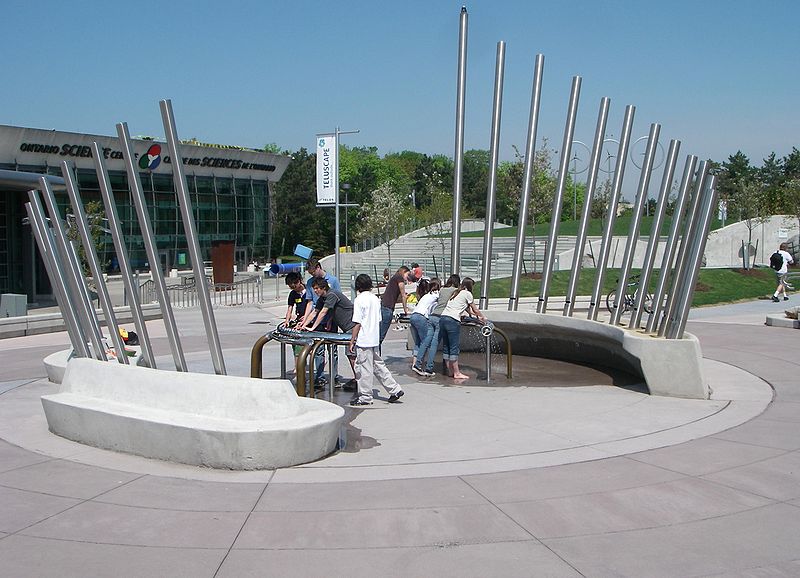
Outside the entrance is a giant hydraulaphone, designed by local inventor Steve Mann. It’s a fountain that makes music, and you control it by closing particular water streams.
800px-Hydraulophone_at_Ontario_Science_Centre_imgp4940rp

There’s also an entire section where I’ve never been because I’m not allowed inside: adults can only enter it if they’re accompanied by a child, and I didn’t know any children of the right age.

It’s a bit hard to find any information on the permanent exhibits on the site (it’s here – took me a while), because it’s all focused on themes and events. The museum hosts rotating exhibits, and they seem to be getting all the attention. For example, I saw Body Worlds here a couple of years ago.

Speaking of moving exhibits, the Ontario Science Centre rents out some of its own original exhibitions. Among the collection of exhibits they offer to other science centres is my favourite OSC exhibit, about living on Mars! I went there with friends, and we had a great time practicing our survival skills. There was one display where you had to try to get a solar panel to produce as much energy as possible, using only a bunch of random objects. After lots of puzzling, we managed to get it up to about 99%, woo!

Another fun hands-on part of the museum is the Weston Family Innovation Centre, although, like in other popular parts of the science centre, things often start to move away from science. I’m not sure how I feel about that, especially considering this part gets a lot of media and attention, and is easy to find on the site. I know a lot of science museums are branching out, but it would be nice to also focus on the science exhibits.


Shelley loves intestines