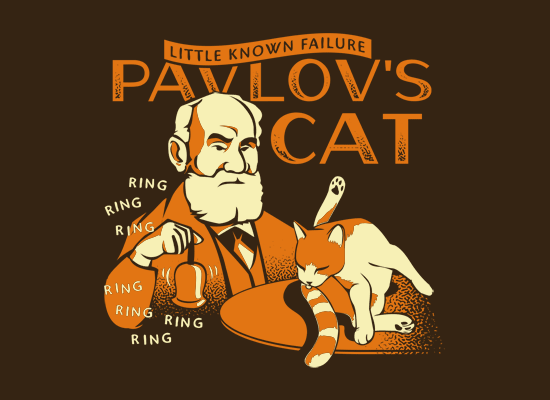
Everyone knows about Pavlov’s dog and Schrodinger’s cat. But what about Pavlov’s cat? This illustration suggests that cats are better at conditioning humans than vice versa. Like it? You can get it on a t-shirt at SnorgTees.

Everyone knows about Pavlov’s dog and Schrodinger’s cat. But what about Pavlov’s cat? This illustration suggests that cats are better at conditioning humans than vice versa. Like it? You can get it on a t-shirt at SnorgTees.
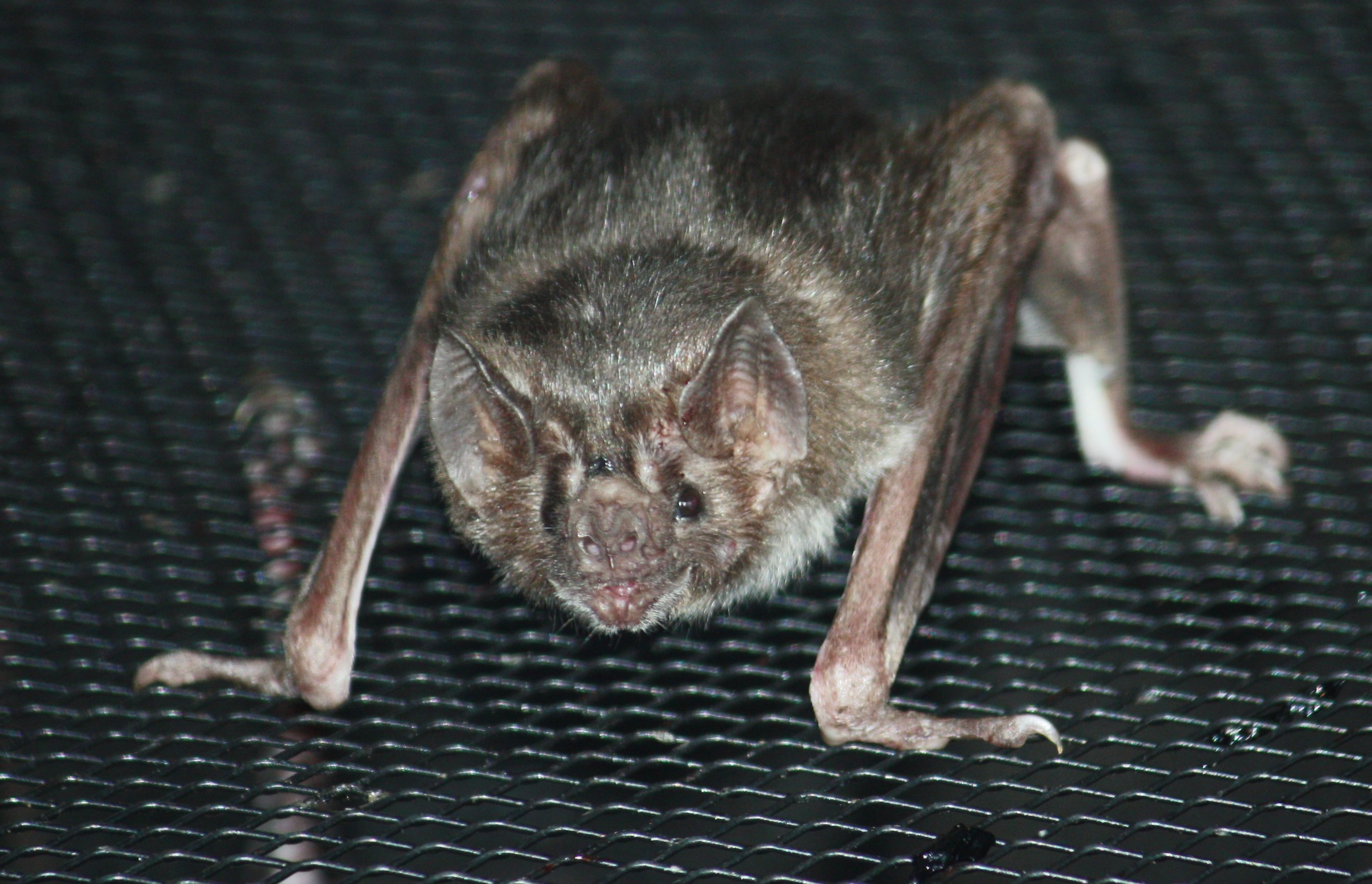 While no one I know personally has ever been infected with rabies, I do recall a tale of my father donning a racing helmet and wielding a tennis racket to rid our house of a bat. Presumably, he was protecting us from rabid bat fangs. Rabies is relatively well controlled in the US through pet vaccinations and early prophylactic care when someone is bitten by a potentially rabid animal. While rabies as a health concern in the US may be fading, rabies as a molecular biology tool is a cutting edge new technology. Continue reading “Rabies, doing what it does best”
 It is almost impossible to study basic cellular mechanisms in humans. This is why scientists spend so much time trying to find animal models for human diseases. Sometimes, there is a naturally occurring disease in animals that is analogous to a human condition. Other times, the animal’s genome can be modified to replicate mutations that are found in human diseases. However, despite the best efforts of many scientists, models often fail to faithfully replicate all aspects of human disease.
This led to the creation of a new mouse model of spontaneously developing Creutzfeldt-Jakob disease (CJD) by the Lindquist lab at MIT. Continue reading “Making mouse diseases more like human diseases”

Lake Titicaca resides between Bolivia and Peru at an extremely high altitude. One animal that has evolved to live in the environment is the Lake Titicaca frog (Telmatobius culeus) whose Latin name possibly started as a joke during an expedition in the late 1800s. Because there is sparse oxygen at high altitudes this frog has tons of extra skin to increase the surface area for oxygen absorption. While the average size of the frogs in the lake home has decreased over time, so too has the overall population and the IUCN now considers this animal as critically endangered. In the past, frog legs of Telmatobius culeus were eaten by visitors and locals alike, and animals were often used in local medicines. As a result of the IUCN status many locals are turning from cooking frog legs for dinner to becoming conservationists. Click on the link to watch the video!

“Meet the…” is a collaboration between The Finch & Pea and Nature Afield to bring Nature’s amazing creatures into your home.

Birds poop all over everything. Or as Spanish artist Fabrizio Lamoncha puts it, “A common idiosyncratic habit in all birds is their inevitable punk nature to shit over our most precious belongings.”
He decided to transform what he calls this “countercultural attitude” into a “marketable artsy product”. Thus he created the Poo Printer, a slow, messy noisy machine which uses bird poop as pixels. He describes the printer:
“The Poo Printer consists of a wooden cage sized 170x120cm and 100cm high with a removable tray in the center. This tray has interchangeable parts looking like tree branches with integrated food dispensers. According to the order of placement of these pieces it creates the shape of each of the characters of the Latin alphabet. The birds will hang out there most of the day, eating, pooing and even eating and pooing simultaneously.” (source)
A large roll of paper covers the bottom of the cage, so as the birds poop from their letter-shaped perch, the “pixels” accumulate in roughly the same shape on the paper below.
Lamoncha’s first group of birds consisted of four male zebra finches, who apparently worked well as a team, pooping out a large letter “A” in about 2 days. (He chose all males to discourage the aggression that accompanies mating) He plans to make the printer available to art venues to use with their own teams of birds, and is currently working on an outdoor version. Click here for a time-lapse video of the Poo Printer in action.
 The Finch and Pea