Exploratorium at Fort Mason

I was at a workshop last week, about article level metrics. It was in San Francisco, and I was hoping I might have some time to check out the new location of the Exploratorium, but my schedule was too packed, and it wasn’t worth paying the entrance fee for just an hour or so of museum time.

Luckily, the workshop itself was at a nice location, at Fort Mason – an area of warehouses converted to art studios and the like. The walk from the hotel to the venue went past Ghirardelli square and had a nice view of Alcatraz. There were people walking dogs along the water, there were little boats moored at the docks, and there was a strange little house called “House of Days”. I know an art project when I see one, so I walked up to the pee-scented doorway to take a closer look.

2013-10-10 08.10.17

It was an Exploratorium exhibit!

House of Days shows pictures taken of the San Francisco coast at different times of day over the past weeks to illustrate how the view changes over time. I had no idea there were any Exploratorium things outside the Exploratorium itself, so this was really exciting, and I took several pictures.

2013-10-10 08.09.11

As I got closer to the workshop venue, I found another Exploratorium exhibit.
Continue reading “Exploratorium at Fort Mason”

Chance & Necessity in Baseball

I know people don’t like whiners…but the squeaky wheel gets the grease. Last night, my very clichéd gripe about the abuse of statistics perpetrated by broadcasters of playoff baseball spun into a discussion of statistics and probability, including the contribution of computational models from renowned and/or infamous UC Berkeley faculty. As one is obligated to do in such situations, I Storify-ed it (and continue to as the conversation, like the playoffs, is ongoing).
Image from xkcd by Randall Munroe (Creative Commons BY-NC 2.5)

Mushroom Soup for Fungus Day

Editor’s Note – Thanks to Michele we now know that today is the inaugural UK Fungus Day. There was a Fungus Day last year, but it was confined to Wales and, therefore, was “National” Fungus Day (and in the minds of the English did not count anyway).

Ben first gave us this recipe over a year ago (18 September 2012) and we thought it would be a fitting tribute to a long overdue day in tribute to fungi. 

This week’s recipe is a bit of a two-for-one. The “main” recipe is a fall favorite of mine, mushroom soup (PDF – 770kb). This recipe only has five ingredients (not including salt and oil, which are staples, not ingredients), the most important of which is not, in fact, the mushrooms. It’s the stock (PDF – 115kb). Just replace the mushroom with any number of vegetables and we can still make a delicious soup – as long as we start with good stock. So, if we want to understand the science behind great mushroom soup, we need to understand the science behind good stock. Continue reading “Mushroom Soup for Fungus Day”

#standingwithDNLee

Blogger, post-doc, and science communicator DN Lee politely declined an offer to work for a money-making operation for free. The word “whore” was used in response. DN Lee wrote about this experience and what it meant from her perspective as a black, female scientist at an early stage in her career. The overlords at Scientific American deleted the post for very vague reasons without consulting with DN Lee.

But that is not how the Internet works. And that is not how the online science communication community works. As requested by Dr. Isis with DN Lee’s permission, we are putting up the censored post. Unlike Scientific American, we think the human experiences of scientists are of interest to people who are interested in science. To get a grasp on the issue you can read the following:

UPDATE 14 OcTOBER 2013

DN Lee’s original post is back up at Scientific American after the factual accusations were confirmed. She does not get the credit she deserves if you are reading this here in measurable ways that will benefit her career. So, we are removing the post as its utility has passed.

As many, including yours truly, guessed early on, the take-down was due to lawyers worrying if the alleged events (ie, emails) were authentic. The lawyers were not necessarily worrying that they were made up. The correspondent may not have been a real Biology-Online representative (he was).

Scientific American stepped in it by obfuscating about the real reasons for the takedown, allowing it to appear that they did not try very hard to discuss the legal concerns with the author before or immediately after the takedown, issued conflicting explanations, appeared to doubt the victim’s veracity, and used explanations that easily reminded folks of loaded rhetoric used routinely to dismiss and distract. They also seem to have failed to grasp the immediacy of response necessary to manage response on the internet.

It doesn’t make the folks at Scientific American bad or misguided. They aren’t. They were very unaware of the situation they were stepping into, and that isn’t a good excuse for such an organization. It was legitimate to expect better. The whole incident was about managing appearances, and they failed. Hopefully, this has been a learning experience.


Science Caturday: Antarcticat

penguincat

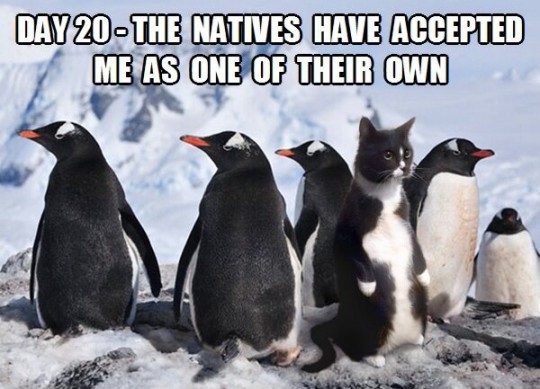
Bad news kept coming for US scientists this week, as the National Science Foundation announced that they would cancel the U.S. Antarctic research program for this year because of the ongoing government shutdown.  The cancellation will directly affect over 50 scientists, grad students and support staff, and Stanley, a cat conducting important research on Antarctica’s penguins.  Sorry, buddy.