
Happy New Year from the Finch & Pea. Remember, if you’ve overdone the EtOH, a little C 8 H 10 N 4 O 2 may help!

Happy New Year from the Finch & Pea. Remember, if you’ve overdone the EtOH, a little C 8 H 10 N 4 O 2 may help!

A group of scientists, journalists and volunteers on an excursion to Antarctica have had an even whiter Christmas than they dreamed of, as their ship became trapped in heavy ice off the coat of Antarctica on December 25. The Australasian Antarctic Expedition (AAE) commemorates the 100th anniversary of Sir Douglas Mawson’s expedition to the eastern Antarctic. The current voyage aims to replicate many of the measurements made by Mawson’s crew in 1911-13, to record changes in the region over the last century.
Two journalists from the UK’s Guardian, Alok Jha and Laurence Topham, are aboard the ship and have been blogging and tweeting about the expedition as it made its way to Antarctica. On December 26, Jha reported that the ship, the MV Akademik Shokalskiy, had been hit by a blizzard on Christmas Eve. By Christmas day, it was beset by ice and unable to move. Yesterday, December 27th, a Chinese ice-breaking ship, the Xue Long, attempted to reach the Akademik Shokalskiy but was unable to navigate through the thick ice.
As they await help from other vessels, Jha and Expedition leader Chris Turney both reiterated that the ship’s passengers are not in any danger, and that the scientists are using the extra time to do research. As Jha wrote, “Being on this continent is a privilege. Not just because it is so remote, unique or because you hear indescribable silence or see epic empty landscapes. The privilege comes from being in a place that requires you to engage with it, become attuned to it and make a serious attempt to understanding it…Right now the continent has us in its grasp and, though help is coming, the continent will decide when to let us go.”
You can follow the Guardian’s coverage of the AAE in its special Antarctica Live section and follow Alok Jha on twitter.

Mary Anning described the discovery of a plesiosaur to the world in a letter from 26 December 1823. You were probably hungover.
*For the unfamiliar, Boxing Day is the day after Christmas.
From Wikipedia via Kind of A Menace via Scientific Illustration
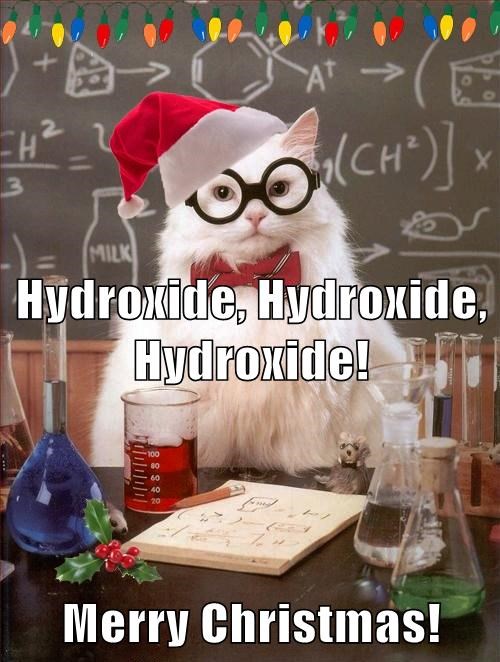
Dear Punters,
A very Merry Christmas & Happy Holidays to those who celebrate, and a happy new year to all from The Finch & Pea.
Thank you for joining us this year to share science-y art, music, travel, poetry, animals, and food, along with notes and reflections on the major events and findings of the year in science. And some lolcats.
Love,
The Finch & Pea Staff (Josh Witten, Mike White, Marie-Claire Shanahan, Eva Amsen, Michele Banks, Heidi Smith, Ben Witten, and Sarah Naylor)
PS – Special thanks to our friend @itsjusttracy for decorating Chemistry Cat’s lab

Originally posted on 24 December 2012 when my now 5 year old was 4.
Tis the season…for my 4 year old to ask me to sing Rudolph the Red-Nosed Reindeer repeatedly during any car trip longer than 30 seconds. My apologies to anyone who gets caught in the crossfire. My singing does not get better with repetition.
My kids also love the Rankin/Bass stop animation classic film Rudolph the Red-Nosed Reindeer. As you probably have come to expect, I have had a lot of time to wonder about how two seemingly normal reindeer could have a child with a glowing nose. Classic genetics is well-equipped to deal with this problem.
Both Santa and we should be very concerned about the genetics of red reindeer noses. According to Wikipedia, the Rudolph story dates back to 1939. There have probably been quite a few foggy Christmas Eves in the intervening years. According to the Pittsburgh Zoo, reindeer typically live for 10 years in the wild. While we can expect that Santa’s reindeer do a bit better than those in the wild, it is clear that Rudolph alone would not be able to “guide Santa’s sleigh” today. Given their success breeding flying reindeer, it is not hard to imagine that Santa’s elves could generate a stable of red-nosed reindeer. How they would go about doing so would depend on how, genetically, Rudolph wound up with that first Red Nose. Continue reading “The Red Nose Gene [Repost]”
 The Finch and Pea