Giant’s Causeway

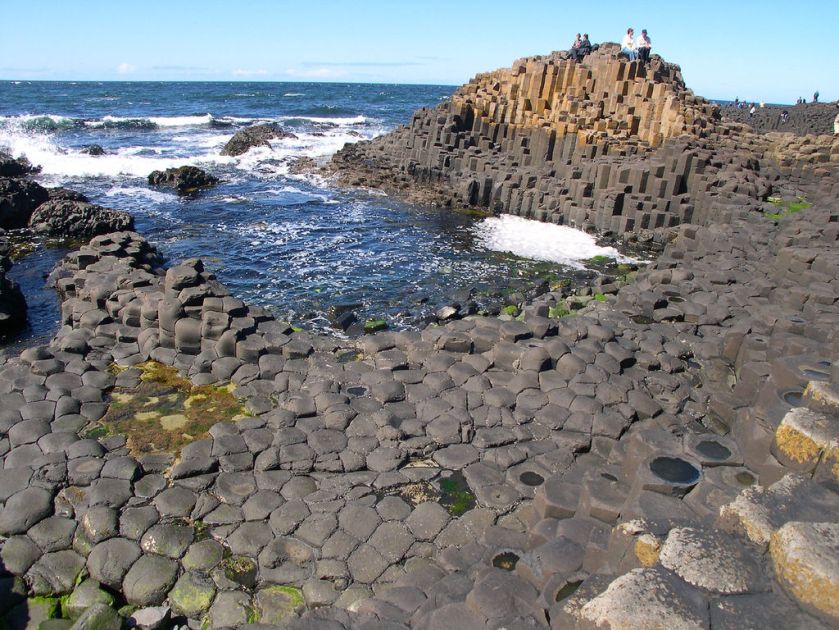
Legend has it that Irish giant Finn MacCool built a causeway across the water from Ireland to Scotland to challenge Scottish giant Benandonner to a duel. Before the duel, Finn tricked Benandonner into thinking he was a much larger giant by pretending to be a baby. Benandonner feared the enormous size of an opponent that would have a baby that big, and quickly retreated to Scotland, demolishing the causeway behind him to keep Finn away. Remnants of this Giant’s Causeway remain along the coast of Northern Ireland.

20005235_8f5a3a4159_b

Giants_causeway_closeupOf course the structures that resemble the cobblestone ramp to a causeway are not really built by giants. They’re basalt pillars, most of them hexagonal, created by fast-cooling lava over 50 million years ago, when volcanoes were active in what is now Britain and Ireland.

The basalt pillars of Giant’s Causeway reach high out of the water and really look like they’re part of a purpose-built structure. You can’t really blame people for coming up with giant legends in the absence of other explanations, but even now that we know that the basalt pillars are really remnants of more than 50 million year old volcanic activity, myths are still being propagated. In 2012, when the new Giant’s Causeway visitor centre opened, one of its audio exhibits mentioned that Creationist’s believe that the Causeway was not older than 6000 years. They have since removed the audio, to avoid confusion. Everyone agrees that the story about two giants was merely a fictional explanation of reality, so that myth gets to stay in the exhibit. But really, volcanoes and hexagonal basalt pillars are pretty cool themselves. No myths needed!

Images: Scenic shot by code poet on Flickr. Hexagon close-up in public domain, via Wikimedia.

The Last Supper

“The Last Supper” by Leonardo da Vinci


I recently received, as a gift, My Last Supper: 50 Great Chefs and Their Final Meals and My Last Supper: Second Course by Melanie Dunea. As the titles suggest, the books ask chefs about their ideal final meal on Earth.

The gift was very appropriate because I regularly ask people this question. It was, I believe, one of the first questions I asked The Wife when she was still The-Really-Interesting-Woman-I-Want-To-Date, and it is a question that I ask everyone that I interview for a job. During one such interview, another manager exclaimed, “That’s a really morbid question.”

I couldn’t disagree more. Continue reading “The Last Supper”

Science Caturday: Love Thy (Microbial) Neighbors

samplin

Over the last several years, scientists have made huge strides in understanding the microbiome – that is, the community of microorganisms populating our air, water and soil, as well as our bodies. In a blogpost this week, UC Davis biologist Jonathan Eisen draws attention to two new studies of the microbiome of the built environment – one on the microbial profile of a hospital NICU and one on the relationship between architectural design and the biogeography of buildings.

builded

Eisen points out that a thorough understanding of microbial environments is crucial to changing the widespread fear of microbes, most of which are not only not harmful, but possibly crucial to maintaining healthy living spaces. He points out, “Just as we would not argue for killing all mammals simply because one might be annoying us, we need to stop trying to kill all germs just because some do us harm.”

microbeking

Since it’s Caturday, we should point out that, besides being a very smart guy, Jonathan Eisen is a friend of kitties (evidence). He has served as a senior advisor on the not-terribly-serious Kitten Microbiome Project  and also compiled a handy list of more rigorous scholarship on kitty gut bug microbiology on Mendeley. And he provided us with a great excuse to re-use these lolcats.

Fiber, not just for your guts!

Soybeans are a great source of dietary fiber. Image courtesy of Wikipedia.

Allergies have been on the rise in the last few decades – not just the highly publicized increase in peanut and gluten allergies, but also allergic asthma caused by allergens in the air (like dust mites, mold, or pollen). Poorly controlled asthma and asthma emergencies result in many ER visits. What is causing this trend of increasing allergies?

The hygiene hypothesis – lack of exposure to potential allergens due to homes that are too clean leads to kids being hypersensitive is popular with many folks.

A new paper, however, tests an alternative  hypothesis about the increased rate of allergies. Could low fiber consumption in Western diets be to blame?

Continue reading “Fiber, not just for your guts!”

Meet the Giant Oarfish

Picture credit: kalambo  http://kalambo.deviantart.com/art/Giant-Oarfish-365262027
Picture credit: kalambo
http://kalambo.deviantart.com/art/Giant-Oarfish-365262027

Warning: you might want to quit your job immediately to go out and find a giant oarfish (Regalecus glesne).

This fish is beyond huge and crazy looking. Also, these guys are thought to predict earthquakes. Please sit down in case you faint from this dose of amazing.


Video Credit: Mark C. Benfield

“Meet the…” is a collaboration between The Finch & Pea and Nature Afield to bring Nature’s amazing creatures into your home.