White coats are gross

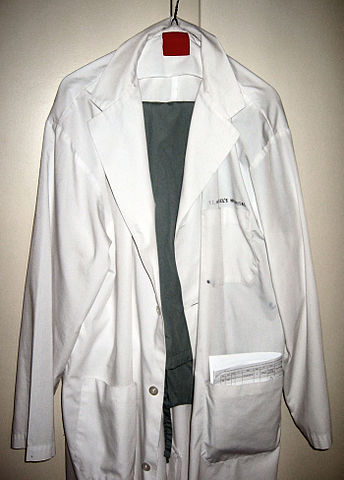
White coat. Image courtesy of Samir via Wikimedia Commons.

For physicians, the white coat that comes with their profession is a badge of honor. At the beginning of medical school, new students receive their first white coat, albeit a short one, in a special ceremony. It’s a momentous occasion when at the end of medical school they receive their full length white coats. The coats represent their status and position at a glance to anyone in the hospital. They should also ring an alarm bell in anyone about to see a physician because those coats are often TEEMING with all sorts of gross things.


Continue reading “White coats are gross”

Science Caturday: How to Lolcat

mu

Yesterday at the ScienceOnline conference, we had a great conversation led by Tara Haelle about the importance of images in science communication. Alas, the subject of lolcats did not arise, so I will address it here. Lolcats are, in fact, the key to all successful science communication. The effective deployment of lolcats is a secret scicomm weapon of mass destruction, by means of cuteness-induced head explosions (See Fig. 1 above. Boom.)

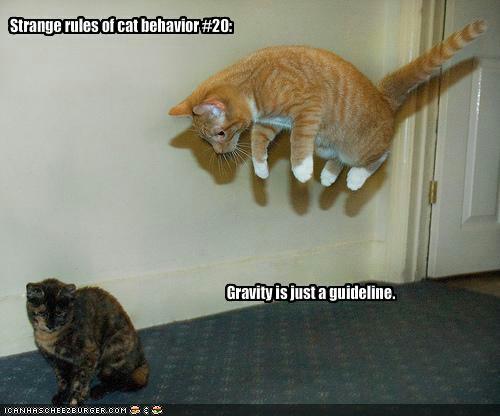
Science communicators should exercise caution when using lolcats to illustrate scientific concepts, however, because it turns out that cats are exempt from certain laws of science.

Fig. 2. Effective use of lolcat to illustrate gravity

grabbity

Fig. 3. Oops.

Gravity-Is-Just-A-Guideline

Voyage of Discovery: The Slideshow

Michele posted fabulous pictures from Voyage of Discovery – her collaboration with Jessica Beels and Ellyn Weiss at the AAAS Art Gallery in Washington, DC – allowing those of us who cannot make it to the gallery to get a virtual taste of the experience.

This slideshow requires JavaScript.

Voyage of Discovery – Michele Banks, Jessica Beels, and Ellyn Weiss

Art like this requires the talent and creativity of artists. That means our artists need our support. You can support these artists by visiting their websites:

Michele Banks

Jessica Beels

Ellyn Weiss

Artwork by Jessica Beels, Ellyn Weiss, and Michele Banks. All photos by Michele Banks. All rights reserved by respective copyright holders. Used with permission. 

Meet the Hookworm

hookworm-07022012-04Recently, the genome of the American hookworm, Necator americanus was completed (read more here). In celebration of this achievement, the American hookworm is our cool animal of the week. Also, parasitic nematodes just really don’t get enough love and attention, so it is time to honor them.

The American hookworm is picked up by humans and other mammals from the soil and then feeds on blood before making a home in the small intestine. An estimated 700 million people are affected by this parasite worldwide and unfortunately none are investment bankers or other financial district employees (because that would be amazing–parasites living within the parasites of society….soo meta and karmic).

You can protect yourself from hookworm, by simply wearing shoes which means that poor people from developing nations are overwhelmingly the afflicted majority.

Hookworm FootCheck out the sensational (in a ridiculous way) video on hookworms by Animal Planet.

If you want to help–donate money to a world health organization, which can build proper latrines and put down cement, instead of buying a pair of TOMS shoes.

“Meet the…” is a collaboration between The Finch & Pea and Nature Afield to bring Nature’s amazing creatures into your home.

Pi Day 2014

Pi DayAs you may know, it is my firm and unflinching belief that our math & science “holidays” should be scheduled so that they actually teach something about the number being celebrated. Sure, 3.14 is a reasonable estimate of π, and March 14th does represent that number in typical US calendar notation (which has no respect for the hierarchical organization of dates).

But, that says nothing about what π represents. It represents the relationship between the radius (r) of a circle and both its circumference (C=2πr) and area (A=πr2). When it comes to expressing this relationship using dates, I prefer circumference because both the radius and circumference are lengths. Also, expressing the year as a circle makes sense to me (and, based on their mythologies, a large number of human cultures).

If C is 365.25 days and π is π, then 2r is approximately 116 days, which makes r approximately 58 days.

Which is why, at The Finch & Pea, 27 February is Pi Day.