
 I use twitter primarily to keep up with what’s new and newsworthy in science and science communication. It’s a great tool to quickly catch up on new discoveries or controversies. It also can expose opportunities you had no idea existed. The other day I saw a tweet about small grants to fund science outreach projects. So cool! I didn’t realize these small scale funding mechanisms existed to help encourage scientific outreach.
The Art of Science: Tagny Duff’s Cryobooks
The internet was all a-squeal this week over the revelation that Harvard University’s libraries house a number of books bound in human skin. (Actually, the news that launched a thousand blogposts was that a Harvard-owned volume alleged to be bound in “all that remains of my dear friende Jonas Wright, who was flayed alive by the Wavuma” was, in fact, bound in sheepskin. ) Horrified and delighted, journalists gleefully explained that “anthropodermic bibliopegy” was once a thing, way back in the 16th and 17th centuries.
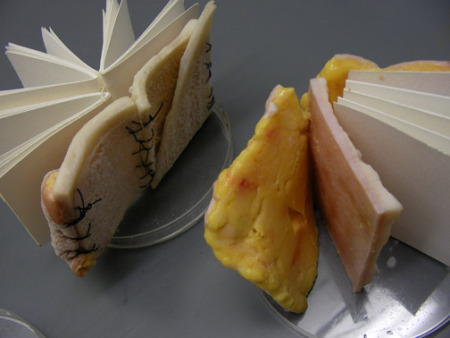
Well, it’s still a thing. Canadian artist Tagny Duff undertook a project from 2008-2011 called The Cryobook Archives, in which she used human and animal skin and modern biotechnology to grow “living” covers for handmade books. Duff even used a sort of ink made from a lentivirus to make designs on the book covers, which she displayed in a custom-built cryogenic freezer unit.
Duff explains that her cryobooks, which use skin cells donated by surgical patients and are stitched with surgical suture, are a way of reclaiming knowledge from its disembodied, electronic form. “We often overlook the fact that information is created from physical bodies” through the study of anatomy and biology.
I’m not sure Harvard’s libraries would be interested in these particular skin-covered tomes. For all the years of study and preparation that went into creating their covers, these books are blank.
Duff blogged extensively about The Cryobook Archives here. You can watch a video of her presenting the work at Dublin’s Science Gallery here.
Map update: astronomy and permafrost edition
I’ve added a few blog posts by other people to our ever-expanding science travel map.
1. Edmond Halley memorial at Westminster Abbey. There are a lot of scientist graves and memorials at Westminster Abbey in London, but Edmond Halley’s comet-shaped memorial is in a lovely spot, away from the crowded sections. Matt Brown wrote about it a few years ago on the now defunct (archived) London Blog for Nature Network.
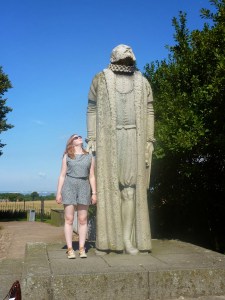 2. Tycho Brahe’s observatory on the island of Hven. Heather Frizzell has been writing science tourist posts on her own blog, The Science Tourist. In one post, she describes a visit to the island of Hven, between Denmark and Sweden, where she visited Tycho Brahe’s 16th century observatory.
3. Field work in Siberia. The Polaris Project studies climate change in the Siberian arctic region, and graduate students on the project keep blogs on the site. We added a post by Kelsey Dowdy to the map, which describes permafrost sample collection.
Continue reading “Map update: astronomy and permafrost edition”
The Extreme Life of the Sea
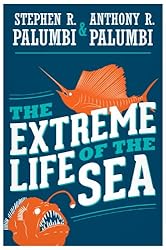 The Extreme Life of the Sea by father-son team Stephen R Palumbi (marine biologist) and Anthony R Palumbi (science writer & novelist) was, to me, like a grown-up version of some of my favorite childhood books – books of interesting animal facts, like how high a mountain lion can jump or how fast a house fly can fly.
The Extreme Life of the Sea is less narrative and more an enthusiastic sharing of cool things in the sea, which are loosely tied together in thematic sections. It is not, however, just a collection of “gee whiz” facts. The compelling vignettes help to convey broader concepts of science and nature with excitement and enthusiasm.
Most of all, the Palumbis remind the reader that science and nature are not just important, they are fun. Continue reading “The Extreme Life of the Sea”
Sunday Science Poem: The Stark Dignity of Self-Organization
William Carlos Williams’ “Spring and All” (1923)
After an unintentionally long hiatus, our Sunday Science Poem is back. April is National Poetry Month, and this month we’ll read the poetry of the American physician-poet William Carlos Williams (1883-1963).
“In physics, irreversibility and dissipation were interpreted as degradation, while among natural scientists biological evolution, which is obviously an irreversible* process, was associated with increasing complexity… Today scientists realize that dissipative systems constitute a very large and important class of natural systems.” (Grégoire Nicolis and Ilya Prigogine, Exploring Complexity (1989), p. 50-51
Nicolis and Prigogine argue that we should no longer take the simple, regular, and stable motions of classical mechanics as the essence of our macroscopic physical world. Rather, we live in “a world of instabilities and fluctuations, which are ultimately responsible for the amazing variety and richness of the forms and structure we see in nature around us.” Nature is characterized by spontaneously organizing structures. Continue reading “Sunday Science Poem: The Stark Dignity of Self-Organization”
 The Finch and Pea