
Breaking News: Kids Distract Easily

Art, by a kid (mine) that was hung on a wall (mine)

Those of us in online environments are familiar with the concept of attention allocation or attention as currency. A new research paper in Psychological Science argues that off-topic wall decorations in the classrooms of young students distract from the learning.

I’m not a psychology researcher. So, I can’t and won’t comment on the merits of the work as it relates to the body of related research. From reports, the study does use a small sample size (24 students in one class) and the same students in both conditions. So, don’t start yelling at your kid’s kindergarten teacher based on this study alone.

As the parent of a kindergartener and a recently graduated kindergartener, I was a bit surprised to discover that there was debate about the decoration of classroom grounds on its educational merit. Here, competition for kindergarten students is pretty fierce. At the same time, we parents are pretty irrational consumers of education as a product.

Walls covered in bright colors and cute art by little kids? That makes a classroom look fun, inviting, and warm. It distracts us too; and, before you know it, we are signing applications and deposit checks.

 

The Power of Positive Thinking

Upwell‘s Rachel Dearborn has a thoughtful post over at Medium arguing for more positivity in communication about conservation that emerged from her visit to the Circumnavigating Hope workshop in London.

Doom and gloom can be overwhelming. The seriousness of a problem can actually stop people from acting constructively, because humans are mercurial things.

What if the stories we told about the ocean weren’t all doom and gloom?

Can we foster a kind of hope that inspires people to protect our planet’s most precious resource?
Rachel Dearborn

Can we create hope and build momentum? The workshop spawned the #OceanOptimism hashtag on Twitter where you can see folks giving it a try. You can also visit Upwell or subscribe to their Tide Report for doses of science, fun, and hope.

Adjusted for Accuracy

In the wake of the sensational story about a larger shark potentially killing and eating a smaller shark, shark conservation advocate and researcher David Shiffman has posted a series of overwrought shark headlines paired with versions that have been adjusted for accuracy.

My favorite is “Shark seen swimming in ocean. You know, where sharks live”.

David has invited readers to submit their own suggestions.

*Hat tip to Andrew David Thaler of Southern Fried Science.

The Art of Science: Karen Russell’s Bad Plant Romance

badgraft
Photo by Michael Marcelle for The New Yorker

My art of science posts usually focus on visual art, but this week I stumbled upon a beautiful example of a much rarer species – a short story thoroughly saturated with science. “The Bad Graft”, a story by Karen Russell in this week’s New Yorker, tells the story of a sort of love triangle between a man, a woman and a plant. Russell, best known for her novel Swamplandia, knows her way around exotic flora.

This story is set in the Mojave Desert, where a young couple, Angie and Andy, have come to visit Joshua Tree National Park. The Joshua tree, aka Yucca brevifolia, is a tough, twisted plant with painfully spiky leaves. Angie and Andy happen to arrive in the park during what a ranger calls “a pulse event” during which yucca moths pollinate the trees. “You think you’re in love? The moths are smitten. In all my years, I’ve seen nothing to rival it. It’s a goddam orgy in the canyon.”

The ranger goes on to describe the obligate relationship between the moths and the Joshua trees, each species entirely dependent on the other. He explains that the trees may be on the brink of extinction, and that the current “orgy” may be the ancient species’ “Hail Mary pass” or last shot at survival.

The trees may be prepared to go even further. The “Bad Graft” of the title occurs soon after the couple’s meeting with the ranger. Russell describes it in prose that suggests an earthquake or a war: “The yucca moths arrive like living winds, swirling through Black Rock Canyon. Blossoms detonate. Pollen heaves up. Then the Joshua tree sheds a fantastic sum of itself.”  Angie pricks her finger on one of the plant’s spines “and becomes an entire new creature.”

I won’t spoil the rest of the plot. I’ll only say that Russell has given serious thought to what it would be like to have a hardy desert plant take over the core of your being. She also thoroughly explores the metaphorical aspects of convergent evolution, obligate relationships and the idea of rootedness in both people and plants.

You can read “The Bad Graft” here – it’s subscriber-only, but you can get a free month’s trial that will unlock this little treasure.


Filling Up the Map

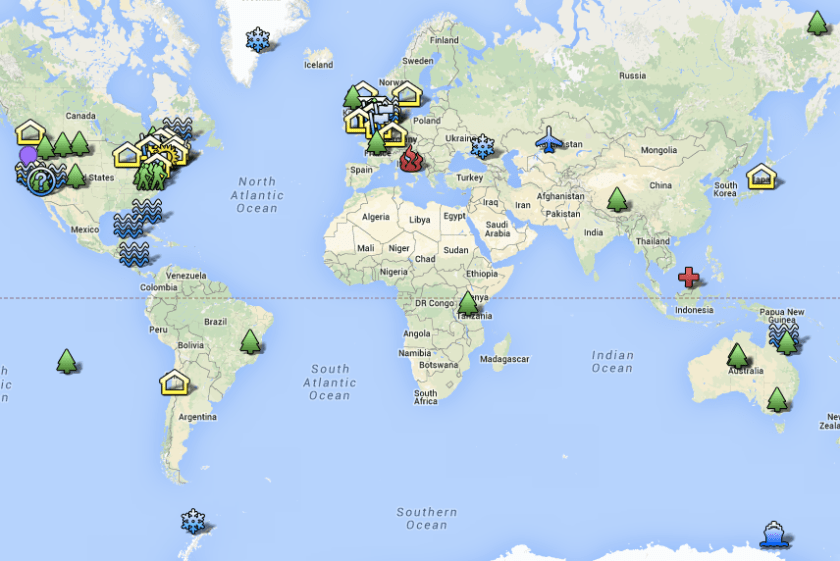
Screenshot 2014-06-10 15.20.45Eva is off today, which gave me a chance to get update the Have Science Will Travel Map. While Eva has done a wonderful job highlighting the writing of others about science-y destinations, I have done a miserable job of adding the destinations she has been writing about here at The Finch & Pea. Let’s blame it on the end of the school year chaos and my kids, like usual.

One of the biggest treats for me was getting to add the Baikonur Cosmodrome in Kazakhstan as a location for Eva’s “Dark Side of the Moon” post. The Baikonur Cosmodrome was the launch site for Luna 3 in 1959, which was the first probe to actually take images of the far side of the moon (ie, never visible from earth due to tidal locking).