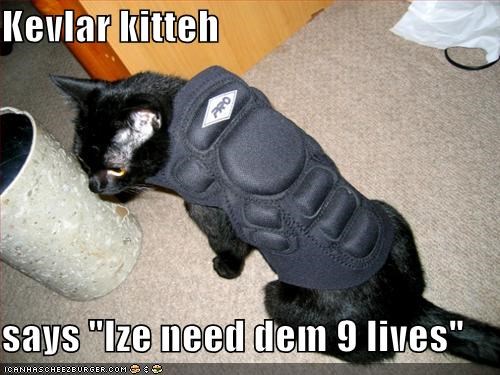
Science Caturday: Kevlar Kitteh says Thank You

kevlar

The science community is mourning the loss  of Stephanie Kwolek, a DuPont chemist who invented the synthetic fibers used in Kevlar body armor, who died this week at the age of 90.

Like many scientific breakthroughs, the invention of Kevlar at first seemed like a dud. As part of a DuPont team working to create a stronger synthetic fiber in 1965, Kwolek came up with a liquid crystal solution that could be cold-spun.

According to the American Chemical Society: “Most researchers would have rejected the solution because it was fluid and cloudy rather than viscous and clear. But Kwolek took a chance and spun the solution into fibers more strong and stiff than had ever been created.” By weight, Kevlar is 5 times stronger than steel.

Kwolek herself said “I never in a thousand years expected that little liquid crystal to develop into what it did.”

What it developed into, of course,  was Kevlar, a material that when made into light, strong body armor, has saved thousands of lives and has since been used in hundreds of different products.

So thank you, Stephanie Kwolek.

Please note that the cat in the photo above is not wearing a kevlar vest (looks like a knee pad), but many armed forces and law enforcement dogs do, and some of them undoubtedly also owe their lives to Stephanie Kwolek’s invention.


Science for The People: Environmental Debt

#270 - Environmental Debt
#270 – Environmental Debt

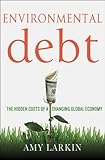
This week, Science for The People is looking at how worldwide environmental challenges interact with our increasingly global economy. They speak to Amy Larkin, founder of Nature Means Business, about her book “Environmental Debt: The Hidden Costs of a Changing Global Economy.” Journalist Ken Silverstein joins them to explain the way climate change is dividing the insurance and energy industries. And they’ll talk to Arjen Hoekstra, professor of Water Management at the University of Twente, about the effects of water scarcity on business.


More Bad News for Patent Trolls

The Supreme Court of the United States has ruled several software patents invalid because the patents did not cover a detailed process, but an abstract idea. This could place a number of dubious patents in software, technology, and science at risk of being invalidated in the future, too.

It may set a very important precedent for other legal cases involving lawsuits involving “patent trolls”. Currently, the most well-known of these actions has been efforts by Personal Audio to extort money from podcasters by threatening lawsuits based on supposed infringement of patents Personal Audio claims cover podcasting.

A key element of patent trolling is the inherent vagueness of the patent, which allows the concept of infringement to be drawn as widely as possible. The vague patent interpretation that makes patent trolling possible makes them vulnerable to being viewed as too broad, too abstract, or too vague by the courts and the US Patent Office. Indeed, the Electronic Frontier Foundation has reported success with getting the US Patent Office to narrow or invalidate overbroad patents.

This ruling may add another arrow to the quiver of those fighting the abuse of patents to stifle innovation*.

Hat tip to Giles Newton

*And your ability to listen to the WTF Podcast.

Buffy the Pertussis Slayer

Sarah Michelle Gellar (aka, Buffy the Vampire Slayer1) is the celebrity ambassador for the Sounds of Pertussis vaccination campaign from the March of Dimes and Sanofi Pasteur. She recently published an editorial at CNN encouraging adults to get their pertussis vaccination in order to protect infants from this potentially fatal disease (aka, whooping cough).

Although we typically associate celebrity medical endorsements with disproven woonackery or dangerous foolishness, that is a bit unfair. We’ve always been able to recruit celebrity spokespeople for important public advocacy campaigns. In 20122, Amanda Peet made a splash for her advocacy in favor of vaccinations as a counter to Jenny McCarthy.

The Sounds of Pertussis campaign has clearly been learning from the successes (vaccination rates are down, infectious disease outbreaks are up) of the enemies of sound medical science, good public health, and social ethics. Continue reading “Buffy the Pertussis Slayer”

The Art of Science: Summer of SciArt

from Modular Systems (2012) by Laura Splan, on display at SciArt Center

As art inspired by science gains in popularity, new spaces are springing up to showcase it. Europe had a head start, with London’s GV Art and Dublin’s Science Gallery, but now the US is catching up, with the opening of the Art.Science.Gallery in Austin, Texas, last year and SciArt Center in New York City this week.

For its inaugural exhibition, opening on Friday, June 20, SciArt Center has chosen the theme “What Lies Beneath,” as interpreted by artists Daniel Hill, Steve Miller, Jonathon Wells, Laura Splan, Jim Toia, and Jonathan Feldschuh. The exhibition runs through July 5 at the new gallery space on the Lower East Side.

Art.Science.Gallery currently has a group show called “Year of the Salamander” on display through June 21, featuring salamander-inspired artwork by a number of artists including Ele Willoughby, featured here before.  Upcoming events include the Tesla Project on July 5, a day-long celebration of everyone’s favorite eccentric genius.

In Washington, DC, the American Association for the Advancement of Science (AAAS) plays host to “Gedankenexperiment”, a show by 24 members of the Washington Sculptors Group.  The work in the show, which runs from June 16 through August 22, is inspired by scientific and mathematical theories, hypotheses, and principles from Archimedes, I Ching, geology, geometry, architecture, and others.  An opening reception and artist talk will be held on Friday, June 20, from 6-9 pm.