Titanography

Titan (NASA’s Cassini Probe)

I think there are two ways to view this detailed, scientific map of Titan from Captain Marvel. The first is that we don’t need to send more missions to Titan, because we already know what is going on. The second is that we absolutely need to send more missions to Titan because what is going on there is so freaking cool.

Art by Jim Starlin in Captain Marvel #27 (1973)

I favor the second option, both in the comic book and the real world. I mean, come on, lakes of liquid methane. How cool is that?

HT: Pariah Burke

Poe’s Comet Cataclysm: End of the World 1839

Edgar Allen Poe’s The Conversation of Eiros and Charmion (1839)

Great_Comet_1861The word “apocalypse” not only means a cataclysm that ends the current world order, but also, from the word’s Greek root, a revelation of truth. Poe’s very short story about the End of the World is an apocalypse in both senses of the word. In this early instance of the cataclysmic-collision-with-celestial-object tale, Poe makes an odd mix of science and prophesy to capture the moment of “the speculative Future merged in the august and certain Present.” “Eiros and Charmion” shows us what happens when the unknown becomes the dramatically revealed known.

The story starts with Eiros waking up to the startling realization that the afterlife is real, and that he (or she — Poe doesn’t say) is in it. His old friend Charmion, who died ten years earlier, is there to welcome him, happy to see Eiros “looking life-like and rational.” Charmion informs Eiros that their earthly names have been discarded, and that tomorrow he’ll induct his friend “into the full joys and wonders of your novel existence.” Continue reading “Poe’s Comet Cataclysm: End of the World 1839”

Science for The People: Science & Politics

sftpThis week Science for The People is talking about science and evidence in the political process. They talk to Dan Kahan, Professor of Law and Professor of Psychology at Yale Law School, about the Cultural Cognition Project, which studies group values and perceptions of risk in science communication. They also speak to Shane Trimmer, Executive Director of Franklin’s List, about their work to elect pro-science candidates. Biologist Katie Gibbs returns with an update on Evidence for Democracy, which advocates for the transparent use of evidence in Canadian government policy.

If reading is more your thing, check out “I’ll Trade You an Evolutionary Theory for Your Creationism” or “For Sale: 1 Vote, Price ‘Science’ or Best Offer” (posted at Culture of Science) for a Finch & Pea-esque take on some of the topics raised in this episode of Science for The People.

*Josh provides research help to Science for The People and is, therefore, a completely biased and cooperative member of the team. He does, however, insists on capitalizing the show name as he sees fit.

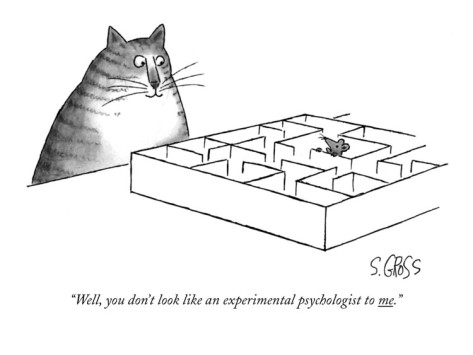
Science Caturday: Slightly Suspicious

Psychologists from all over the world are gathered this week for the annual meeting of The American Psychological Association (APA2014), so they can haz this cat cartoon, by Sam Gross for The New Yorker.

sgrosscat

You can buy a print of it here.

“…there is no support from the field of population genetics for Wade’s conjectures.”

If you are a regular patron of The Finch & Pea, you know that Nicholas Wade’s controversial book, A Troublesome Inheritance (link is to David Dobbs’ unflattering review), is a work of pseudoscience that purports to draw on the fields of human and population genetics to support a panoply of racist stereotypes. Now, a lengthy list of leaders in these fields, tired of their work being misappropriated, have signed a letter asserting:

We are in full agreement that there is no support from the field of population genetics for Wade’s conjectures. – Graham Coop, Michael Eisen, Rasmus Nielsen, Molly Przeworski & Noah Rosenberg (+134 signatories)

As Mary Carmichael notes, this is probably the first time these 139 scientists have ever agreed on anything.

*Hat tip to Daniel MacArthur.