Today is the anniversary of the discovery of our sentimental favourite dwarf planet, Pluto. On February 18, 1930 Clyde Tombaugh, working at the Lowell Observatory in Flagstaff, found the first evidence of a planet beyond Neptune. This seems like the perfect day to revisit an old post about a song that reminded me of the equipment he used. This is an edited and updated version of a Finch and Pea post from February 11, 2012.
With rich dark wooden curio cabinets and a narrow book-filled balcony accessed by a steep staircase, the Rotunda at the Lowell Observatory in Flagstaff feels like a natural home for the distinguished scientist. I visited the Lowell in 2011 for the National Association of Science Writers meeting, and it was everything that I had always imagined being a scientist would be when I was a kid. Feeling the warm glow of scientific discoveries past, there was one thing in the room I couldn’t take my eyes off: the glass plates and elegant brass eyepiece of the blink comparator used to discover Pluto. Continue reading “Revisting the blink comparator and The Rural Alberta Advantage”
Ekaterina Smirnova, 67P V, Watercolor on Paper, 2015
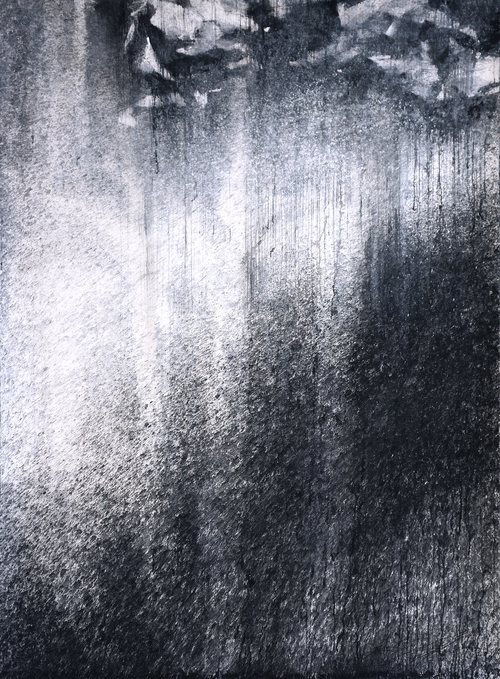
Some painters grind their own pigments, but Ekaterina Smirnova is the first artist I know of who makes her own water. Smirnova was inspired by the landing of the robotic probe Philae on comet 67P Churyumov–Gerasimenko in 2014. When she learned that scientists had discovered that the water on the comet is very different from the water on Earth, she decided to try to generate water that is similar in composition to the water found on 67P and use it in her paintings.
Smirnova found out that the water on 67P was heavy water, containing D20, or deuterium oxide. Since it’s not the kind of thing you can pick up at the grocery store, Smirnova set about McGyvering a system to make some in her studio, using electrolysis. (blog) That didn’t produce quite the results she wanted, so she bought some from a nuclear energy source and mixed until she was satisfied.
The artist says that through her work she studies the relationship between humans and the universe. She is particularly interested in the vapor that is released when the comet passes close to the Sun, forming the comet’s tail.
67P VII, Watercolor on Paper, 2015
The focus on vapor and spray carries through to her painting technique: “I use splashing techniques, vaporizing watercolor paint before it hits the paper, this allows me to create an effect of mist, little droplets of water streaming with a strong force to the dark vacuum of space. Painting most of the work without touching paper with a brush, I use 30 to 40 layers, which helps to create complex textures on the painting.”
Next month, Smirnova will show her 67P-inspired work, including a musical collaboration to an audience of scientists at the 50th ESALAB Symposium which will be held in Leiden, in the Netherlands. If you can’t make it there, she’ll be showing in New York later this year.
Caltech astronomers, including Mike “Pluto Killer” Brown, announced this week that they have strong evidence for a ninth planet in our solar system. “Planet 9” as they call it, is a gas giant 5,000 times bigger than Pluto and billions of miles farther away.
The catch: nobody has actually seen Planet 9 yet. The astronomers reported their research, based on mathematical and computer modeling, in The Astronomical Journal this week. They anticipate its discovery via telescope within five years or less, and they want help.
“We could have stayed quiet and quietly spent the next five years searching the skies ourselves and hoping to find it. But I would rather somebody find it sooner, than me find it later,” Brown told The Associated Press. “I want to see it. I want to see what it looks like. I want to understand where it is, and I think this will help.”
Well OK then! Space kittehs, to your telescopes! There are new planets to be found.
This week, we learned that one of the top threats to the US power grid is neither terrorists nor hackers but – wait for it – squirrels. According to ossim website Cybersquirrel1.com, more than 600 successful attacks have been launched on power networks by squirrels since 1987. Squirrels are by far the most active, but birds, raccoons and snakes have also launched over 300 successful “cyberattacks”, while human hackers, foreign and domestic, have managed only to take down a few twitter accounts and magazine websites. It’s pitiful, really.
What does this have to do with cats, you ask? Who do you think is running those crack troops of cybersquirrels? Dogs?





 The Finch and Pea