
Doctors Without Borders: Don’t wait for Ebola magic bullets

Earlier this week I argued that hand-wringing over the lack of Ebola vaccines and drugs is misguided. We have effective tools to fight Ebola right now.

This week in the New England Journal of Medicine, physicians from WHO and Médecins sans Frontières make a similar argument much more eloquently:

There has recently been immense media, public, and medical attention to specific treatments for Ebola virus infection. Although these experimental interventions represent important potential treatments, they also reflect our seemingly innate focus on developing magic bullets. It seems that focusing on reducing mortality in the existing “control group” by applying the current standard of care is less interesting, even if much more likely to be effective. Though we recognize the potential incremental value of new antiviral options, we believe that EVD requires a greater focus on available basic care…

Public health interventions including characterizing the outbreak epidemiology, contact tracing, social mobilization, and public education are essential steps in stopping Ebola and will ultimately save many more lives than can be saved by individual patient care…

Excellent clinical care and improved outcomes will result in improved community compliance, will help to break transmission chains, and will lead to a greater willingness of health care workers to engage in care delivery. To quote William Osler, “The best preparation for tomorrow is to do today’s work superbly well.”

Science for the People: Mental Health Myths

sftp-square-fistonly-whitebgThis week, we’re listening to “Mental Illness Myths,” a panel discussion about public perceptions of mental health  at CONvergence 2014. Panelists Megan Press, Miri Mogilevsky, Julia Burke and Olivia James discuss misconceptions about diagnosis, treatment and symptoms, and the harm that stigma does to individuals affected by mental illness.


Race for the Prize

There aren’t many mainstream songs about scientists. I only know of two. One is quite well-known but I don’t like it and it doesn’t really seem to be about science anyway. The other one is The Flaming Lips’ “Race for the Prize”. It was released in 1999 on The Soft Bulletin, and describes a competition between two scientists who are in a race to find “the cure” (not the band, all lower case).

Continue reading “Race for the Prize”

Polio in Pakistan – Collateral Damage of the War on Terror

Thanks to the CIA using fake vaccination programs (something they claimed to have stopped doing earlier this year) in the terrifying “War on Terror” the Taliban banned polio immunizations since 2012. It should come as no surprise that the Taliban is perfectly happy to violently enforce this ban. Not only are polio cases increasing in Pakistan, but more 60 healthcare workers have been killed trying to administer life saving polio inoculations.

They are among the more than 60 polio workers who have been killedsince the Pakistani Taliban banned polio immunization in 2012…The edict by the Islamic militants to ban immunization was in response to the CIA’s setting up a fake hepatitis vaccination campaign in Pakistan. The covert operation was part of an attempt by the U.S. spy agency to verify whether Osama bin Laden was holed up in the city of Abbottabad. – Jason Beaubien, NPR

*Hat tip to Xeni Jardin at BoingBoing.

I’m Old(er)

Today is my birthday.

Thank you.

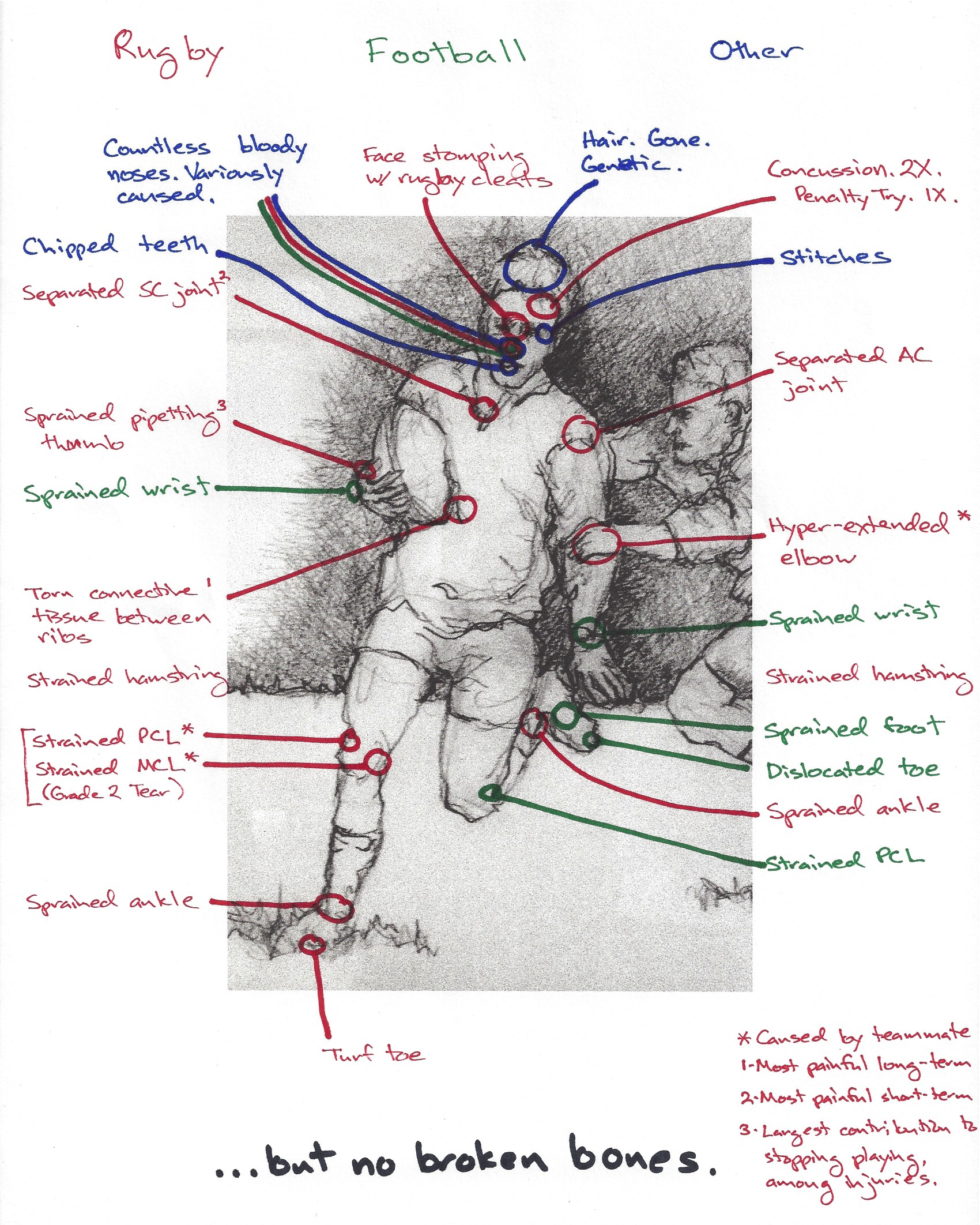
On average, I’m not old, but there is significant variance across my body. Certain joints etc. have accrued a bit more mileage over the years. To celebrate my birthday, I’ve created an illustrated annotation of all the significant injuries I’ve suffered over a variety of activities (color coded for the most major contributors).

Original drawing by Susan Witten (Used with Permission)

The underlying drawing is a badly modified version (to make up for bad photography) of a pencil drawing of me playing rugby that my mother gave me as a college graduation gift.

You can hear me tell a story about the “face stomping” incident here.