The Art of Science: Fruit of Knowledge

Charlotte Jarvis’ Blighted by Kenning is a unique cross-disciplinary art project that draws upon nature and biblical symbolism as well as cutting-edge science. As she describes it:

The project has bio-engineered a bacteria which has the Universal Declaration of Human Rights encoded into its DNA sequence. The DNA has been extracted and apples grown near The Hague, which houses the International Court of Justice, have been ‘contaminated’ with the synthetic DNA. They are currently being sent to genomics laboratories around the world, which have been asked to sequence the declaration and also to eat the fruit. Continue reading “The Art of Science: Fruit of Knowledge”
The Art of Science: Mika Aoki

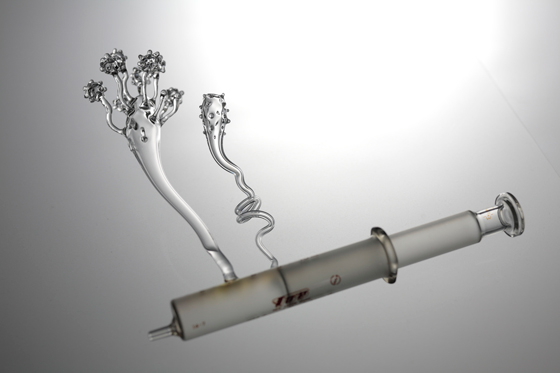
Mika Aoki is a Japanese artist working mainly in glass. Her work, which features crystal-clear groupings of spore- and cell-like objects, treads a line between science and fantasy. Of this piece, Syringe, from 2009, Aoki says, “I got this theme from the idea of a sperm bank. Sperm donations are classified according to educational background or appearance. Great expectations are entrusted to microscopic life which can be sucked up by syringes. From this point of view, I notice that my personality is breathing within each cell of my body.” (source)

A viewer who didn’t know Aoki’s intent might see other possibilities in this piece, however – perhaps the specter of hospital-acquired infections or the idea behind vaccinations, of injecting ourselves with viruses to protect ourselves from them.

You can see more of Mika Aoki’s work at her website.

The Art of Science: Growth Factor

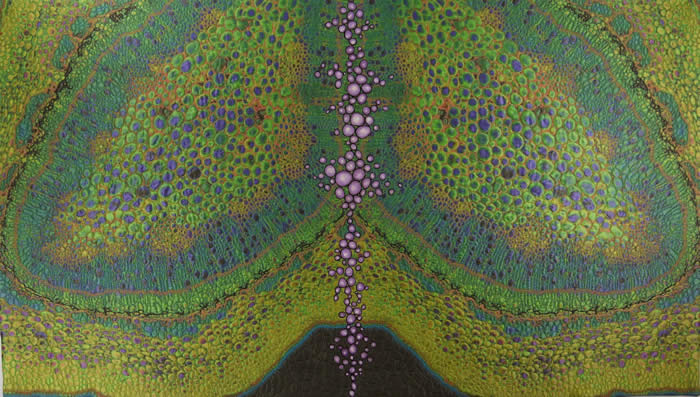
Betty Busby, a textile artist based in New Mexico, uses quilting to explore scientific themes.  Her large and often spectacularly detailed pieces represent biological processes, including cell division and the growth of plants and other organisms.

Busby uses photomicrographs of scientific images as inspiration for her work.  She says that because the colors in microscope photos are mostly artificially produced, either through chemical or lighting methods, it gives her the freedom to experiment with “the wildest color combinations I can think of, unhindered by expectations of realism.”

This piece, Growth Factor, looks at cell growth and development.  Busby printed the cell images on silk in a palette of green and gold, evoking a forest, then appliqued the purple organelles welling up in the middle. This piece will be shown at “Quilt Visions: Brainstorms”  at the Visions Art Museum in San Diego, CA, in October 2012.

You can see more of Busby’s work on her website  and at her etsy shop.

This post contains material that originally appeared in Guru magazine

The Art of Science: Olympic Edition

The lighting of the flame in the stadium is an iconic moment in any Olympic games. The designer of the cauldron for the 2012 London games, Thomas Heatherwick, preserved the tradition but gave it a few new twists. As Heatherwick told a press conference in London,  “When we were thinking about the cauldron , we were aware that cauldrons had been getting bigger, higher, fatter as each Olympics has happened and we felt we should not try to be even bigger than the last ones. Continue reading “The Art of Science: Olympic Edition”

The Art of Science: The Lure of Lead

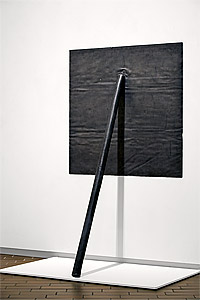
Lead is heavy. Not just in terms of physical density, but also of cultural weight.  Malleable, ductile and resistant to corrosion, lead has been used for over 8,000 years for many purposes. The Romans, who gave the element its name (Pb, for plumbum) built their famous water and sewer system of lead pipes, and used it to make statues, sarcophagi, cooking pots, and wine vessels.   In the middle ages, lead was used in roofing and plumbing, as well as for statues and ornaments, including the strips joining the pieces of colored glass in church windows. Up until the 20th century, lead was still widely used in paint and solder and as an additive in fuel. Continue reading “The Art of Science: The Lure of Lead”