Yes, interactive robot poetry dioramas (by MindShift). I went to high school in the wrong decade. Though, I did once have an animatronic element on my Science Fair board (studying circadian rhythm in gerbils).
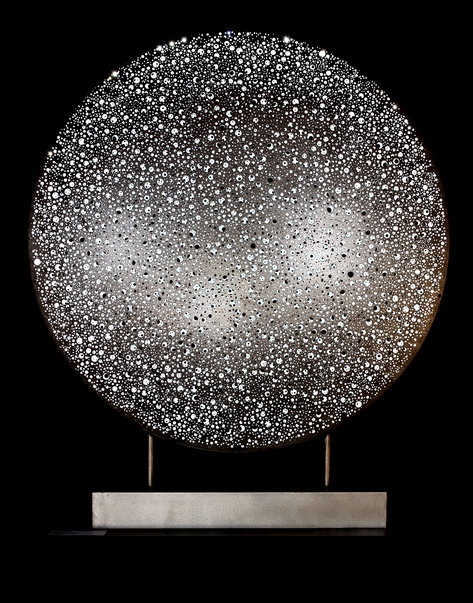
Michael Enn Sirvet is a sculptor, a nature lover and structural engineer. All of these come together in his work in wood, plastic and metal, which he says are “inspired by chaotic and yet uniform naturally occurring patterns, and the technology and industry which mimic them.”
This 2012 sculpture, The Orb of Tranquility, is made up of two aluminum dishes with multiple holes and an LED light source between them. Its name and shape evoke the moon, stars and planets. Its intricately patterned surface, however, may be more reminiscent of atoms, molecules, or dividing cells.
Although his work is based in nature, industrial materials and technology form an intrinsic part of Sirvet’s sculpture. “The most organic of my sculptures are industrial, and the most engineered of my pieces reflect primitive natural calm.”
You can see more of Michael Enn Sirvet’s work at his website.
The actual strip feature no real nudity, but, if your workplace or conservative christian dominated place of residence objects to pseudo-nudity, you may want click through in a private location.*
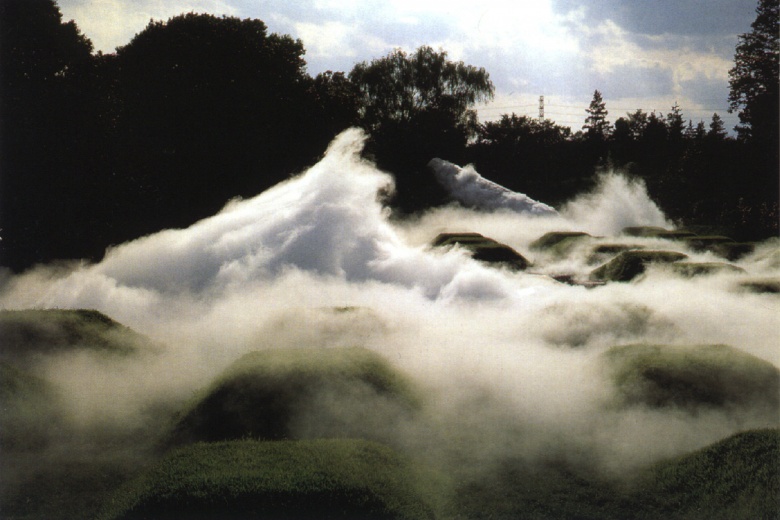
Fujiko Nakaya is the world’s foremost sculptor of fog. And in the sense that it is not really possible to sculpt fog, you could say she has been doing the impossible for over 40 years.
Nakaya began her career in Japan as a painter. But, frustrated with the limitations of painting and inspired by her father, a scientist who is credited with making the first artificial snowflakes, she essentially invented her own medium. Working with engineers, she developed a system to create and disperse water vapor through pipes to create fog. For her first fog sculpture, she covered the entire Pepsi pavilion at Osaka’s Expo ’70 in fog. Since then, using the same technology, she has created more than 50 fog sculptures in environments ranging from art galleries to bridges to forests.
Using water vapor as a sculptural element is at once simple and profound. It transfigures the environment, making the familiar seem strange and dreamlike, and then disappears without a trace, absorbed back into the air. The artist says that in ancient Japan, fog was seen as “the breathing of the atmosphere.”
Intriguingly, Nakaya’s latest fog sculpture is set to debut at the Exploratorium in San Francisco, a city famous for fog. Her work will be installed along a pedestrian bridge in the sure-to-be-spectacular new Exploratorium space which will open on April 15 on the Embarcadero waterfront. As Nakaya explained to ArtNews, “On calm days, fog will bundle on the bridge and gently flow along the canal onto the ocean,” she says. “With a strong wind, it will hoist upward into the sky like a dragon. On humid days, it floats over the water and lingers in tufts. Its ever-changing form is the probe, in real time, of its immediate environment.”
If you can’t make it to San Francisco, here’s a video of Nakaya’s installation Cloud Forest, from 2010.



 The Finch and Pea