The Art of Science: Dude, Giant Shrooms

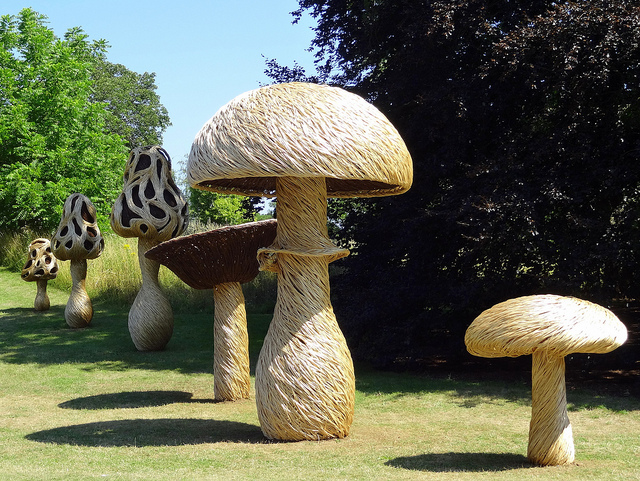
Tom Hare, Fungi Fairy Ring

Gigantic fungi have sprouted in London’s Kew Gardens, thanks to sculptor Tom Hare, who created an installation called Fungi Fairy Ring for the IncrEdibles exhibit, a celebration of “autumn’s edible delights” that runs through November 3rd. Working with mycologists from Kew’s Fungarium, Hare created a series of sculptures made from woven willow, representing seven different species of native edible fungi. The sculptures,  which tower up to 12 feet, are based on close collaboration with scientists to ensure that they not only portray each type of fungus accurately, but also show various stages of their life cycles.  Not to mention that their giant size makes them ideal to use as backdrops for photos of full-sized humans as gnomes and fairies.

They also provide a perfect visual for the UK’s first National Fungus Day, which takes place this coming Sunday, October 13. It will be celebrated at Kew with a full program of events including tours of the Fungarium, fungi-spotting walks, model-building and mushroom soup.  Many other events are happening in other cities – see ukfungusday.co.uk for details

Support Your Local Artist

Portrait of a Human by Michele Banks (All Rights Reserved – Used with Permission)

Michele is a bit bashful about using this as a forum to promote her own work. I, for better and worse, run this joint. So, I feel no compunction about using this platform as I see fit. I also happen to believe that figuring out how to support our artists in this online era is a critical challenge for science communication.

We all should support our local artists, bearing in mind that the Internet has rewritten the definition of “local”. Around here, Michele is our local artist and we think she deserves your support. Continue reading “Support Your Local Artist”

The Art of Science: What’s a Wirbelwerk?

Wirbelwerk, 2013
Wirbelwerk, 2013

I’m crazy about Olafur Eliasson’s Wirbelwerk, an installation of colored glass, metal rods and a light source that throws constantly changing patterns over every surface of the atrium at Munich’s LenbachhausWirbelwerk, which means vortex or whirlpool, looks like a glittering, light filled cross between a tornado and an icicle. The piece combines three longtime preoccupations of Eliasson’s work: weather, light and space. Not to mention packing in plenty of engineering and optical physics for us nerds. Lots more photos here.

The Art of Science: Sticks and Swells

Marshall Islands Stick Chart, mid-19th century, Cambridge University Library

When I came across a photo of a Marshall Islands stick chart on Tumblr, I had no idea that it was anything other than an elegant piece of modern art. I was very surprised to discover that the stick chart was an important piece of navigational equipment that was in active use for thousands of years.

The Marshall Islands are a group of over a thousand small islands in the northern Pacific, which were settled in the second millennium BC. Stick charts were an ingenious way to navigate among the islands by canoe. The charts, made from coconut fronds tied together in an open framework, depicted major ocean swell patterns and the ways the islands disrupted those patterns. Shells were sometimes tied to the framework to represent the position of islands. Reading and interpreting the charts was a crucial skill handed down through generations.

The Marshallese continued to use canoes and stick charts for navigation until the mid-20th century, when they gradually switched to motorboats and electronic navigation systems. The charts survive not only as history, but as an art form deeply imbued with the values of an ancient, ocean-centric culture.

The Art of Science: The Crafty Creatures of Hiné Mizushima

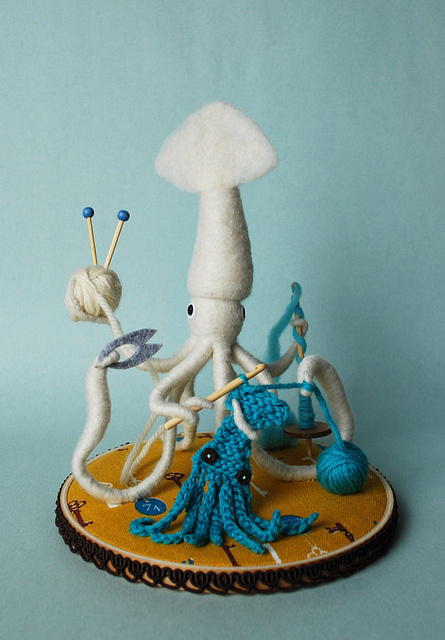
squid knitting

She describes herself as a “slow crafter”, but Hiné Mizushima has managed to pack a lot of projects into the last few years. A native of Japan, Mizushima started out there as a painter before moving first to Europe, then to the US, before settling in Vancouver and starting to create adorable needle-felted creatures. Not the usual bears and mice, though – she prefers offbeat creatures like squid, slugs, daphnia and even ectoplasm, which she shows in galleries and sells in her etsy shop.  I love the combination of humor, smarts and beautiful craft in pieces like this needle-felted squid knitting a squid. If you’re not in the market for a gorgeous woolen cephalopod, this Unnatural History Museum postcard set should fulfill your needs for sweet, quirky science on a budget. (Note the detail: each little “ectoplasm” carefully sealed in its own labeled test tube)

Mizushima recently began creating stop-motion animations using her felted creations, and has been commissioned to make several music videos for the ultimate geeky band, They Might Be Giants. I especially love the “Insect Hospital” video, where sick and injured bugs get fixed up with various computer parts.  She has also been making super-short animated gifs, including this amazing self-extinguishing firebug.

You can see lots more of Hiné Mizushima’s work on her website  and follow her on twitter @hine_art