The Art of Science: Roni Horn’s Library of Water

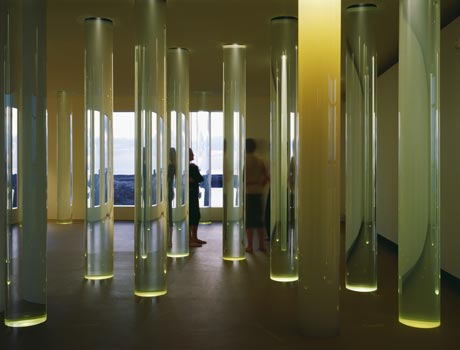
Roni Horn, Water, Selected, 2007

Artist Roni Horn has been traveling to Iceland from her home in New York since the 1970s. The unique nature of the Icelandic landscape and climate deeply informs all her work, which ranges from sculptures and drawings to photos and books.

In the 1990s she discovered the local library in the small town of Stykkisholmur and was impressed with its architectural style and its views of the sea, sky, town and harbor. When the library ceased operations in 2003, Horn proposed the creation of a permanent installation in the building. The result, Vatnasafn/Library of Water, opened in 2007.

The Library of Water consists of three linked parts: The first, Water, Selected is a sculptural installation of 24 glass columns containing water collected from ice from some of Iceland’s major glaciers. The columns bend and reflect the light onto a rubber floor which is printed with words in Icelandic and English related to the weather. As Gordon Burn described it in The Guardian, “with the windows cut to the floor, Library of Water pokes up into the weather. It sets its face at everything the weather can throw at you, which in Iceland invariably means extremes of light and wind and cold; visibility often varies from minute to minute.”

The second exhibit, Weather Reports You, consists of taped interviews with 100 Icelanders about their interactions with the weather and selections from Horn’s books about Iceland. The third part of the library is a private writers’ studio where each year writers from Iceland and abroad are invited to live and work for several months at a time.

The idea of a library of water gathered from glaciers is not only beautiful and novel, but may become essential. A great deal of information about historical climate, atmospheric and geological conditions is trapped in the ice of glaciers. As global warming causes the glaciers to melt, we may have no choice but to look at them in a preserved and cataloged form, like antiquated books in a library.

Information about visiting the Library of Water is here.  If you can’t make it to Iceland, you can see related work by Roni Horn at the Hauser & Wirth Gallery in New York City until January 11, 2014.
The Gift of Science: Handmade & Hand-Picked

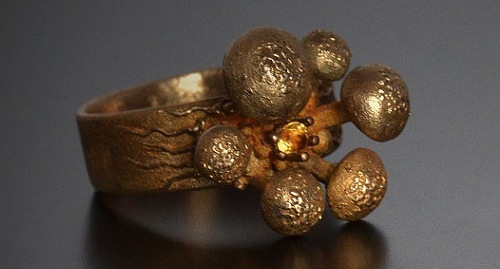
il_570xN.506447360_hf9vThis one-of-a-kind ring in citrine and bronze depicts a honey fungus, or Armillaria. A perfect gift for a mycologist or anyone who appreciates the more obscure beauties of nature. $120

These “nondenominational festive ornaments” celebrate the contributions of six key women in science: Rosalind Franklin, Marie Curie, Jane Goodall, Rachel Carson, Elizabeth Blackwell and Ada Lovelace.

Hang them on your Christmas tree, menorah, Festivus pole or wall. Made of wood with ribbon hangers. $36 – also available as a set of coasters.

Delftia is a new Israel-based etsy shop featuring jewelry made by a self-described “nerdy armchair scientist and metalworker.” Her science and nature inspired pieces include brains, atoms and caffeine molecules, but our favorite is this silver and brass pendant of Darwin’s original sketch for the tree of life. $45

Beautiful, practical and sustainable, this cutting board adorned with a Fibonacci spiral can be customized with an Einstein quote or with your own personal message. (Please note 3 week lead time if you need it by Christmas.) The shop also features other boards with science motifs, including a periodic table, DNA spiral or solar system. $45

Remember your furry friends (and your microbiologist or infectious-disease specialist friends) with an adorable needle felted pathogenic cat toy by Mycrobe Catnip. Pretend your cat is a healthy immune system or strong antibiotic tearing into this catnip-infused bacterium. Lots of other nasties available in Mycrobe’s shop, including myxococcus, trypanosoma and giardia. $10

Sevenstone makes simple and beautiful bowls, vases and tealights from lovely rocks – like this small vase “crafted from a polished glacier stone with a striking band of quartz” A perfect gift for a geology fan, or for anyone who appreciates decor that is both rugged and refined. $65

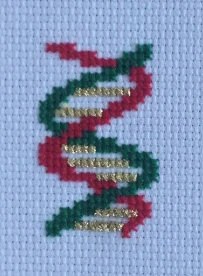
Genegeek’s line of cross-stitched Christmas ornaments merge old-fashioned craft with modern science. Our favorite is the DNA double helix.

Note that the DNA double helix is in the correct, right-handed direction.

You can also choose from microscope, pipette or cell motifs. $7.70 each or $24.05 for a set of all four.

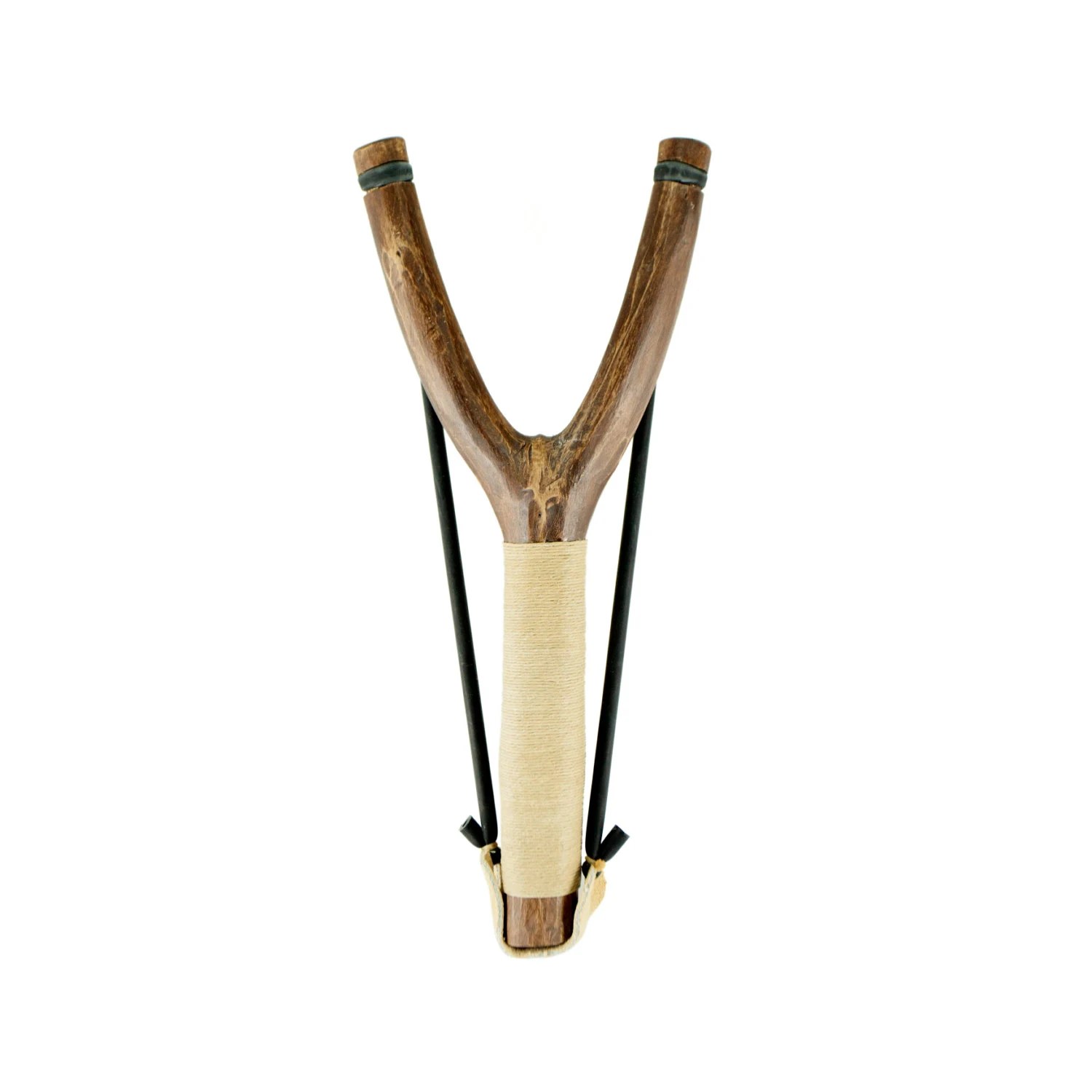
A slingshot is an ideal vehicle for exploring numerous concepts of basic physics: tension, elasticity, potential and kinetic energy, just to name a few. So you can tell yourself that is why you want this sweet, handcrafted slingshot. Says the maker: “Each one-of-a-kind slingshot is handmade in San Francisco from forked tree branches. They’re carefully varnished, twined in shellacked hemp, and outfitted with a leather projectile pouch using natural latex tubing and imitation sinew. So grab one, head outside and cause some mischief.” OK! $36

Get extra-scientifically clean with handmade glycerin soaps from Sky Rain Soap, an etsy shop packed with choices like astronauts and meteors (pictured), crinoids and trilobites, dinosaurs, elements, and plenty of robots and aliens.Perfect stocking stuffers from $3 and up.

Why wear reindeer when you could have dinosaurs? Be the toast of holiday nerd gatherings with this screen-printed sweatshirt featuring Santa with a triceratops and an apatosaurus. $29

The Art of Science: Rogan Brown Cuts Deep

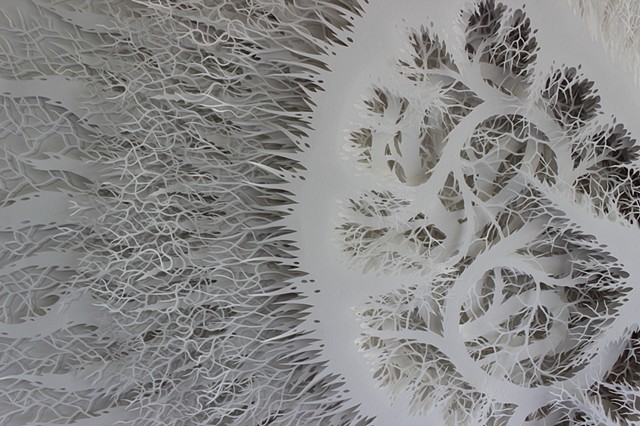
Rogan Brown, Detail from Kernel, 2013

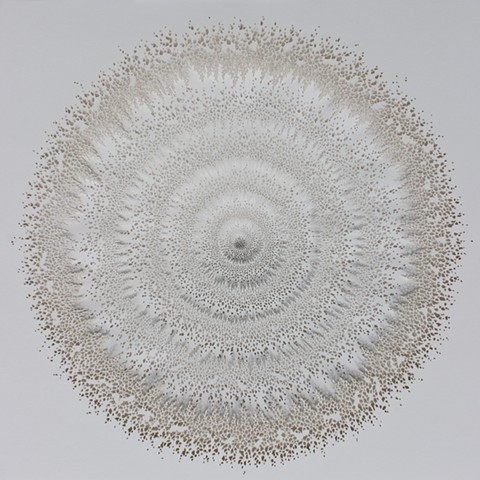
For artist Rogan Brown, the process of making his cut-paper sculptures is as important as the finished product.  Each artwork is built from painstakingly cut and assembled pieces of paper – an arduous, time-consuming task. Says Brown, “The finished artifact is really only the ghostly fossilized vestige of this slow, long process of realization. I have chosen paper as a medium because it captures perfectly that mixture of delicacy and durability that for me characterizes the natural world.”

I would add that by working only in white, Brown amplifies the impact of his incredibly complex works, putting the focus squarely on what Darwin called “endless forms most beautiful.”

Clone, 2012
Clone, 2012

Brown says he is inspired by natural shapes and patterns “from the microscopic to the macroscopic, from individual cells to large scale geological formations”.  While his art, and the process of study that precedes each piece, pay tribute to scientist-artists such as Ernst Haeckel, Brown does not seek to replicate nature. He rather describes his pieces as explorations: “Everything has to be refracted through the prism of the imagination, estranged and in some way transformed.”

You can see more of Brown’s work on his website and buy originals and prints here.

The Science is the Art

by Christian Gottfried Ehrenberg (Public Domain)

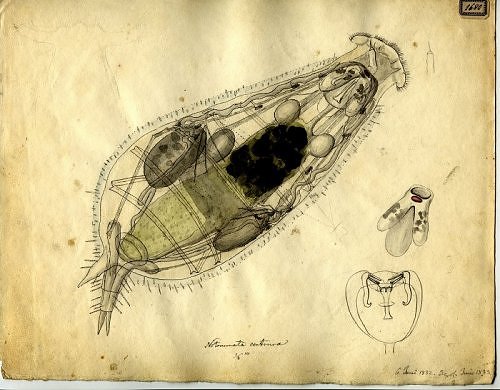
The images Christian Gottfried Ehrenberg made of microscopic organisms in the mid-1800s are both art and ground breaking science. They should be appreciated as both. A massive collection of his specimens, images, and records reside at the Museum für Naturkunde in Berlin.

Found via David Orr pointing to The Caledonian Mining Expedition Company.

The Art of Science: Tamsin van Essen’s Charming Quarks

Tamsin Van Essen, Quarks (Back), 2008
Tamsin van Essen, Quarks (Black), 2008

Ceramic artist Tamsin van Essen uses a combination of novel and traditional techniques to produce thought-provoking pieces, including many drawn from science and medicine. For example, her Medical Heirlooms series comprised a series of vessels that seemed to have skin diseases, while the cups in her Contamination series appeared to have been colonized by various nasty bacteria.

I was particularly drawn to her Collection of Curious Objects, a series of less traditionally shaped objects inspired by theoretical physics.  On her website, Van Essen explains:

Physicists are busy developing sophisticated theories around the existence of things that are impossible for us to see, perfecting mathematical models of the ‘beyond-visible’ worlds of the very large and distant (using Einstein’s theory of relativity) and the very small (using quantum mechanics).

Focusing on this realm of the intangible, I wanted to explore how abstract theoretical ideas can be visually represented. I also wanted to play with the notion that today’s cutting-edge theories may one day be seen as quaint and curious museum pieces: theoretical antiques or abstract junk.

The objects might be found in someone’s dusty attic or perhaps turn up on Antiques Roadshow in the future: “Oh my! Look what they thought in 2008!”

Tamsin van Essen, “Curious Objects”

I love their simultaneous seriousness and playfulness – ceramic quarks and wormholes! – demonstrating van Essen’s willingness to engage with difficult and abstract ideas in an accessible but not dumbed-down way. And while I can admire the thought and craft that goes into a vase that appears to have syphilis, I’d much rather have a shiny quark.

If you’re in the UK, you can see some of van Essen’s work in the Subversive Design show at the Brighton Museum through March 2014.