The Cutting Edge

If you are in the DC area tomorrow, the AAAS is hosting an interesting event that piggybacks off the Voyage of Discovery art installation by Jessica Beels, Ellyn Weiss, and our own Michele Banks called Cutting Edge: Art & Science of Climate Change:

Join AAAS for an evocative exchange as artists and scientists come together to interpret the effects of climate change on the poles…This live event features talks by two leading Arctic researchers, followed by a panel discussion on communicating climate change to the public.

“Cutting Edge: Art and Science of Climate Change” coincides with the art installation, “Voyage of Discovery,” currently in the lobby of AAAS headquarters. This remarkable exhibition, featuring works by Michele Banks, Jessica Beels, and Ellyn Weiss, explores a “hypothetical journey” to the poles where climate change has caused the ice to recede, reawakening life that has been frozen for millennia.

Cutting Edge will be held on Thursday, May 1 at 6:30PM at the AAAS Headquarters in Washington, DC.
The Art of Science: Lemurs out on a Limb

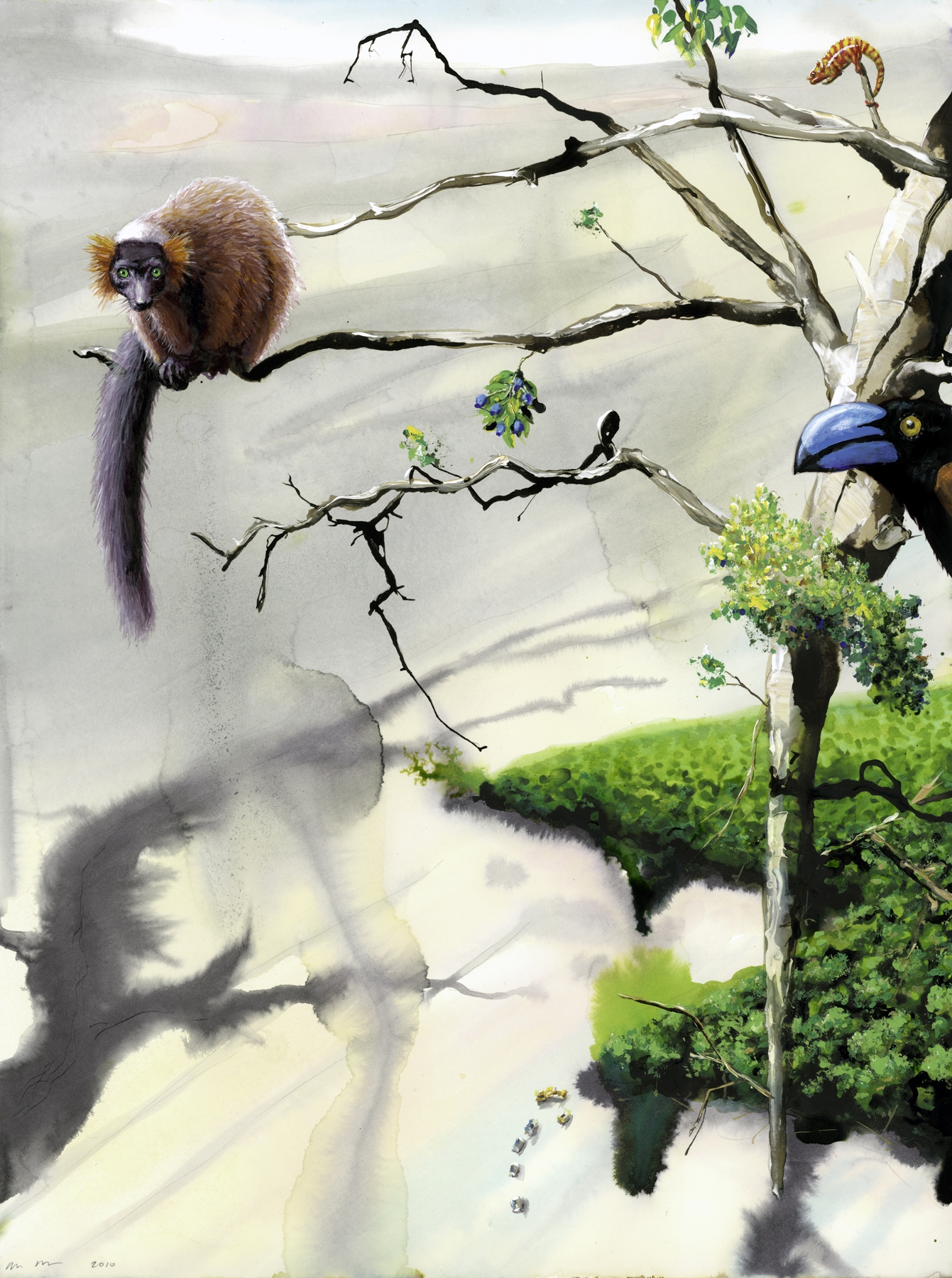
Alexis Rockman, Fragments
Alexis Rockman, Fragments, 2010

About 100 species of lemurs live on the island of Madagascar. The astonishing diversity of lemurs in this one location has allowed scientists to make important advances in evolution and island biogeography. Unfortunately, habitat loss and hunting are threatening their survival.  According to the International Union for Conservation of Nature (IUCN) lemurs are the world’s most endangered mammals, with up to 90% of all lemur species face extinction within the next 20 to 25 years.

The Lemur Conservation Foundation (LCF), is a small, Florida-based non-profit dedicated to the preservation and conservation of the Madagascar primates, is hosting a show of art featuring lemurs.

Vanishing, an exhibit featuring works from LCF’s permanent collection, includes works by 17 artists, including Alexis Rockman, who contributed Fragments, a painting depicting an imagined future of a devastated lemur habitat.

Rockman, well known for his dystopian visions of an earth ravaged by pollution and climate change, traveled to Madagascar in 2009 with LCF. He later painted Fragments, a lovely but unsettling image of a rare red ruffed lemur on a bare branch of a tree that offers little shelter or sustenance.

LCF founder Penelope Bodry-Sanders hopes the art exhibit will help people “understand the awfulness of extinction—without that, there is little hope for the future of lemurs and life itself in its magnificent diversity. “

Vanishing is on exhibit at Art Center Sarasota in Florida from May 22 – June 27. More information is here.


The Art of Science: Blogger’s Block

Evan Robarts, Molecule 2A, 2010

Dear Readers of the Finch & Pea,

I want to thank you for tuning in on Wednesdays for a little dose of art and science. I really appreciate it. But I also want to ask you, have you blogged? Have you blogged weekly? Because if so, you’re probably familiar with the feeling that I’m feeling right now. I got nothing. I’ve been searching the recesses of the internet for, well, maybe not hours, but a good long time, and all I came up with was this molecule made out of discarded playground balls. Like it? I think it’s kind of cool. I could try to spin some deep meaning out of it, like that it’s a molecule made of things that are themselves made of molecules. But really, dear readers, I respect you too much for that. I’ll try to find something great next week.

Sincerely, Michele


Feminalist Science Posters

by Hydrogene (CC BY-NC-ND 3.0)

Hyrdogene generally creates minimalist posters around science-y themes. The set of six she created celebrating women who made a big impact on science and the world is particularly compelling. According to the FAQs, an online store selling the posters will be opening up this summer, hopefully in time for my birthday.

The Art of Science: Ants Are People, Too

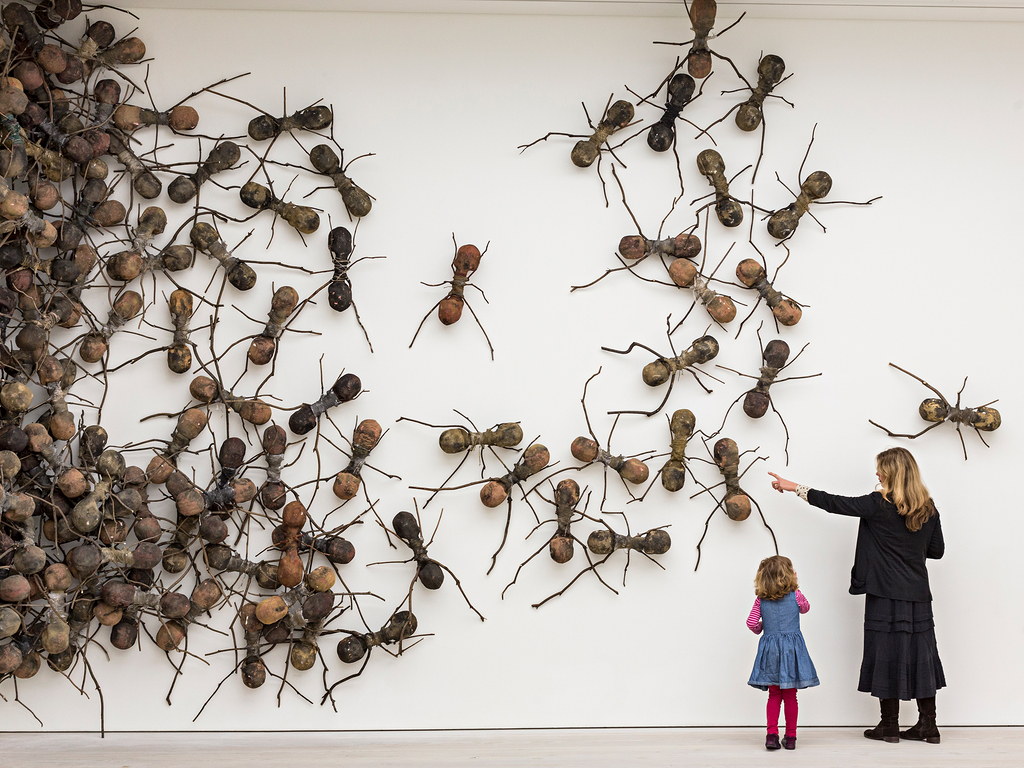
Rafael Gomezbarros, Casa Tomada, 2014Photo by David Levene
Rafael Gomezbarros, Casa Tomada, 2014    Photo by David Levene

Ants are crawling over the walls of London’s Saatchi Gallery. No, the cleaners aren’t on strike; the ants are an installation by Colombian artist Rafael  Gómezbarros, part of a group exhibition called Pangaea: New Art from Africa and Latin America.

If you look closely, you will see that the bodies of the ants, each of which is 50 CM (about 19 inches) long, are made up of casts of human skulls in fiberglass and resin.  For the artist, the ants represent  the millions of immigrants traveling the earth in search of a home.  In particular, Gómezbarros  pays tribute to thousands of Colombians who suffered internal displacement and violent deaths in the armed conflicts that have convulsed his country over the past five decades.  His ants have taken over the facades of several important buildings in Colombia, including the National Congress building in Bogotá.

Why ants? It’s easy to see why they work well as a stand-in for the teeming masses of immigrants. Humble, hardworking and capable of building complex social organizations, ants are also unfortunately easy for larger animals to snack on or crush underfoot.  But ants are resilient, too. They are able to “farm” their own foodstuffs, band together to kill much larger species, and create rafts of their own bodies to float in water. Ants are survivors.

Pangaea: New Art from Africa and Latin America is on view at the Saatchi gallery through August 31. You can see photos of the ants crawling on other buildings at Gómezbarros’ website

.