
Our own Michele Banks had her scarves featured on MSNBC this morning (along with our friend The Vexed Muddler):
Category: The Art of Science
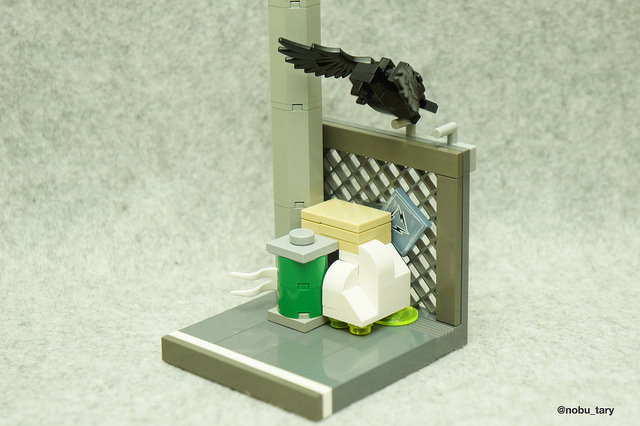
A Murder of Legos

It might be enough to say that I love Lego depictions of biology just because they are lovely. It might; but that would go against my nature. After a period of intense navel gazing, I’ve concluded that my febrile brain likes the idea of creating elegance from a simple set of basic building blocks – much like actual biology does.
This build of a crow by nobu_tary recently caught my fancy. It uses very few pieces to capture the essence of the bird and allow the dynamic motion of the wings to be represented.
HT: Brothers Brick
The Art of Science: Biologically-Enhanced Fashion
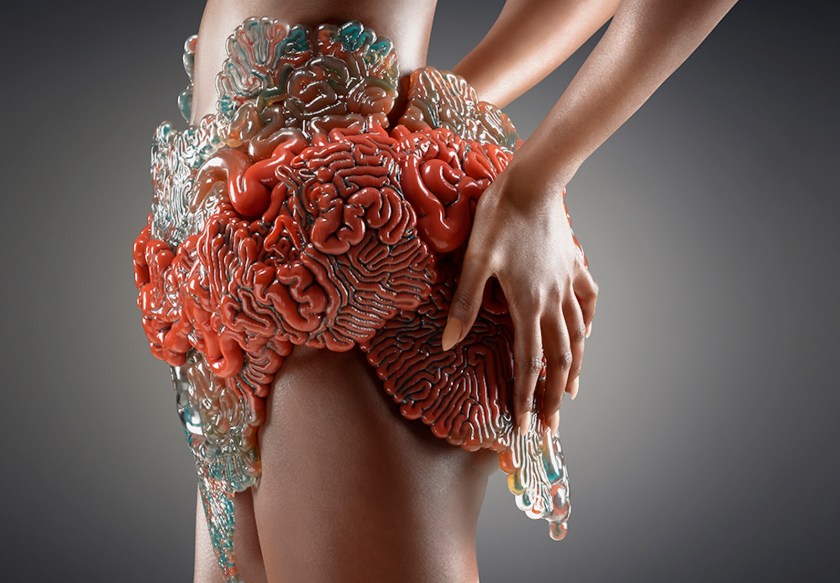
This is the Björkiest thing I have ever seen. Wanderers, a collaborative project to create digitally grown and 3d printed wearables that could embed living matter, looks like a perfect fit for the Icelandic chanteuse, who is famous for her biophilia and wildly adventurous fashion sense.
A team led by Neri Oxman of MIT and Christoph Bader & Dominik Kolb of Deskriptiv is working on a computational growth process which can mimic a wide variety of growing structures. Based on growth patterns found in nature, computer models create shapes that adapt to their environment. Once a design is generated, a 3D printer creates a wearable structure.
Filip Visnjic at Creative Applications Network explains: “Starting with a seed, the process simulates growth by continuously expanding and refining its shape. The wearables are designed to interact with a specific environment characteristic of their destination and generate sufficient quantities of biomass, water, air and light necessary for sustaining life: some photosynthesize converting daylight into energy, others bio-mineralize to strengthen and augment human bone, and some fluoresce to light the way in pitch darkness.”
In the long term, the team hopes to produce 3D printed microfluidic devices through which to pump living matter (such as photosynthetic bacteria) to bring the Wanderers to life. In the short term, they’ve created an amazingly hypnotic video showing how the computer simulates growth patterns (watch it here) and some stunning molded plastic breastplates and even a skirt. The pieces, which look a lot like glistening external brains and intestines, are more attractive than I’m making them sound. And sure, they’re wearable – if you’re Björk.
More photos and information about the Wanderers project are here.
Nature Makes Pretty Things, Not Art

For one moment, I’m going to be that guy who insists on taking a metaphor literally. Artists are not defined by their methods, nor by their ability to make pretty things.
The job of artists is to touch draw us out through sensory experiences in ways that convey understanding, challenge preconceptions, and move us in new, unique, and effective ways. Beauty is but one tool that can serve the artistic purpose.
I cannot define art coherently. I simply know that we need both robotic space probes taking pictures of other planets and creative human beings here on Earth devoted to artistic exploration – and that we conflate the two at our own peril.
The Art of Science: Sculpture with Deep Roots
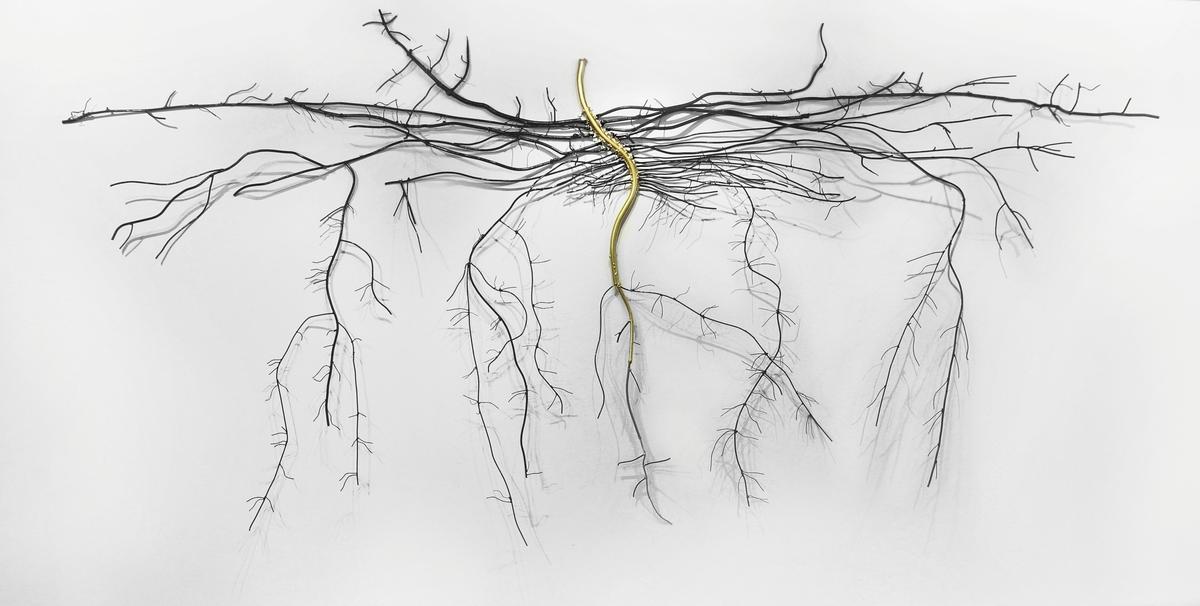
Artist Dalya Luttwak takes hard steel and transforms it into the sinuous shapes of roots. For a recent show at the Greater Reston Art Center in Virginia, Luttwak chose as one of her subjects the root system of Cannabis Sativa. Cannabis, a plant of many uses, which evokes strong and complex responses and touches on so many areas of our culture – industrial, medical, recreational, and criminal – is an irresistible subject for art.
Working in a combination of gilded and blackened steel, the artist “sought the “golden balance” arising from the combination of vertical and horizontal black roots, and existing between the different elements of the Cannabis plant and their nutritious, medical, and psychedelic uses.”
Luttwak, who was born in Israel and now works in the US, says that her work tries to “uncover the hidden beauty of roots, exploring the relationship between what grows above the ground and the invisible parts below of various root systems. My sculptures reveal what nature prefers to conceal. My wish is to uncover and discover roots even when they are hidden, indeed especially when they are hidden.” (source)
Beyond the secrets of plant life, however, this sculpture, and many of Luttwak’s other works, strongly evoke the brain and nervous system. Seeing the roots of the Cannabis Sativa as a metaphor for the paths of chemical stimulation or even of our tangled attitudes to drug-taking, elevate and deepen our response to this deceptively simple art.
You can see more of Dalya Luttwak’s work on her website.
 The Finch and Pea