
How to zoomorphically slur the people in your life

Tired of restricting yourself to the overused ‘bovine’? Chris Love has some great suggestions that will expand the biological diversity of your insults:

ant: formicine: ex. “Overwhelmed by the formicine crowds at the officeplex, we sought refuge in the nearest bar.”

The most important of these adjectives is obviously “hircine.” Of, pertaining to, or resembling a goat. Ex. “The man created a new alternative energy source that reduced conflict in the world, and saved the planet. He also wrote a symphony for the ages. As hircine a fellow as you’ll ever find.”

You owe it to yourself and to those you slur to check out the entire list.
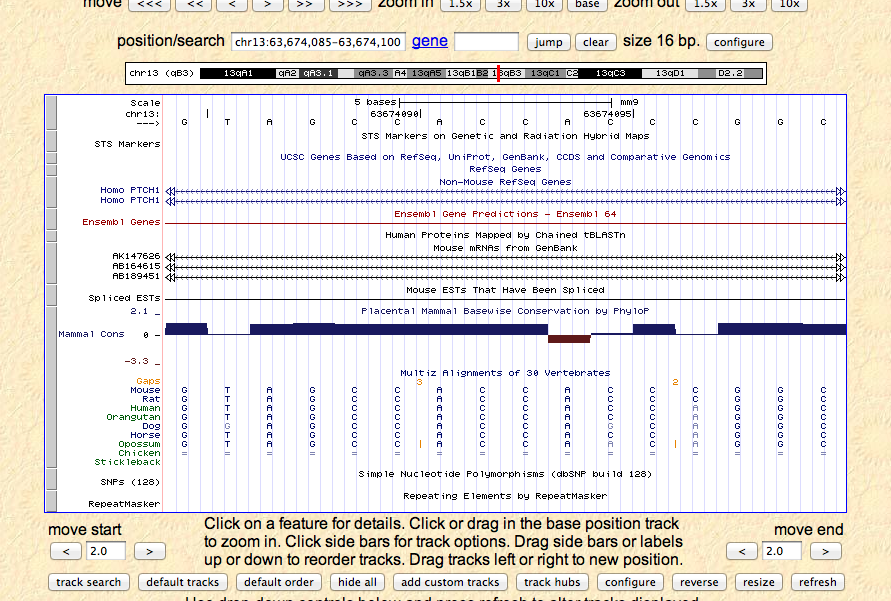
Kids, don’t try this at home

No matter what your mother told you when you were twelve, the most surefire way to promote blindness is in fact to stare at UCSC Genome Browser windows all day.

I really should try to automate more, but sometimes it’s hard to avoid old-fashioned sequence gazing.

Since corporal punishment in class is off limits, we need the NCSE

Social (not scientific…) controversy over science issues sometimes gives students a chance to act up.

Eugenie Scott has a guest post up at Real Climate on why the NCSE has taken up the issue of climate change in the classroom:

Imagine you’re a middle-school science teacher, and you get to the section of the course where you’re to talk about climate change. You mention the “C” words, and two students walk out of the class.

Or you mention global warming and a hand shoots up.

“Mrs. Brown! My dad says global warming is a hoax!”

Or you come to school one morning and the principal wants to see you because a parent of one of your students has accused you of political bias because you taught what scientists agree about: that the Earth is getting warmer, and human actions have had an important role in this warming.

Cormac McCarthy, science editor

Continuing on the theme of scientists and novelists:

From the Guardian:

McCarthy has long enjoyed a close interaction with scientists, keeping an office at the Santa Fe Institute, an independent research centre that also houses a host of scientists, founded by the Nobel prize-winning physicist Murray Gell-Mann. (George Johnson’s biography of Gell-Mann, Strange Beauty, reveals that McCarthy performed a line-edit on the entire manuscript of his The Quark and the Jaguar, “but Gell-Mann was too rushed and disorganised to take advantage of the suggestions”).

Gell-Mann disorganized… that makes me feel better about my own work habits. On the other hand, Gell-Mann is a genius.

Tell me why I’m doing this again?

They don’t tell you this in Bio 101:

Ars Technica, The Tenure Track Not Taken:

Becoming a university professor requires a lot of work for very little financial reward, compared to most other professions. In STEM (science, technology, engineering, math) fields, the minimum requirement is four years of undergraduate education, plus anywhere between four and a half and eight years of graduate studies, followed by an (ever increasing) number of years of post-doctoral work. That may get you an assistant professorship where, at a state university, the starting salary is in the $60k-70k range.

(The only other career path I have seen that has similarly low pay for exorbitant requirements is becoming a chef. In both cases, you only do them because you simply love doing them.)

Continue reading “Tell me why I’m doing this again?”