
Giant’s Causeway

Legend has it that Irish giant Finn MacCool built a causeway across the water from Ireland to Scotland to challenge Scottish giant Benandonner to a duel. Before the duel, Finn tricked Benandonner into thinking he was a much larger giant by pretending to be a baby. Benandonner feared the enormous size of an opponent that would have a baby that big, and quickly retreated to Scotland, demolishing the causeway behind him to keep Finn away. Remnants of this Giant’s Causeway remain along the coast of Northern Ireland.
20005235_8f5a3a4159_b

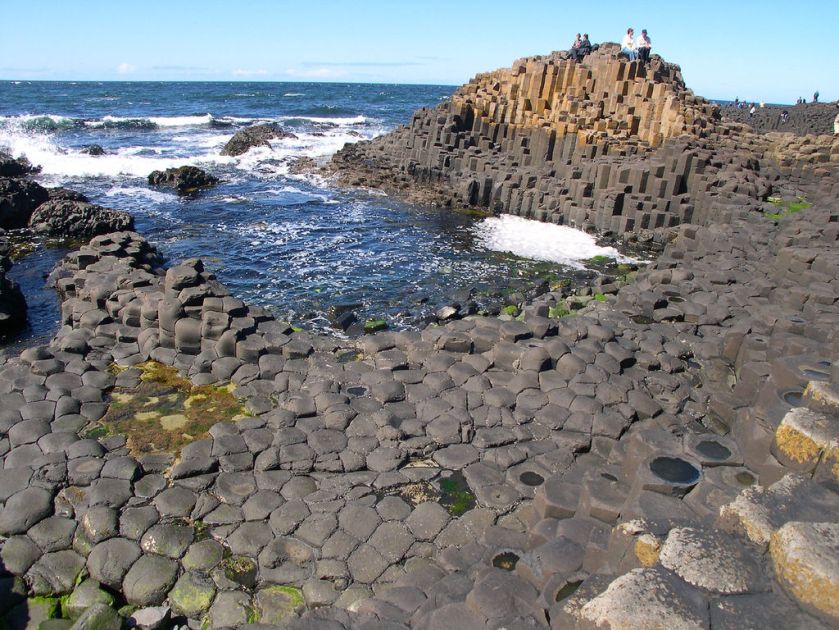
Giants_causeway_closeupOf course the structures that resemble the cobblestone ramp to a causeway are not really built by giants. They’re basalt pillars, most of them hexagonal, created by fast-cooling lava over 50 million years ago, when volcanoes were active in what is now Britain and Ireland.

The basalt pillars of Giant’s Causeway reach high out of the water and really look like they’re part of a purpose-built structure. You can’t really blame people for coming up with giant legends in the absence of other explanations, but even now that we know that the basalt pillars are really remnants of more than 50 million year old volcanic activity, myths are still being propagated. In 2012, when the new Giant’s Causeway visitor centre opened, one of its audio exhibits mentioned that Creationist’s believe that the Causeway was not older than 6000 years. They have since removed the audio, to avoid confusion. Everyone agrees that the story about two giants was merely a fictional explanation of reality, so that myth gets to stay in the exhibit. But really, volcanoes and hexagonal basalt pillars are pretty cool themselves. No myths needed!

Images: Scenic shot by code poet on Flickr. Hexagon close-up in public domain, via Wikimedia.
Gallifrey and HD 106906 b

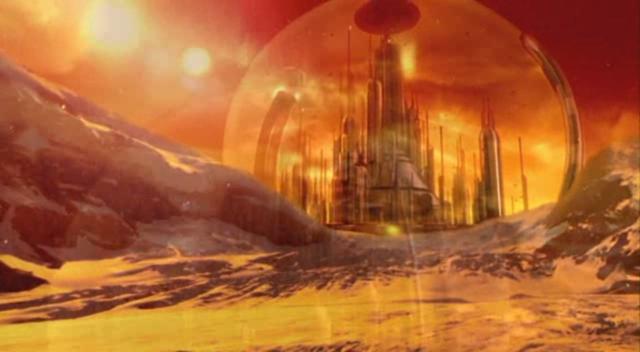
GallifreyThe long-running British sci-fi series Doctor Who is centered around The Doctor, the only remaining member of the Time Lord species from the planet Gallifrey. In a last-ditch effort to save the world, The Doctor has had to destroy Gallifrey in the Time War, so he’ll never be able to go home – or can he?

In more recent episodes of the show, it was revealed that Gallifrey is not lost forever, but that it has been relocated to a different universe, setting the scene for a future plot line involving a return to Gallifrey. Two weeks after the fictional planet Gallifrey was revived in the TV series, astronomers announced the discovery of a new, real-life, distant exoplanet. Continue reading “Gallifrey and HD 106906 b”

Nemo – Amsterdam’s science center

800px-NEMO_(Amsterdam)Finding Nemo isn’t difficult. The science and technology museum has a prominent spot in Amsterdam, over the tunnel underneath the IJ*, the main water in the North of the city. The architect, Renzo Piano, built the structure to be an inversion of the tunnel below, but thanks to the green copper siding the structure also resembles a large cargo ship. In summer, you can sit on the upper deck (ie the roof) of Nemo and get a great view of the city.

Even though I’ve been on the roof/deck, and I’ve been inside once for an award ceremony, I’ve never properly been to Nemo. Not in this shipshape building, anyway. Continue reading “Nemo – Amsterdam’s science center”

Yellowstone National Park – birthplace of Taq

Welcome to Yellowstone National ParkI’ve never been to Yellowstone National Park, but it’s on my list of places I want to visit, not only for the beautiful scenery and spectacular hot springs and geysers, but also because it’s the site of origin of one of the most famous molecules in molecular biology.

Tdb-at-yellowstone-2002bThomas Brock is a retired biologist who started his career in the early 1950s, as a microbiologist. He preferred the outdoors over the lab, so he started looking for opportunities to do more ecological studies, and in 1963 he launched a program focused on the study of  microbes living in geysers and hot springs. These pools were considered to be naturally occurring steady-state ecosystems. Sort of like a controlled lab setting, but outdoors. Brock hoped that organisms the hot water pools would allow him to better understand the physiological limits of photosynthesis, but he soon made a much more interesting discovery. Continue reading “Yellowstone National Park – birthplace of Taq”

A new year of science travel

Happy New Year!

My first year here on The Finch and Pea has been a busy one. You can see all my science travel posts to date (and some posts by others – see further down this post) on the map below. However, as I alluded to last year, I’ve run out of science travel destinations that I’ve been to, so this year is going to be a little different.

First of all, as usual, if you would like to write a science-related travel guest post, get in touch! Ironically, I sometimes don’t have time for my weekly travel post because I travel too much, so any help to cover those weeks is very welcome.

Second, I’m going to be focusing on places I have NOT been, so if you have suggestions, throw them my way. They can be destinations that are themselves of scientific interest but possibly hard to get to (Mariana Trench, the moon), great science or natural history museums that we haven’t yet covered, destinations with an interesting scientific history (VLA, Galapagos), or combinations of the above. As you can see I’ve come up with some myself, but my imagination has limits.

Finally, we’re adding some destinations to the Have Science Will Travel Map: Destinations that may not have been covered on The Finch and Pea, but that appeared on other blogs.

Over the break I added these five posts/locations to the map:

Stuck in Antarctica’s Icy Grasp – One of Alok Jha’s updates from his time on the Akademik Shokalskiy while it was stuck in the ice. Actually, I believe that as of this time, the ship is still stuck, but Alok and others have been rescued by helicopter in the mean time.

Another one from Antarctica, but this one from a staff member at Palmer Station. “May you live in interesting times”.

Monarch Butterflies at the Ellwood Butterfly Grove in Goleta, California. This is a post from travel blog The Intrepid Tourist, and from the same blog I also added Akumal, Mexico, place of the sea turtles.

Last but not least, I added a post from the travel blog that my friend and former lab mate Roberta kept during the year she took a sabbatical from her work as a science teacher to literally travel around the world. One of her stops was Tanzania, where she volunteered with a group of teenagers to make them more aware of local wildlife conservation efforts. In All Good Things Must Come to an End she describes what they did in the programme, and how the kids went to the nature reserve for the very first time to finally see the wildlife they had been studying.

Know of any other science travel posts? Send them our way and we’ll consider them for the map. I’ll do some regular updates after we’ve added a few new ones.