
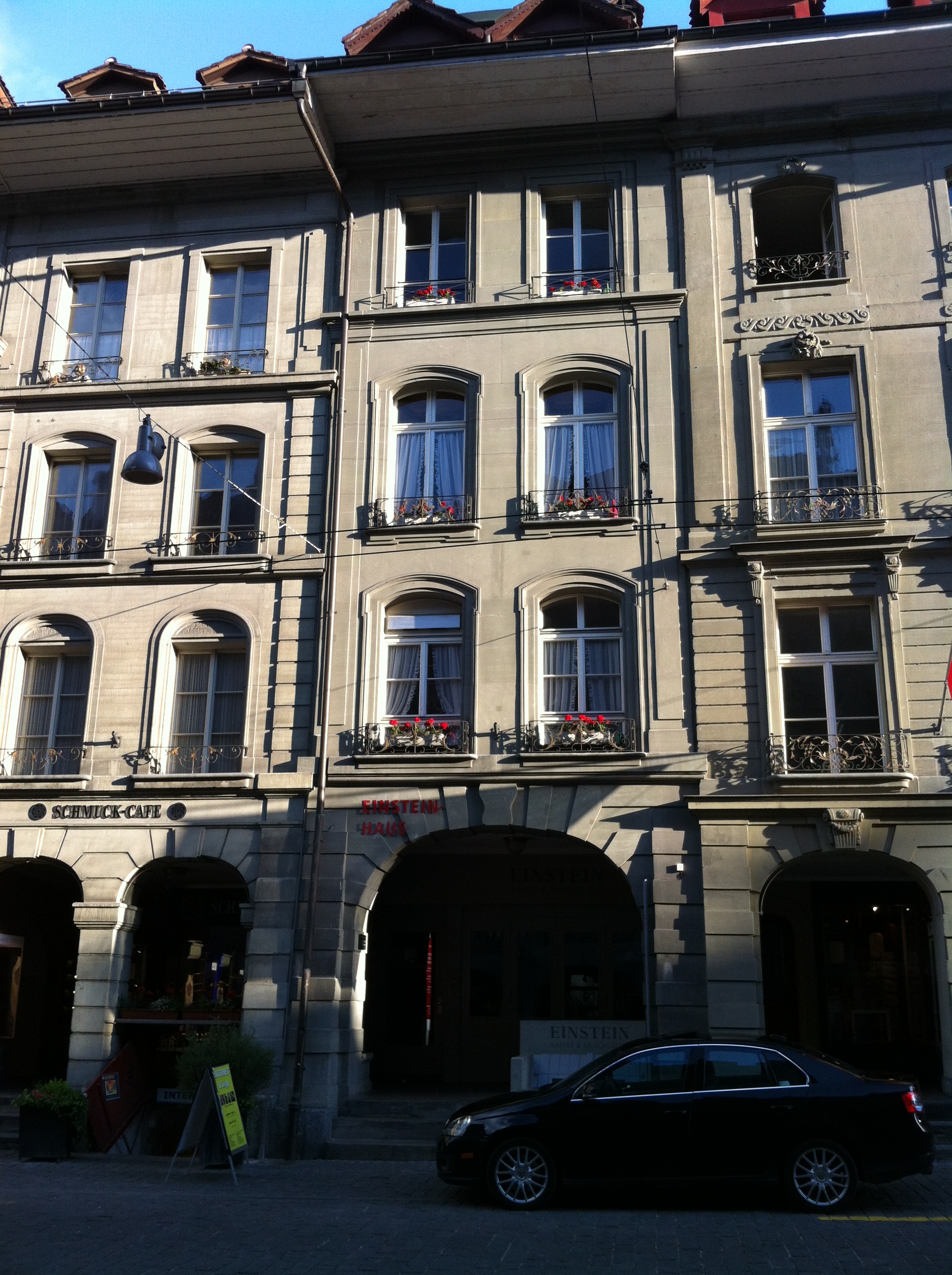
Einstein Haus

2014-05-18 19.32.04I was in Bern for work last week, so I took the opportunity to drop by the Einstein Haus (or Einstein House).

Albert Einstein lived in Bern for several years after graduating from university. He worked at the patent office here, but was simultaneously writing physics papers. The apartment where he lived from 1903 to 1905, right in the center of Bern, is now a  small museum. One floor is the former living area, where you can sit at the dining table and look at family photos on the wall.

2014-05-18 15.25.19

The upstairs apartment has been converted to an exhibit about Einstein’s life. There’s a case with his passport in it, and a famous photo of many well-known physicists at a Solvay convention.

2014-05-18 15.31.41

All along the walls of that floor are panels with information about historical events in Einstein’s life. The first few of them all emphasize how much of a mediocre student he was. He wasn’t terrible, but all through university he seemed to have struggled, which was why he didn’t go straight to academia, but found work in the patent office instead.

One of the last panels was about his life as a musician. I was most interested in that, for my “musisci” project, and on my way out of the museum I bought a small booklet (in German) produced by the museum, all about Einstein and his violin.

The Einstein Haus is a very small and unassuming museum, and from the street you can barely spot it unless you know where you’re going, but well worth a visit if you’re ever in Bern.

Carbon offsets

Airplane

According to a carbon footprint calculator my air travel between 2010 and 2012 produced 58,005 pounds of CO2 per year! I flew for work, vacation, and family visits these years – and several of my science travel reports on this blog were based on locations I visited on these trips.

Several companies allow you to “offset” the CO2 you produced as part of travel of home energy use. But what’s the science behind carbon offsetting?

The idea behind carbon offsetting is that you pay a company to invest in green technology, forestation, or anything else that would reduce CO2 by the same amount you added to the world with your lavish lifestyle. This is the same mechanism used by companies that advertise “carbon neutral” travel or events.

Scientifically, you’re still producing CO2 with your air travel, and it’s still having an effect on our overall climate. There is no guarantee that what you’re investing in carbon offsets will really reduce greenhouse gases by the same amount as you added to the world. It’s really hard to measure exactly how much CO2 is sequestered in offset programmes, and carbon offset companies can’t guarantee that what you paid them for carbon offset credits will eventually reduce CO2 by the amount you intended. It’s also difficult to predict what the long-term effect will be from the current increase, regardless of a future reduction.

The most convincing scientific theory of carbon offsets comes from the field of psychology. What you’re actually doing when you buy carbon offsets for an airplane trip is making yourself feel less guilty about your environmentally unfriendly habits. A recent study shows that people will even increase their greenhouse emitting activity if they know it’s going to be offset by carbon offset credits. [PDF]

I just got back from a trip to Switzerland, and produced another 440 pounds of CO2. For $5.95 I can pay a company to offset it, but I think I’ll hang on to the guilt for a while so that I can think about more direct ways to reduce my own footprint, rather than simply paying someone so that I don’t have to think about it anymore.

 Photo by Francois Roche on Flickr.

Travel round-up: Mysterious nature

I’ve added two new posts from other blogs to the travel map:

What makes a river sing the blues?
by Steve Caplan on Occam’s Corner
Steve visited Rio Celeste in Costa Rica. This bright blue river has confused scientists for years. The blue colour is only visible at the point where two rivers converge, and a study published last year offers an explanation for this interesting phenomenon. See Steve’s post for details.

OLYMPUS DIGITAL CAMERAEvery devil I meet becomes a friend of mine
by Matthew Francis on Galileo’s Pendulum
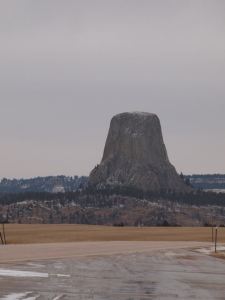
Matthew had a chance to see the Devil’s Tower volcanic formation in Wyoming. The structure was formed underground, but the surrounding soil has eroded over time. Matthew muses: “So, the Devils Tower we see today was born deep underground. To me, it’s a beautiful example of something that looks inexplicable, yet we can understand through science — yet the marvel of seeing it is undiminished by comprehension. Far from losing a sense of wonder, scientific knowledge leads us to greater wonder.”

Finally, this third link was a bit too complicated to add to the map: a Buzzfeed round-up of 22 destinations that “science nerds” need to see before they die. How many have you visited yet? We’ve only covered three of them on the Finch and Pea so far!


Devil’s Tower photo by Matthew Francis.

The meter and the metric system

Outside number 36 of the Rue de Vaurigard in Paris is one of only two remaining meter standards installed in the late 18th century to get the people of Paris used to the new metric system, introduced in 1795.

OLYMPUS DIGITAL CAMERA
Meeting the meter, summer 2003. (Own photo).

The metric system became mandatory in France in 1799, and spread across the world. Until then, people had been using variable units of measure for length, weight and time that made communication difficult. If a tradesman sold you a “foot of fabric”, he basically got to decide how long a foot was to him, or use a local definition which might not correspond to the use of length at his destination market town.

In 1960, the metric system was further formalized as the International System of Units (SI system). That system has a built-in clause that says that they will always use the best available standard to set each unit.

Continue reading “The meter and the metric system”

Chilean National Museum of Natural History

I first heard about the Chilean National Museum of Natural History last year, when they were a finalist for the museum category of the Shorty Awards – basically the Oscars of social media. Although they weren’t able to beat The Brain Scoop in the same category that year, the museum’s social media presence is indeed impressive.

800px-MNHN_Diego_Alarcon
The building is also impressive! (Photo via Wikimedia Commons, by Diego Alarcón.)

Why didn’t I know them if they were so adept at social media? Well, despite thinking of myself as relatively well-travelled and globally aware, I’d really only ever visited European and North American natural history museums. And I thought that was enough. After all, these museums often had exhibits about other countries. I was recently in a replica Japanese supermarket in London’s NHM exhibit about earthquakes. Surely museums can show the work of all countries? Continue reading “Chilean National Museum of Natural History”