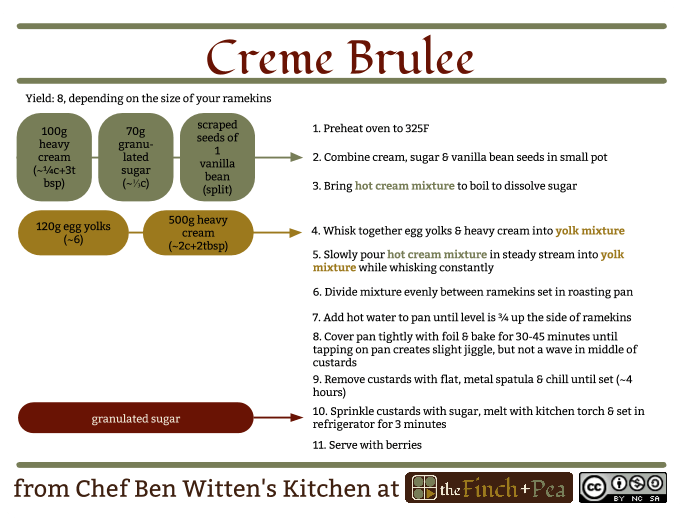
Editor’s Note: Just in time for Valentine’s Day, we are reposting a slightly updated version of Ben’s crème brûlée recipe that was originally posted 31 August 2012. Not only is it delicious, but we have found the eggucation contained within will make all your attempts to cook an egg more successful. The recipe is the same, but we have updated the recipe PDF.
I have promised you sexy food, and the science behind it. Therefore, crème brûlée. Look at all those accent marks! Sexy, right? And, why not start with eggs – queen of ingredients, bringers of life, denizens of diner griddles, the heart of fluffy meringues, and the soul of silky custards. Crème brûlée is sexy because it is simple. Smooth, creamy custard1 contrasts with a thin, crisp layer of smoky caramel. Every flavor and texture is a balance – creamy and crisp, sweet and bitter, light and deep – harmonizing to enhance and elevate the dish.
Don’t worry. Mike is still in charge of post-apocalyptic science fiction reviews.
But, let’s face it. Science doesn’t always pay well. Graduate school doesn’t. Post docs certainly don’t. Adjunct teaching? Don’t make me laugh. Science communication can be more feast than famine.
What I am trying to say is that the odds are good that you are living in a small apartment with a small kitchen and on a small food budget. In which case, good friend of The Finch & Pea‘s executive chef, Joel Gamoran, has got you covered in the first episode of his new cooking web series “Kitchen Wasteland”.
Joel was also kind enough to take some time to explain the science behind his recipe to me.
Me: What is happening when you add the pepper to the pan on it’s own?
Joel: The black pepper undergoes two major reactions happening when toasting in the dry pan. First, essential oils are released when agitated with heat. This is what gives the spice the smell that fills the kitchen. Second, oleoresins are released, which gives the spice a toasty and unique flavor.
Me: What is the water doing to soften the pasta and why can you get away with using so little?
Joel: The water’s boiling temperature of 212F triggers the starch molecules in pasta. The pasta swells. It also releases starch into the water making the cloudy thick substance chefs know and love as starchy water. The starch in the water makes the liquid really viscous and it coats whatever it touches. In the case of a pasta dish, it makes a most thick and concentrated sauce that absolutely shames the conventional method of cooking pasta.
The gift was very appropriate because I regularly ask people this question. It was, I believe, one of the first questions I asked The Wife when she was still The-Really-Interesting-Woman-I-Want-To-Date, and it is a question that I ask everyone that I interview for a job. During one such interview, another manager exclaimed, “That’s a really morbid question.”
For many people, eggplant can be an acquired taste. Not many kids eyes will light up at the idea of eggplant for dinner. I was an exception there, because I was introduced to eggplant via my mom’s fried eggplant. Since eggplant has roughly the same absorption abilities as a kitchen sponge, the fried eggplant had little choice but to taste like deep-fried goodness…so, naturally, I loved it.
Even today, when I eat freshly grilled eggplant with nothing more than a brush of olive oil and some rosemary, I reminisce about my mom’s fried eggplant.






 The Finch and Pea