
At the request of my co-blogger Mike, I’m reposting this article which originally appeared at Science 2.0 on 30 December 2008 where some authors of the paper in question respond in the comments during the run-up to the publication of their book The 10,000 Year Explosion.
Unfortunately for all of us still breathing braniacs, the title only applies to those of us who are also medieval Ashkenazi Jews, according to the authors of the 2006 paper “Natural History of Ashkenazi Intelligence”.
Discussing “race” and intelligence is always a touchy subject and definitely not politically correct; but  science should not be fettered by the chains of political correctness like a mangy circus lion. It must run free across the intellectual savanna, striking down the juvenile wildebeest of ignorance. Following articles on the biology and significance of race by Michael White, Massimo Pigliucci, and moi, my attention was directed to “Natural History of Ashkenazi Intelligence”. Thanks to press attention from biological research bell-weathers like The Economist and the New York Times, as well as discussion on National Public Radio, this paper has gained Goodyear AquatredTM-esque traction on the internet. Continue reading “REPOST: Imagine if Sex Were Only for IQs Over 120”

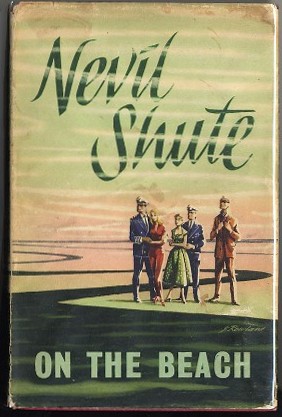 Exactly what nuclear world war would look like was a matter of diverse opinion in the nuclear apocalypse novels of the 1950‘s. Many post-apocalyptic novels of this decade portrayed World War III as an essentially known if more extreme extension of the destructive experience of World War II, much the way that World War II was like World War I jacked up a notch. At worst, large swaths of land would be rendered permanently uninhabitable for decades (The Long Tomorrow), centuries (The Chrysalids), or even millennia (Pebble in the Sky); nevertheless, the destruction of nuclear bombs was fundamentally the same as what came before. Death occurrs on a massive but not extinctive scale, and while there is some danger from fallout, the worst damage is primarily in those areas of direct hits. This was a logical view at the time – after all, the results of the bombing of Hiroshima, at first glance, weren’t much different from the firebombing of Tokyo.
  The Finch and Pea