Voluntary Responsibility and Impostor Syndrome

Look, I know you should be subscribed to the WTF with Marc Maron podcast. You know you should be subscribed to the WTF with Marc Maron podcast. Why aren’t you? Cause you are lazy. That’s why.

But I’m not here to lecture you about your personal failings. I’m here to recommend that you listen to the most recent episode (Episode 283). Why? Two reasons.

First, the show introduction presents a moving story about Marc deciding to take responsibility to see a stray cat through the end of its life. It’s a story of compassion, not “passing the buck”, and putting consideration for another being before one’s own comfort and ease. This is especially recommended for the folks that leave messes in the laboratory common areas around here.

Second, Marc and his guest, young comedian Bo Burnham, have a long talk about impostor syndrome. I knew impostor syndrome was an epidemic among young scientists and writers, but apparently it is also running rampant among comedians. As a seasoned veteran, Marc not only manages to remember the insecurity of youth1 (probably because he never stopped being insecure), but also provides Bo with the insight that there is no “jury” that gets to decide if you are an impostor.

That was a great relief to me, until I realized that science has a whole series of “juries” – thesis committees, journal editors, grant review panels, etc., etc. . .

So, maybe just listen to the introduction.

I now understand why people like Robert Heinlein…

Unfortunately, many classic sci-fi writers are widely famous for works that serve as a poor introduction to their writing. After reading Stranger in a Strange Land, I didn’t get why people found the author of such overbearing verbiage so compelling. Philip Dick’s A Man In the High Castle on a first read was enjoyable, but it didn’t blow me away. C.M. Kornbluth’s Not This August seemed like a generic work of 50’s Cold War angst.

Eventually I figured out what’s so great about Philip Dick and Cyril Kornbluth, and now I’ve had my Heinlein epiphany. Continue reading “I now understand why people like Robert Heinlein…”

Sunday Poem

Not much science in this week’s Sunday poem, but since Monday is the U.S. Memorial Day, and since Walt Whitman’s birthday is May 31st, I think an appropriate selection is the following passage, one of the most sublime sentences in all American poetry, from Walt Whitman’s memorial poem, “When Lilac’s Last in the Dooryard Bloom’d.” Memorial Day began as Decoration Day, originally designated to honor the U.S. Civil War Dead. In this passage, Whitman breaks a sprig of lilac as a memorial offer to the assassinated Abraham Lincoln and all of those fallen in the Civil War.

In the door-yard fronting an old farm-house, near the white-wash’d palings,
Stands the lilac bush, tall-growing, with heart-shaped leaves of rich green,
With many a pointed blossom, rising, delicate, with the perfume strong I love,
With every leaf a miracle – and from this bush in the door-yard,
With delicate-color’d blossoms, and heart-shaped leaves of rich green,
A sprig, with its flower, I break.

If you’re not familiar with this great poem, go read the entire thing here. And if you are familiar with the poem, go read it again.

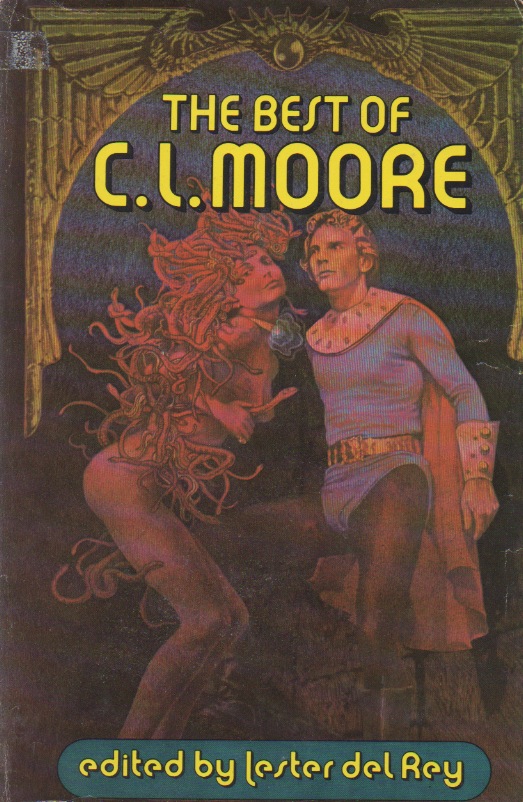
The Sensual Science Fiction of C.L. Moore

My luckiest find at my local library’s discarded book sale bears one of the most embarrassing science fiction covers I’ve ever seen – a remarkably high bar to reach. This cover features a blond hero in a failed Halloween costume that includes tights, cape, and blue leotard, staring past a naked medusa who is attempting, without much success, to strike an erotic pose while fondling a very phallic snake. For a mere quarter, I picked up this ridiculous piece of art, but along with it I scored some of the very finest stories ever to come out of the Golden Age pulp magazines of the 1930’s and 40’s: The Best of C.L. Moore. In a genre featuring techno-fantasies of omnipotent super-scientists rationally masterminding the world, to the delight of fawning female props, Catherine L. Moore managed to thrill fans with sensuous, complex, character-focused stories about desire, love, and women. The Best of C.L. Moore features ten stories that are essential reading for any fan of Golden Age science fiction. Continue reading “The Sensual Science Fiction of C.L. Moore”

Do you want to see the research you pay for?

Then you should sign a petition to encourage the White House to require all tax payer funded research publications to be freely available online.

WE PETITION THE OBAMA ADMINISTRATION TO:

Require free access over the Internet to scientific journal articles arising from taxpayer-funded research.

We believe in the power of the Internet to foster innovation, research, and education. Requiring the published results of taxpayer-funded research to be posted on the Internet in human and machine readable form would provide access to patients and caregivers, students and their teachers, researchers, entrepreneurs, and other taxpayers who paid for the research. Expanding access would speed the research process and increase the return on our investment in scientific research.

The highly successful Public Access Policy of the National Institutes of Health proves that this can be done without disrupting the research process, and we urge President Obama to act now to implement open access policies for all federal agencies that fund scientific research.

* via access2research