
Sunday Science Poem – Nature’s Law

Inspired by this morning’s brunch of toad in the hole and baby bridies at St. Louis’ great Scotch bar, I’ve chosen Robert Burns’ “Nature’s Law” (1786) as this Sunday’s poem. The poem is about reproduction, and instead of God’s command to multiply and replenish the Earth, the drive to reproduce is here presented as Nature’s Law. Assigning the attributes of God to Nature (with a capital N, naturally) became a common tactic of the Romantics, who avoided traditional symbols of piety, as well as the hyper-rational Deism of Age of Enlightenment.

Recognizing “nature’s law” of reproduction is the first step towards Malthusian logic, the second step being the recognition of the consequences of unbridled reproduction. Malthus published his groundbreaking An essay on the principle of population twelve years after this poem, and of course Malthus’ writing was a direct influence on Darwin and his discovery of natural selection.

“Great Nature spoke: observant man obey’d” – Pope

Let other heroes boast their scars,
The marks of sturt and strife:
And other poets sing of wars,
The plagues of human life:

Shame fa’ the fun, wi’ sword and gun
To slap mankind like lumber!
I sing his name, and nobler fame,
Wha multiplies our number.

Great Nature spoke, with air benign,
“Go on, ye human race;
This lower world I you resign;
Be fruitful and increase.
The liquid fire of strong desire
I’ve pour’d it in each bosom;
Here, on this had, does Mankind stand,
And there is Beauty’s blossom.” Continue reading “Sunday Science Poem – Nature’s Law”
Manipulating variables in “Little Bunny Foo Foo”


Don’t worry, “Little Bunny Foo Foo” is not the Song of the Week. Like many children’s songs, it goes through a set number of repetitions1 based on the dubious theory that repetition both appeals to kids AND is good for them.

My daughter, The Frogger, has discovered that, while the number of repetitions (N) has a traditional value (N=3), it is a manipulable variable which can be set at multiple values with effects on the enjoyment of the singers. Continue reading “Manipulating variables in “Little Bunny Foo Foo””

Economics does shape science

Some final observations from Paula Stephan’s provocative book, How Economics Shapes Science (Harvard University Press, 2012):

1) The current incentive structure is creating an inefficient system. The job market for biomedical PhDs has been generally poor for some time now, and it has been getting worse. From the perspective of Deans and established investigators, the system is working beautifully because established scientists are highly productive. But from an economic perspective (and from the perspective of newly trained PhDs), this is a highly inefficient system that relies on cheap, temporary, highly skilled workers with future job prospects that are unlikely to repay the opportunity costs of PhD and postdoc training.

The university research system has a tendency to produce more scientists end engineers than can possibly find jobs as independent researchers. In most fields, the the percentage of recently trained PhDs holding faculty positions is half or less than what it was thirty-three years ago; the percentage holding postdoc positions and non-tenure-track positions (including staff scientists) has more than doubled. In the biological sciences it has more than tripled. Industry has been slow to absorb the excess. A growing percentage of new PhDs find themselves unemployed, out of the labor force, or working part time.

Continue reading “Economics does shape science”

Career outcome numbers in biomedical sciences

Again from Paula Stephan’s How Economics Shapes Science, p. 179-180:

The evidence that problems exist is perhaps even more striking when one studies the over 400 National Institute of General Medical Sciences NIH Kirschstein National Research Service Awards (NRSA) fellows awarded during 1992-1994. Kirschtein fellows are supposedly the very best, selected for their research promise. This particular group of Kirschstein fellows also had the good fortune of launching their careers when the NIH budget was doubling.

What happened to their careers? By 2010, slightly more than a quarter of the former Kirschstein fellows had tenure at a university; 30 percent were working in industry. What about the others? A handful (about 6 percent) were working at a college; 4 percent were research group leaders at institutes. Another 20 percent were working as a researcher in someone else’s lab and a startling 14 percent could either not be located after extensive Google searches or had not published a paper since 1999. This was not exactly what one would expect from “the best” who came of professional age during the doubling of the NIH budget. If times were tough for them, times will be much tougher for those who have graduated since or will graduate in the near future.

That’s remarkable – there are more former fellows who are working as staff scientists in someone else’s lab or who seem to have left science (34% total) than have taken tenure track jobs (~25%), or than have taken jobs in industry (~30%).

Keep in mind that today, a Kirschstein fellowship or some other private fellowship is absolutely a minimum requirement for a faculty position these days.

Aging of the scientific workforce

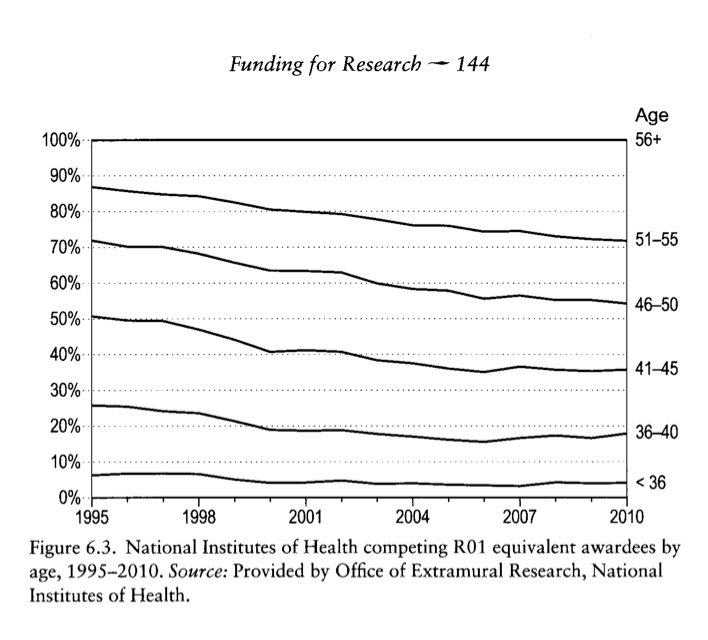
Another snippet from from Paula Stephan’s How Economics Shapes Science (Harvard University Press, 2012). Everyone interested in a science career should read this book.

This figure shows how younger scientists have been squeezed out of funding, while the over 55 group has grown: