Missouri may have opened a creationist Pandora’s Box

Missourians have voted overwhelmingly for a ‘right-to-pray’ constitutional amendment that creationists may use to let students opt-out of certain topics in science class. When I voted on Tuesday in my St. Louis suburb (against this amendment, of course), the ballot described the proposed amendment with a single, innocuous sentence that basically nobody could disagree with (except maybe Richard Dawkins or Jerry Coyne). No wonder the thing passed with 83% in favor – you can make anything sound good if you’re not constrained by honesty, which, when it comes to prayer, one would think ought to be a constraint.

From the St. Louis Post-Dispatch:

In the months leading up to the vote, Amendment 2 prompted unsuccessful lawsuits over its ballot wording, which its critics argued oversimplified the issue to the point of deceit. Continue reading “Missouri may have opened a creationist Pandora’s Box”

Eulogy for Jonah Lehrer’s career

There isn’t much left to be said about the unraveling of Jonah Lehrer‘s career (though I suspect he’ll be back).

For a long time, I’d advised family members to take the information from Lehrer’s writing and TV appearances with some serious salt, which would give you the impression that all new discoveries in neuroscience fit neatly into the way Lehrer had been telling you it all worked. Media personalities have the luxury of making the research fit the world view that has made them popular. Quality researchers with true expertise and experience do not.

Lehrer broke the rules of both journalism and science, but was only punished when he was caught breaking the rules of journalism.

I was never a Lehrer fan, but we can’t pretend this is an isolated action by a “bad apple”. Like many science fraudsters, fraudulent journalists are responding to the perverse incentives provided by their field. Good science reporting often takes time and a moderate tone. We reward speed and attention grabbing prose. It makes you wonder if the decision makers either don’t know or don’t care when the journalists break the rules of science.

Skycranes >> Ospreys

I had a nightmare last night. A very nerdy nightmare*.

During the space shuttle’s ascent in to low earth orbit, I was dropped out of the space shuttle’s cargo bay strapped to an osprey. Somehow, both the osprey and I survived our descent. I know what you are thinking. The poor osprey’s wings should have snapped into pieces the moment it tried to provide lift for the two of us. This, my friends, was a key point in my complaint to the NASA authorities. I also suspected that my publicly stated preference for unmanned space exploration was a factor in the decision to drop me into the upper atmosphere. I have no idea what the osprey did to piss NASA off. Continue reading “Skycranes >> Ospreys”

This is terrible career advice:

From Stewart Firestein’s Ignorance: How It Drives Science:

The poet John Keats hit upon an ideal state of mind for the literary psyche that he called Negative Capability – “that is when a man is capable of being in uncertainties, Mysteries, doubts without an irritable reaching after fact and reason”…Scientists do reach after fact and reason, but it is when they are most uncertain that the reaching is most imaginative. Erwin Schrödinger, one of the great philosopher-scientists, says, “In an honest search for knowledge you quite often have to abide by ignorance for an indefinite period”… Being a scientist requires having faith in uncertainty, finding pleasure in mystery, and learning to cultivate doubt. There is no surer way to screw up an experiment than to be certain of its outcome.

Continue reading “This is terrible career advice:”

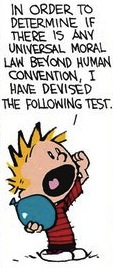
What is wrong with this hypothesis?

Is there anything wrong* with Calvin’s hypothesis and/or experimental design (click-through for full protocol)?

*The answer “Thou shall not tempt the Lord your God” will not be accepted. Really, what is the point of omnipotence if you can’t be tempted**. BOOOORRRRING.

**Can God make something so tempting that God is tempted?