Sunday Science Poem: Why You Should Read Lucretius

We’re bringing the Sunday Poem out of hiatus and will hopefully, with some publisher cooperation, feature some remarkable poetry by contemporary poets who work with science metaphors.

However, before we return to present day poetry, let’s go back two thousand years and tackle the greatest of all science poems: Lucretius’ The Nature of Things.

Why should you read Lucretius? His poem is one of the great works of classical Latin poetry, one which influenced many subsequent Roman poets, notably Virgil. It has the added benefit of laying out Lucretius’ remarkable thinking about the invisible workings of nature. Reading this poem, you inhabit the ancient mind of a sharp observer who was trying to make sense of the macroscopic world by theorizing about motions of the microscopic one.

Lucretius was conscious of the requirements of good science writing. He was explicitly an advocate of the Mary Poppins method of helping the medicine go down with a spoon full of sugar. Lucretius packed his poem with illuminating metaphors and, like Darwin, was capable of making striking observations of everyday phenomena that most of us would take for granted. He used these observations to make inferences about the world we can’t see. As an advocate of the teachings of Epicurus, Lurcetius connects his observations and inferences to crucial ideas about how we should live our lives and think about ourselves.

The Classical scholar Richard Jenkyns makes this argument for reading Lucretius:

Of all the great poems of Europe – and it is indeed among the greatest – Lucretius’ De Rerum Natura (The Nature of Things) is perhaps the most improbable. Here is a poem without people in it, without any story; instead it offers a treatise on science and philosophy. The philosophy, moreover, is a strict materialism, which denies the existence of anything magical, mysterious, or transcendent. It does not sound like promising matter for poetry at all, let alone for a work of more than 7,000 line. Yet the result is a masterpiece. A key to appreciating this most unlikely success is to understand the nature of Lucretius’ beliefs and the circumstances in which he decided to expound them.

– Introduction to the 2007 Penguin edition, vii

Continue reading “Sunday Science Poem: Why You Should Read Lucretius”

Wash your hands

As a parent, you get used to having no privacy. The other day I was interrupted in the bathroom* by my child coming in to wash her hands:

Me: “Hey, Frogger, what are you doing?”

The Frogger: “I was helping Mommy make dinner and I touched the raw meat. So, now, I have to wash my hands so my tummy won’t hurt.”

Me: “Good job. Got to avoid that dysentery.”

Huzzah for food safety, especially considering that her professed life goal is to become a chef, like Uncle Ben. I wish* I could say that she had learned about the importance of hand washing from her favorite cooking shows on the Food Network (whatever the current iteration of Ina Garten and Giada de Laurentis are). Continue reading “Wash your hands”

Don’t stop believing, until you see it

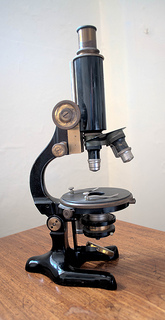
microscopeIf you can’t see something, how do you know it is there? In my research, I rely on my ability to take pictures of neurons making connections with each other and other types of cells. What I know to be the truth about these connections, is based on only what I can see through the microscope. I was reminded just how little we can actually “see” by a recent paper in the journal Science.

This new paper used newer imaging technology called STORM (STochastic Optical Reconstruction Microscopy), which enhances imaging by only exciting and imaging a few individual fluorescent molecules at a time. This prevents groups of fluorescent molecules from distorting fine detail by forming a large bright fuzzy cloud. The Harvard scientists saw that a structural protein, Actin, actually forms rings around the axons of neurons.(!) Up until now, the organization of actin in the axons and dendrites has been a mystery. Continue reading “Don’t stop believing, until you see it”

The Infuriating and Essential Science Fiction of A.E. Van Vogt

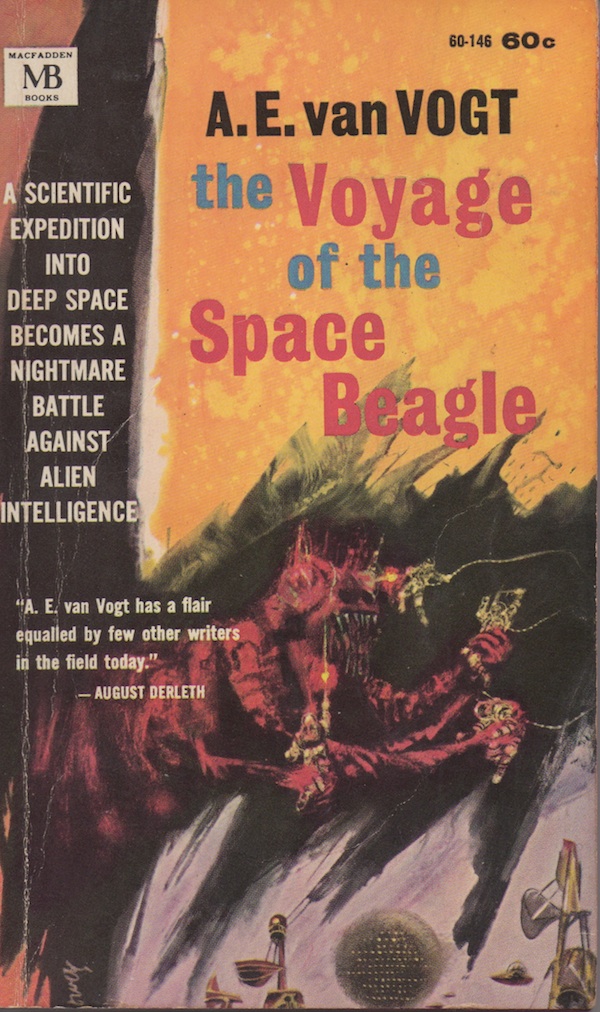
vanvogtvoyagespacebeagleIf you like the pulp science fiction of the Campbellian Golden Age from the late 1930’s to the early 1950’s, you’re bound to run across A.E. van Vogt’s name on nearly every must-read list. (Incidentally, not everyone, including me, considers this era to be the real Golden Age of science fiction). For fans of vintage science fiction, van Vogt is essential because his works were crucial in the canalization of many of the core ideas that we now consider essential to science fiction. At the same time, van Vogt is infuriating because his writing is annoyingly juvenile, even when compared against the other writers who shared pages in the same magazines aimed at juveniles.

When you read van Vogt today, it’s hard not to wonder what people saw in this guy when they ranked his works as some of the greatest ever in science fiction. Continue reading “The Infuriating and Essential Science Fiction of A.E. Van Vogt”

Apocalypse 1950: Science will save us from science

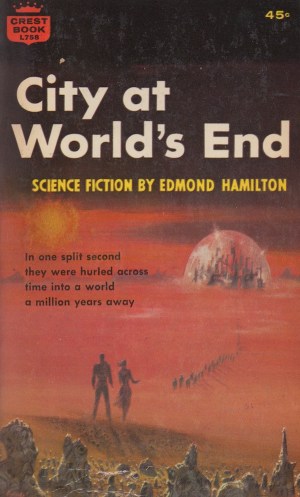
Edmond Hamilton’s City at World’s End (1950)

hamiltoncityatworldsendOn March 1st, 1954, on the Bikini atoll of the Marshall Islands, U.S. scientists detonated a thermonuclear hydrogen bomb called Castle Bravo. The expected yield of Bravo was five megatons TNT, but the scientists had missed a crucial fusion reaction that took place in this particular bomb design. As one scientist described it to the historian Richard Rhodes, “They really didn’t know that with lithium7 there was an n, 2n reaction [i.e., one neutron entering a lithium nucleus knocked two neutrons out]. They missed it entirely.” The actual yield of Bravo was three times the expected yield, measuring in at fifteen megatons. The blast blew a 6,500 ft diameter hole through the coral and trapped people in observation bunkers that were supposed to be situated far from the blast zone. Japanese fishermen aboard the vessel Lucky Dragon were exposed to high levels of radioactive fallout, leading to the death of one member of the crew and sparking an international incident between the US and the country that less than nine years before had been the world’s first nation to be attacked with nuclear weapons.

Recent popular fears that physicists would destroy the world through miniature black holes created in the Large Hadron Collider are just the latest manifestation of the difficulty people have long had in deciding whether to view scientists as the sorcerer or the apprentice. Continue reading “Apocalypse 1950: Science will save us from science”