We are all heretics

heresy (her-i-se); n; An opinion or a doctrine at variance with established religious beliefs… – Free Online Dictionary

A Pew survey in the UK indicates that there is far greater diversity within religions (and the non-religious) and far greater similarity between religions (and the non-religious) than is commonly portrayed in public discussions. Take a look at the highly contentious issue of abortion limits (an issue on which religious opinion is often portrayed as monolithic):

Even the religions that are somewhat distinct are biased toward “Don’t Know” rather than an extreme position on the issue.

It is notable that the opinions of the religious folks in this survey are diverse despite the official teachings of some of these religions explicitly endorsing a “correct” answer. The members of the religion may fiercely defend their faith, but they also can feel rather free to disagree with their leadership, whether they are technically “allowed to” or not.

This is not a new revelation to anyone who has spent a substantial amount of time interacting with the actual members of many different religious denominations and creeds.

It is time we realize that the “spokespeople” for religions (and atheism) are about as representative of the people in their religion as Senator Lindsey Graham (R-SC) is for some of us in the Palmetto State.

Kenan Malik has a lot more about this survey over at his blog Pandaemonium.

*Hat tip to that Ed Yong.

Sunday Science Poem: The Future Will Be Like Disney World

IBM Pavilion New York World's Fair 1964-65May Swenson’s ‘The People Wall’ (1967)

In 1965, if you wanted to see what the future was going to look like, you could go to the New York World’s Fair. Under the giant green Moon Dome of the Transportation & Travel Pavilion, you could see the future of space travel; at the DuPont exhibit, you could see futuristic fabrics featured in a musical comedy about chemistry; at the Hall of Science, kids could play radioactive waste disposal in Atomsville, USA; and at the General Motors Futurama II exhibit, you could watch vacationers lounging in underwater cities, and see how in the future trees will be felled with laser beams.

One of the more spectacular exhibits was IBM’s People Wall, a giant grandstand that lifted the visitors into a spectacular “gunite-spayed steel egg, about the size of a Navy blimp,” where they would be bombarded with futuristic images on 14 different screens in what was supposed to be a visual display of state-of-the-art computer data processing. (I have no idea what gunite is, but it sounds futuristic.) Continue reading “Sunday Science Poem: The Future Will Be Like Disney World”

Sunday Science Poem: Outward Exploration and Our Inner Passage to India

Walt Whitman’s “Passage to India” (1871)

ColombusMapWhat does our drive to explore and discover tell us about our inner landscape?

Walt Whitman’s poem “Passage to India” takes as its launching point three astoundingly ambitious projects to connect the world in the mid-19th Century: the transatlantic telegraph cable, the Suez Canal, and the U.S. transcontinental railroad. These are “the great achievements of the present,” but to understand their full meaning, Whitman tells us we need to turn to the past – to the dreams and aspirations of earlier explorers and visionaries, who launched us into the present, and whose restlessness tells us about our own psychic composition.

The past shows us that humans have always been dissatisfied with boundaries, “Wandering, yearning, curious, with restless explorations,/ With questionings, baffled, formless, feverish, with never-happy hearts”: prehistoric humans expanding out of Africa into Asia and Europe; following mammoths over the frozen Siberian tundra; trekking across to what is now Alaska and down the entire Western Hemisphere; sailing to remote Pacific Islands in what to us seem like insanely inadequate vessels that are are little more than rafts. Are these external explorations a manifestation of our struggles with some unexplored internal landscape?

Continue reading “Sunday Science Poem: Outward Exploration and Our Inner Passage to India”

Scientists against the “War on Drugs”

drugsEveryone has heard about the “War on Drugs”. Most Americans of my generation have sat through D.A.R.E (Drug Abuse Resistance Education) classes in middle school learning how to “just say no”. In addition to their intended effects on rates of drug addiction and, perhaps, unintended effects on the size of the prison population, the laws regulating psychoactive drugs are having a less well-recognized effect.
In a special section of Nature Reviews Neuroscience (Neuroscience and the law-Science and Society) there is an interesting editorial about how Schedule I drug laws are stifling neuroscience research and the development of new treatments. I’ll be honest, my first thought was, “Are these guys just old hippies or do they have a good point?”. David Nutt, Leslie King, and David Nichols may be old hippies, but they also have a point. Continue reading “Scientists against the “War on Drugs””

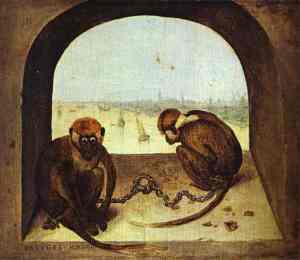
Sunday Science Poem: The Two Apes of Brueghel

pieter-bruegel-the-elder-two-chained-monkeys-1I’ve discussed this poem before, but you may have missed it, in which case it will be, as NBC says, new to you. The Sunday Poem will be back next week with completely new material.

This is one of my favorite poems by the Polish Nobel laureate Wisława Szymborska (1923-2011). All I have to say about this poem is that a monkey rattling a chain is never a good thing, especially at a thesis committee update.

The Two Apes of Brueghel (1957), 

So appears my big graduation exam dream:
In a window sit two monkeys fixed by chains,
Beyond the window the sky flies
And the sea splashes.

The subject is the history of mankind.
I stammer and flail.

One monkey, gazing at me, ironically listens,
The second seems to doze -
But when after a question comes silence,
It prompts me
By softly clinking the chain.

Translation from the Polish by yours truly.
Image: Pieter Bruegel’s “Two Chained Monkeys” (1525)