
H.G. Wells’ The Time Machine (1895)
 With H.G. Wells, science fiction left behind the 19th century and fully entered the 20th. During the new wave of future fiction published in the late 1800’s, writers came up with many of plot lines, settings, and themes that characterize modern science fiction, but it wasn’t until H.G. Wells wrote his rock solid classic, The Time Machine, that SF actually became modern. Chronologically, it’s the first book of science fiction that, to me at least, doesn’t feel obsolete.
Why? The Time Machine, after all, has scenes inspired by 19th century culture: seances in late Victorian drawing rooms and class anxieties of turn-of-the-century Britain. Wells’ radical innovation was to do away with restrictions of scientific plausibility — which ironically let him tackle the intersection of science and human society with more depth than any writer before. Jules Verne, whose classics now feel very dated, wasn’t happy with Wells’ technique:
I make use of physics. He fabricates. I go the moon in a cannon-ball discharged from a gun. There is no fabrication here. He goes to Mars [sic] in an airship [sic], which he constructs of a metal that does away with the law of gravitation. That’s all very fine, but show me this metal. Let him produce it.
– quoted in New Maps of Hell, Kingsley Amis, p. 32
In other words, as Kingsley Amis put it, Wells “liberated the medium from dependence on extrapolation and in so doing initiated some of its basic categories.” Extrapolation is obviously still an important element of the genre today, but Wells showed how to do it without chaining one’s imagination to the boundaries of the science of the day. By giving the imagination freer rein in science fiction – by fabricating freely – Wells could better explore the human implications of science. Continue reading “End of the World 1895: Social Darwinism is Self-Defeating”

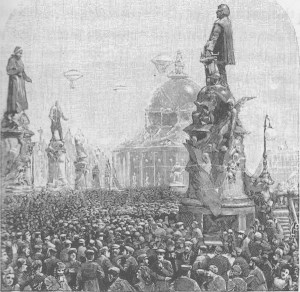 Whether fiction written early in the 19th century qualifies as genuine science fiction is debatable, but when it comes to the futuristic fiction of the end of the century, there can be no doubt. The nascent genre was quickly becoming popular, and in the two decades before World War I, science fiction became truly engaged with science — particularly the radical scientific discoveries that transformed communication, war, public health, and especially, our place in the cosmos.
 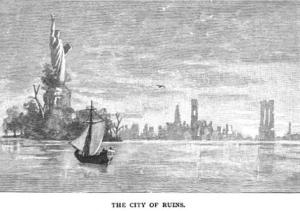 Images of a
  The Finch and Pea