
Louis Pope Gratacap’s The Evacuation of England (1908)

One of the pleasures of reading older post-apocalyptic fiction is seeing how the major themes and plot ideas of today’s genre were first introduced more than one hundred years ago. But just because writers came up with these great ideas doesn’t mean that their books are any good. Many of them are; however the American writer Louis Gratacap’s pioneering post-apocalyptic novel wins the prize as the most turgid and unreadable novel I’ve ever read. In fact, I’ll admit it: I didn’t actually read the whole book; my reading quickly changed into a slow skim. Over at the Encyclopedia of Science Fiction, John Clute has the same opinion:
Gratacap’s range was wide, incorporating much material which has become central to sf, but his books are overlong, choked by his compulsive didacticism, and nearly unreadable today.
So why bother with The Evacuation of England? Because Gratacap came up with a major innovation that is absolutely central to post-apocalyptic SF today. To my knowledge (please correct me if I’m wrong), Evacuation is the first novel in which civilization is destroyed by a natural disaster caused by human beings. It’s the world’s first anthropogenic climate change novel. Continue reading “Apocalypse 1908: The First Anthropogenic Climate Change Novel”
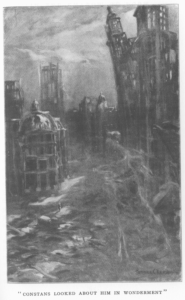 The Doomsman opens in what seems to be the primitive past: A young man sits on the shore of a bay, dressed in a tunic. In the forest behind him are the heavy wooden walls of a stockade, a clue to the defensive nature of life in this sparsely inhabited country. But not everything fits. The young man is looking across the bay at a vague, dark outline of some tall structure, while in his hands he holds a book: A Child’s History of the United States. He is sitting on the shores of New York, looking out at what’s left of Manhattan.
 Post-apocalyptic worlds are always haunted. The empty ruins of great cities, the artifacts of lost technologies, the mouldering books, and the memories of the vanished civilization make it clear that the survivors are now living in the world of the dead. In George Long’s Valhalla, the haunting is literal: the world is now one great hall of the dead, with a billion spirits ready to lend their ghostly hands to help the survivors build a better future. While it’s stiffly written and poorly plotted, this short book is nevertheless an interesting artifact from that optimistic time before the First World War. As he describes a new civilization rebuilt under the guidance of the dead from the last one, Long suggests that the root of human dysfunction is simple: jealousy of love and power. Without jealousy, there would be no serious conflict and people will get along just fine.
 The Finch and Pea