Garrett P. Serviss’ The Second Deluge (1912)
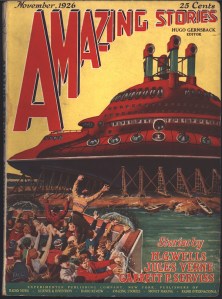 1912 was a good year for science fiction — according to some, it was the best year. Certainly for pulp science fiction, it was a landmark year. Although the first dedicated pulp SF magazine, Amazing Stories, wouldn’t appear for more than a decade, two of the foundational texts of pulp SF were published in 1912: Edgar Rice Burroughs’ A Princess of Mars, which began as the serial “Under the Moons of Mars” in February, and Hugo Gernsback’s Ralph 124C 41+, whose last installment was published in March.
Another contributor to this early pulp ferment, less memorable than Burroughs or Gernsback, was the American journalist Garrett Serviss. Serviss was a popular science writer who had also written an 1898 sequel to Wells’ War of the Worlds, featuring an invasion of Mars led by none other than Thomas Alva Edison. The Second Deluge, serialized in 1911-12, is a pulpy, early instance of a classic storyline that crops up over and over again post-apocalyptic fiction: Noah’s Ark. Continue reading “Apocalypse 1912: Salvation Through Faith in Science”

 This week, Science for the People is learning how private enterprise has jumped in to fill the gap left by shrinking government budgets for space exploration. They’re joined by journalist Elmo Keep, to talk about her article on Mars One, a nonprofit planning to make a reality show out of a one-way trip to colonize the red planet. And they’ll get an update on the state of the for-profit space industry with Space News Senior Editor Jeff Foust.
 Back in 1805, the French priest de Grainville
  The Finch and Pea