
How DNA is like a Magnet

Now that we have piles and piles of widely available genome sequence, one of our main tasks as biologists is to figure out how to read what’s in there. Protein-coding sequences have long been relatively easy to read, ever since the genetic code was worked out. Non-coding regulatory sequences – enhancers and promoters – are much more difficult to interpret, obviously. Usually our first task is to identify the individual binding sites for gene-regulating proteins in these sequences. But then what? Well, most people stop there, happy to have identified the necessary parts of the gene regulating machinery, but many of us are interested in learning the underlying logic by which this machinery operates – we want to learn the grammar of regulatory DNA. The question is, how does a particular combination of regulatory binding sites give rise to a particular pattern of gene expression? In my biased opinion, this the real secret of life – how your cells read information in your DNA in order to turn on the right genes at the right place in the right time.

So, how do we read non-coding, regulatory DNA? One way that has proven very useful is take an approach from the 1920’s that was developed to understand the physics of magnets. No, I’m not talking about the pseudoscience of biomagents; I’m talking about Ising models. Continue reading “How DNA is like a Magnet”
Scientific Award FAIL

Larry Moran reports that John Mattick, author of the infamous dog-ass plot, has won some genomics-related award that I have never heard of.

Moran has the sorry details:

I’m pretty sure that there’s no more than a handful of biochemists/molecular biologists who believe Mattick. They know that lots of noncoding DNA has a function—a fact that’s been in the textbooks for almost fifty years—but they do not believe that most of our genome encodes functional regulatory RNAs. It’s simply untrue that Mattick has proved his hypothesis over the past 18 years. Just the opposite has happened.

He quotes the press release:

The Award Reviewing Committee commented that Professor Mattick’s “work on long non-coding RNA has dramatically changed our concept of 95% of our genome”

Uh, no. Not true. Continue reading “Scientific Award FAIL”

Is science powerless to confront the supernatural?

Larry Moran praises a recent philosophical paper knocking the idea that science, by definition, cannot consider the supernatural:

Maarten Boudry, Stefaan Blancke, and Johan Braeckman have an article coming out in Science & Education on “Grist to the Mill of Anti-evolutionism: The Failed Strategy of Ruling the Supernatural out of Science by Philosophical Fiat.”

It relates to the idea that science is limited by its insistence on adhering to methodological naturalism. According to this view, science cannot investigate the supernatural. The view is popular among some who oppose creationism since it means that creationism can’t be scientific, by fiat. It’s also important for accommodationists because it allows science and religion to co-exist in separate magisteria.

Continue reading “Is science powerless to confront the supernatural?”

‘May I be excused? My brain is full.’

Samuel Arbesman reports for Wired with excitement about a year-old article in PLoS ONE (“Variable Cultural Acquisition Costs Constrain Cumulative Cultural Evolution” by Alex Mesoudi) that presents a dire scenario for the continued progress of human civilization. Apparently, we are getting full. According to the study, human knowledge is becoming so complex that it will eventually take so much time and energy to learn what we already know that there will be no time to discover anything else. Graduate students know this feeling.

I will tell you not to worry. The study proceeds from a specific set of assumptions that we have no reason to accept. One of these assumptions is the knowledge equivalent of the falsified evolutionary development aphorism, “ontogeny recapitulates phylogeny”.

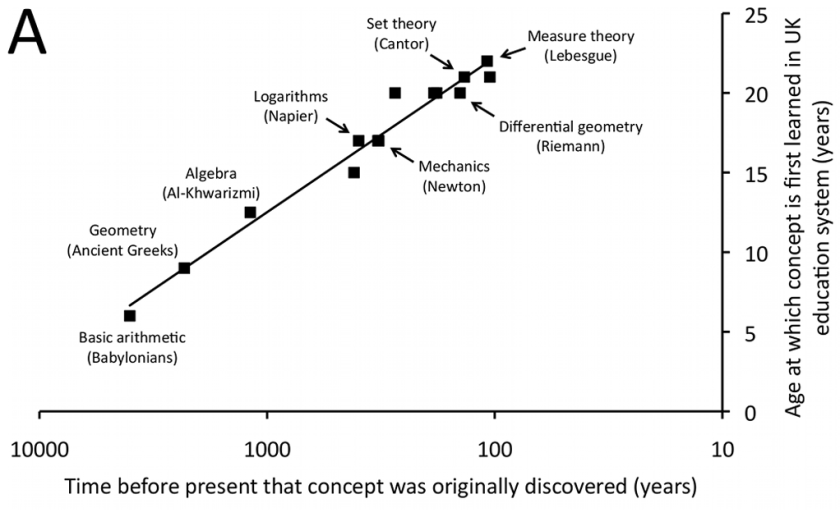
This assumption is presented in such a way that it could look like a finding to some readers using this figure:

This figure shows that UK students learn math concepts in the same order that they were discovered throughout history. It appears that individuals learn concepts in the same order that culture discovered those concepts. It is as if each individual’s learning experience is a microcosm of the entire experience of humanity. Continue reading “‘May I be excused? My brain is full.’”

Just-So Stories

On this week’s episode of Skeptically Speaking, host Desiree Schell interviewed Mark Changizi about his book, The Vision Revolution. I listened to the live taping this past Sunday at what I believe George RR Martin would have referred to as the “hour of the eel” here in England.

Changizi is never short of interesting ideas, and a researcher should always make the strongest case for their ideas that they can. Unfortunately, I have some issues with the evidence supporting that “strongest case” and the way he presents it: Continue reading “Just-So Stories”