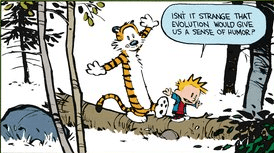
 Dear Calvin,
The correct answer may be genetic drift, unless you can reject the null hypothesis.
Yours truly,
Josh

Dear Calvin,
The correct answer may be genetic drift, unless you can reject the null hypothesis.
Yours truly,
Josh

Goldilocks & The Three Bears is more than a bizarre endorsement of woodland home invasion. It’s also a thermodynamic riddle that has befuddled the wisest among us1. One word – porridge.
The facts of the case are these. At the initial time point (t0), all Three Bears thought their porridge was too hot. At the second time point (t1), when Goldilocks gets there, the three bowls are at different temperatures (TPB > TBB > TMB). No one cares about the porridge’s temperature at the final time point (tf), as one doesn’t after one’s home has obviously been broken and/or entered. Continue reading “Just right”
One of the keys to success in life is to regulate your genes properly. Genes are regulated by transcription factor proteins, which have to navigate their way around the genome and bind particular DNA targets. The problem is that there are only a few correct targets and the genome is large. So an obvious question is, why don’t transcription factors get lost? Do they stop and ask for directions? Where is the information for genome navigation coming from?
The answer to this question is still being worked out for eukaryotes, but it has been solved for E. coli. Peter von Hippel and Otto Berg largely figured out the answer in their classic 1986 paper “On the specificity of DNA protein interactions.” E. coli’s solution for making gene regulation manageable is simple and elegant, because this bacterium has the virtue of possessing a small genome. Let’s take a look at how genome navigation works in a bacterium: Continue reading “How to find your way in E. coli without stopping for directions”

“American SF by the mid-1950’s was a kind of jazz, stories built by riffing on stories. The conversation they formed might be forbiddingly hermetic, if it hadn’t been quickly incorporated by Rod Sterling and Marvel Comics and Steven Spielberg (among many others) to become one of the prime vocabularies of our age.”
So writes Jonathen Lethem in his introduction to The Selected Stories of Philip K Dick. If you’re looking for that sci-fi conversation at its most hermetic, go read the 1956 celebratory anthology, The Best From Fantasy and Science Fiction, Fifth Series. The collection reads like a series of bad inside jokes, although three stories make it worth the $2.50 I paid for it at my favorite source of vintage sci-fi. (Check out the full listing of this anthology at isfdb.org.)
So where did this collection go wrong? Continue reading “Inside the 50’s science fiction bubble”
Turing biographer Andrew Hodges writes in today’s issue of Science:
But more deeply, anything that brings together the fundamentals of logical and physical description is part of Turing’s legacy. He was most unusual in disregarding lines between mathematics, physics, biology, technology, and philosophy. In 1945, it was of immediate practical concern to him that physical media could be found to embody the 0-or-1 logical states needed for the practical construction of a computer. But his work always pointed to the more abstract problem of how those discrete states are embodied in the continuous world. The problem remains: Does computation with discrete symbols give a complete account of the physical world? If it does, how can we make this connection manifest? If it does not, where does computation fail, and what would this tell us about fundamental science?
Personally I find this the most interesting question in science. It’s what drew me to biology, and it is what drives my current research in gene regulation. The problem of gene regulation is a problem of computation, and what is remarkable is the fact that genetic information is stored digitally as a string of discrete, two-bit chemical units. It didn’t have to be that way, and people* didn’t think that way until Schrödinger’s speculations on aperiodic crystals and the discoveries of molecular biologists in the 50’s and 60’s.
*To be fair, geneticists were thinking digitally, beginning with Mendel, and continuing, after a hiatus, with the early 20th century pioneers. But these geneticists didn’t really didn’t care about the physical implementation of genetic information. Those who did think about it weren’t thinking in terms of digits.
 The Finch and Pea