
“Lectures on Chemical Reaction Networks”

A classic set of lectures by Martin Feinberg:

The occasion was a semester-long in-gathering of people interested in the behavior of complex chemical systems. At the end of that period there was a large meeting, the proceedings of which were published by Academic Press in a book, “Dynamics and Modeling of Reactive Systems,” edited by W. Stewart, W. H. Ray and C. Conley. My chapter amounted to a summary of some of the things I talk about during the course of the nine lectures.

It was an exciting time, which began when Charles Conley called me at the University of Rochester. He explained the MRC plans for 1979 and asked if I could spend a semester in Wisconsin. He said that they would pay my salary, provided that my salary wasn’t too high. I told him my salary. Conley asked if I could come for a year.

These seem useful, at least based on what I see in this paper: “A Linear Framework for Time-Scale Separation in Nonlinear Biochemical Systems,” Jeremy Gunawardena.
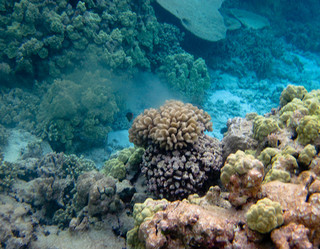
Sperm Donors Save Coral


For a time in graduate school, my research involved the use of zebrafish. We would collect and freeze eggs and sperm from the fish to provide a back-up for our stocks. While I’m not a zebrafish expert, freezing these stocks efficiently enough to generate a viable embryo after thawing is extremely challenging. Therefore, I was really impressed by a project to build a coral “sperm bank” described in a recent NY Times article. These sperm banks could be the best tool to preserve the biodiversity of our oceans, both by saving the coral and consequently preserving the coral-based habitats of over one million species.


Stationary coral are especially vulnerable to changes in their immediate environment. Many also have very irregular and inefficient methods of breeding. This “sperm bank” approach will be critical for the coral that are dying off at an alarming rate. Approaching conservation by building banks of sperm, however, may signal that scientists are beginning to realize our efforts at environmental conservation are failing. This leads to some important questions. Should scientists be pursuing better ways to preserve sperm and eggs of all endangered species at the cost of traditional conservation measures? Should more funding for sperm banks be included in budgets for environmental conservation? Conservation will buy time to preserve these species, but is time running out?

The link between information and entropy on Azimuth

Mathematical physicist extraordinaire John Baez digs in to Shannon entropy and coding over at Azimuth:

So, I want to understand Shannon’s theorems and their proofs—especially because they clarify the relation between information and entropy, two concepts I’d like to be an expert on. It’s sort of embarrassing that I don’t already know this stuff! But I thought I’d post some preliminary remarks anyway, in case you too are trying to learn this stuff, or in case you can help me.

Continue reading “The link between information and entropy on Azimuth”

Former climate skeptic finally catches up to current science

LA Times: Koch-funded climate change skeptic reverses course

WASHINGTON – The verdict is in: Global warming is occurring and emissions of greenhouse gases caused by human activity are the main cause.

This, according to Richard A. Muller, professor of physics at UC Berkeley, MacArthur Fellow and co-founder of the Berkeley Earth Surface Temperature project. Never mind that the United Nations Intergovernmental Panel on Climate Change and hundreds of other climatologists around the world came to such conclusions years ago. The difference now is the source: Muller is a long-standing, colorful critic of prevailing climate science, and the Berkeley project was heavily funded by the Charles Koch Charitable Foundation, which, along with its libertarian petrochemical billionaire founder Charles G. Koch, has a considerable history of backing groups that deny climate change.

Continue reading “Former climate skeptic finally catches up to current science”

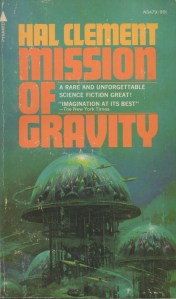
Hal Clement’s Mission of Gravity

Classic Hard Sci-Fi By The Book

Charles Lackland is far from home, holed up in an isolated outpost on the inhospitable planet Mesklin. Inhospitable to humans anyway, but not to the methane-based, centipede-like natives who are adapted to the enormously high and remarkably variable gravity, the fierce cold, and the extreme storms of this gigantic, disc-like planet. Lackland’s mission is to assist a crew of Mesklinite natives on a journey to recover mission data from an unmanned rocket that crashed near one of Mesklin’s poles. With a gravity 700 times that of Earth, the pole is a place no human can survive. But the natives, Captain Barlennan and his methane sea-faring crew of the Bree, can make the journey. Continue reading “Hal Clement’s Mission of Gravity”